Aspen Ideas Festival Summer Schedule Reveals Star-Studded Lineup
The Aspen Ideas Festival announces its free community summer schedule featuring high-profile speakers like Bobby Flay and Maria Ressa. Learn the first-come, first-served registration details for these competitive local events.
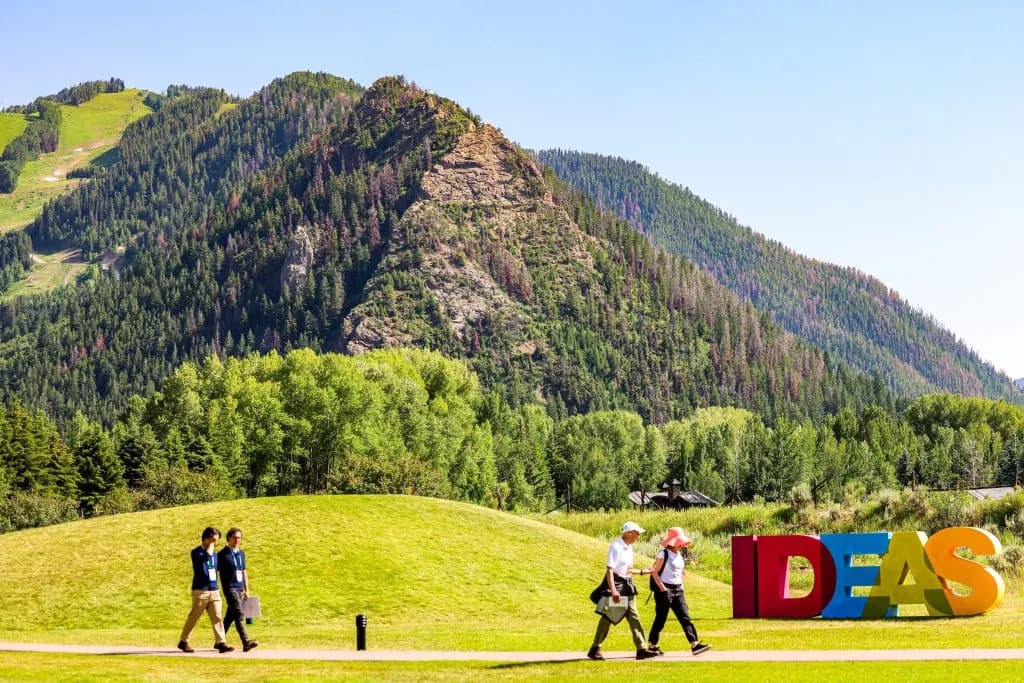
Aspen —"The Aspen Institute expects full audiences, so early registration is recommended," the press release reads. It’s a polite way of saying: if you want a seat, you need to be ready to click "register" the second the clock strikes 10 a.m. on June 9.
That’s the new reality for the Aspen Ideas Festival’s community summer schedule. It’s free, it’s local, and it’s fiercely competitive. The series — comprising the Hurst Lecture Series, the McCloskey Speaker Series, and the Murdock Mind, Body, Spirit Series — opens its doors to the public with a pre-registration window that will likely vanish in minutes.
The question is whether the folks who live here, who pay the property taxes and drive the local economy, can actually snag a ticket against the influx of festival regulars and day-trippers. The answer lies in the first-come, first-served model. No lottery. No paid priority. Just speed.
And the lineup suggests why people will be rushing.
June 18 kicks things off with the Hurst Lecture Series: “Food, Culture, and the Craft of Cooking.” Bobby Flay and Corby Kummer are taking the stage. If you’re a neighbor who cares about what’s on your plate, that’s a draw. But it’s not just about the food. It’s about the access. These aren’t just talking heads; they’re heavyweights.
Then comes July 8. The McCloskey Speaker Series hosts “America at 250: Liberal Education, Self-Government, and the Future of the Republic.” Shilo Brooks is the headline, but Todd Breyfogle, President and CEO of the George W. Bush Presidential Center, is the one holding the mic. That’s a specific kind of political gravity.
July 9 shifts gears to economics. “The Global Economy at a Crossroads: Leadership in an Uncertain World.” Roger Ferguson and Nancy Lazar are the names on the card. You don’t need a degree in macroeconomics to know that uncertainty is the only constant right now. This is the kind of talk that helps locals make sense of the interest rates affecting their mortgages and the inflation hitting the grocery store.
The schedule tightens in mid-July with the Aspen Security Forum on July 14 and 16. Speakers are TBD, but the theme is security. That’s a big word for a small town. It implies geopolitics, it implies defense, and it implies a level of seriousness that cuts through the usual summer tourism chatter.
By July 21, the focus turns domestic. “Govering a Changing America.” Several Republican governors are on deck. This isn’t just a lecture; it’s a political forum. For the voters in this valley, seeing governors discuss governance in a free, public setting is a rare opportunity. It’s direct democracy, lite.
July 22 brings Maria Ressa. The Nobel laureate and author will be joined by Aspen Digital Executive Director Vivian Schiller to discuss “How are Media and Technology Reshaping Democracy.” If you’ve ever wondered why your news feed looks the way it does, or how algorithms influence the vote, this is the place to get answers.
The series doesn’t let up. July 27 features Michael McFaul, former U.S. ambassador to Russia, talking with Elliot Gerson about “Democracy, Diplomacy, and the New World Order.” It’s a mouthful, but it’s relevant. The world outside our mountains is shifting, and this series is trying to map it out.
August brings more depth. Sean Wilentz, the historian, takes the Hurst stage on July 30 for “American Democracy in Historical Perspective.” Then, on August 5, the McCloskey series tackles “The American Economy in a New Era.” A speaker is yet to be announced, but the title alone suggests a look at the structural changes in our own economic engine.
Finally, August 6 closes the loop with science. Peter Hotez, dean of the National School of Tropical Medicine at Baylor College of Medicine, will discuss “Science, Public Health, and the Politics of Truth.” Post-pandemic, that last part is crucial. It’s not just about the virus; it’s about trust.
The logistics are simple. Free admission. First-come, first-served. But the value proposition is high. You’re getting world-class insight for the price of your time and a fast internet connection.
As the June 9 registration window approaches, the local angle isn’t just about attendance. It’s about participation. This is our town’s intellectual infrastructure, open to the public. The speakers are confirmed. The topics are vital. The only variable is whether you can beat the crowd.
"The lectures will include talks from renowned chefs, foreign policymakers, economists and more that will be announced," the release notes. But the ones listed are enough to fill a room. The real test will be the digital rush.
The schedule is set. The only thing left to do is register.
Keep up with Aspen
The day's Western Slope news, one email each morning. Free.