Deep-pocketed groups dominate Colorado ballot questions as citizen power fades
Colorado’s initiative process has shifted from a grassroots tool to a premium product for deep-pocketed businesses, with signature costs reaching millions and wealthy groups dominating the November ballot lineup.
Colorado voters are increasingly voting on ballot questions that were written, funded, and pushed by the very special interests they were meant to check.
The state’s initiative process, once a tool for everyday citizens to bypass a cautious legislature, has become a premium product line for deep-pocketed businesses and political groups. Between 1960 and 2024, only 36% of the 256 citizen-initiated questions that made it onto Colorado’s ballot passed, according to a state legislature tally. Questions referred directly by lawmakers fared better, passing nearly 60% of the time.
The difference isn’t just in the wording. It’s in the wallet.
Getting a measure onto the ballot now requires collecting signatures from across the state, a process that can cost between $1 million and $3 million in signature gatherer fees alone. Former Colorado Senate President Steve Fenberg said that figure is "not a high bar" for well-financed groups.
“We are considered one of the easiest states in the country to get on the ballot,” Fenberg said. “You basically just write a check.”
John Matsusaka, a professor of finance and business economics at the University of Southern California and executive director of the school’s Initiative and Referendum Institute, noted that Colorado had 14 statewide ballot questions in 2024 — the most in any state that year. Half were citizen-initiated, and half came from the legislature. Yet, Colorado ranks third in the nation for the total number of voter-initiated measures, trailing only California and Oregon.
This shift toward wealthy influence mirrors trends seen elsewhere. Seth Masket, a political science professor at the University of Denver who has studied ballot measures in California, said interest groups have long used initiatives to influence laws more quickly than traditional lobbying. About a decade after California adopted its initiative process, oil companies were already using it to push favorable measures.
This year, Colorado voters could face about 15 ballot questions in November’s election. Several are currently undergoing signature verification with the Secretary of State’s Office, a process set to conclude by September 2.
The dynamic changes how locals perceive their power. When a measure is citizen-initiated, voters assume it reflects grassroots concern. But when the cost to get there is measured in millions, the assumption that these measures represent the "little guy" becomes less certain.
Fenberg argued that over the last decade, since the requirement to collect signatures statewide was implemented, the process has become "almost exclusively" for well-financed groups. The money buys access. It buys visibility. And increasingly, it buys the outcome.
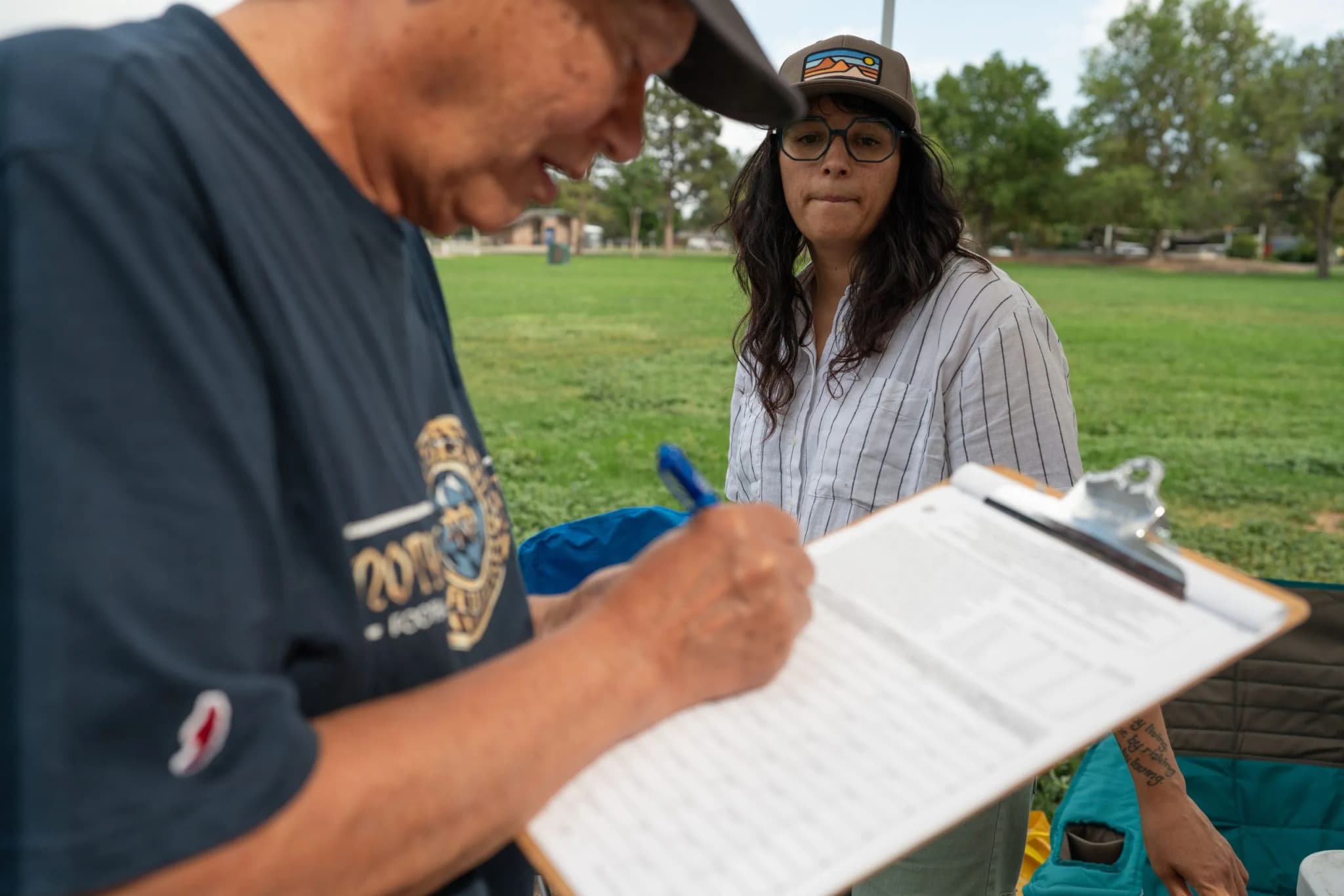
A volunteer collects signature petitions for a graduated income tax initiative on July 27, 2026, at Del Mar Park in Aurora. The scene looks like civic engagement in action — people standing in the sun, handing out paper, asking neighbors to sign. But behind that paper lies a financial engine.
The part everyone skips past is the verification phase. The Secretary of State’s office is currently checking whether those signatures are valid, real, and sufficient. Until September 2, the final lineup of roughly 15 questions remains in flux. Some may fall off. Others will hold their ground, funded by the same interests that now dominate the state’s political landscape.
Voters will decide in November whether to accept these pre-packaged solutions or reject them, as they have done for over 100 years. The process is open. The checkbook is ready.
Keep up with the Western Slope
The day's Western Slope news, one email each morning. Free.