Dry Creek Fire Claims 288 Acres South of Rifle
The Dry Creek Fire has burned 288 acres along Gage Road south of Rifle, prompting immediate evacuations for residents in the Grass Mesa area as wind drives rapid expansion.
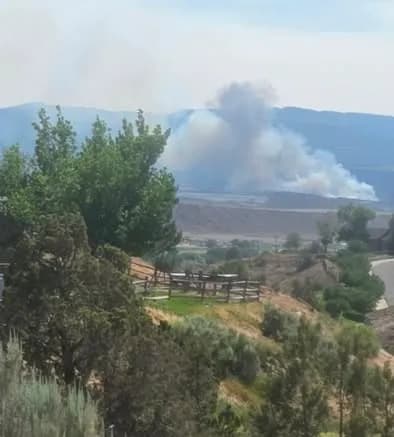
Rifle —The wind doesn’t just move across the Western Slope; it pushes. It shoves flames up the canyons like a hand forcing open a heavy door, turning a manageable spark into a sprawling, breathing entity before you’ve even finished your morning coffee. That’s what we’re seeing south of Rifle, where the Dry Creek Fire has already claimed 288 acres of land along Gage Road, a rapid expansion that feels less like a natural progression and more like a sudden, violent inhale.
It’s easy to look at the number 288 and file it away as another statistic in a long line of Colorado wildfires, but if you look closely at the map, you see the specific vulnerability of this stretch of the valley. The fire has already jumped County Road 319, a significant boundary that suggests the flames are moving with a speed and confidence that outpaces our usual containment strategies. This isn’t just a brush fire anymore; it’s a structure fire that might have started in the brush, or perhaps in a home, with the two indistinguishable in the chaos. The uncertainty is part of the texture of the event — we don’t yet know if the fire began in a living room or in the dry grass outside, but we know it’s there, and it’s hungry.
Evacuations are underway, not as a precautionary measure, but as an immediate necessity for those on Gage Road and in the Grass Mesa area, specifically south of Rodeo Drive and Coyote Trail. You can feel the tension in the logistics of it all. The Garfield County Fairgrounds, located at 1001 Railroad Ave., have become the temporary anchor for displaced neighbors, a place where the familiar rhythm of community life is paused while the sky turns orange. It’s a stark contrast to the usual bustle of the fairgrounds, now serving as a staging ground for people who have to leave their gas wells, their homes, and their routines behind.
The response is robust, a coordinated effort that speaks to the seriousness of the situation. Colorado River Fire Rescue is leading the charge, supported by Grand Valley Fire Protection District, the Glenwood Springs Fire Department, the Bureau of Land Management, and the U.S. Forest Service. It’s a multi-agency dance, one that involves two airplanes, two helicopters, and an air attack aircraft currently working the fire. Maria Nechkash, the spokesperson for Colorado River Fire Rescue, noted that additional resources, including large air tankers and single-engine tankers, have been requested. This isn’t just about putting out fire; it’s about managing a complex infrastructure crisis. Gas wells are being threatened, and crews are in the process of shutting them down to prevent explosions or further ignition sources. Fire Marshal Orrin Moon described the fire as moving quickly, driven by the wind, a detail that underscores the urgency of the evacuation orders.
There’s a warmth to the community’s response, but there’s also a rough edge to the reality. The fire has jumped a major road, and the threat to structures is real. Two aircraft are already on scene, but the request for more air tankers and hand crews suggests that what we have now is only the start. The wind is the unseen actor here, pushing the flames and dictating the pace. It’s a reminder that in this valley, nature doesn’t ask for permission to change the landscape.
As the sun sets on Tuesday, the Dry Creek Fire continues to grow, proving the power of wind and dry fuel. The air smells of smoke and diesel, a sharp, acrid scent that lingers in the back of your throat. You can hear the distant thump of helicopter blades, a rhythmic pulse that marks the passage of time in a valley holding its breath.
Keep up with Rifle
The day's Western Slope news, one email each morning. Free.