Gaard Moses Releases New Book Capturing Aspen’s Visual History
Aspen Times contributor Willoughby introduces Gaard Moses’s new book, *Aspen, Signs of History*, which blends the artist’s iconic sign designs with local anecdotes and mining lore.
Aspen —“Those who know him have been anxiously awaiting its publication and would say, ‘well worth the wait.’”
That’s how Aspen Times contributor Willoughby opens his latest column, introducing Gaard Moses and the release of Aspen, Signs of History — Stories and Scalawags. It’s a book that feels less like a history text and more like an invitation to walk down Cooper Avenue with a friend who happens to have designed the signs hanging above your head.
You might not know Moses’s name, but you’ve likely stopped to look at one of his creations. He is the artist-designer behind dozens of Aspen’s business signs and several graphics adorning local buildings. His work connects the visual identity of a shop to its essence, turning a simple walk through town into something visually entertaining. The new book captures that same energy. It is, as Willoughby notes, a “work of art,” where topics are introduced through artwork rather than hundreds of words.
Moses visited Aspen in 1964 and moved there permanently in 1968 to live as a ski bum. He took various jobs, including serving as an art teacher at Aspen Country Day School. That is where Willoughby first met him. One of his earliest memories involves Moses and Mick Franta climbing South Maroon Peak and skiing down — a feat believed to be a first ascent. Moses brought his dog, Wagner, along for the ride and included a photo of it in the book with little explanation.
The book explores Aspen’s history through several lenses: business, anecdotes, buildings, and people. It gives history to each building, complete with illustrations, and includes sketches of the interesting characters Moses has interacted with over five decades. There is even a section titled “Aspen-esque local palaver,” which highlights the small dictionary of words, phrases, and expressions unique to Aspen and its ski vernacular.
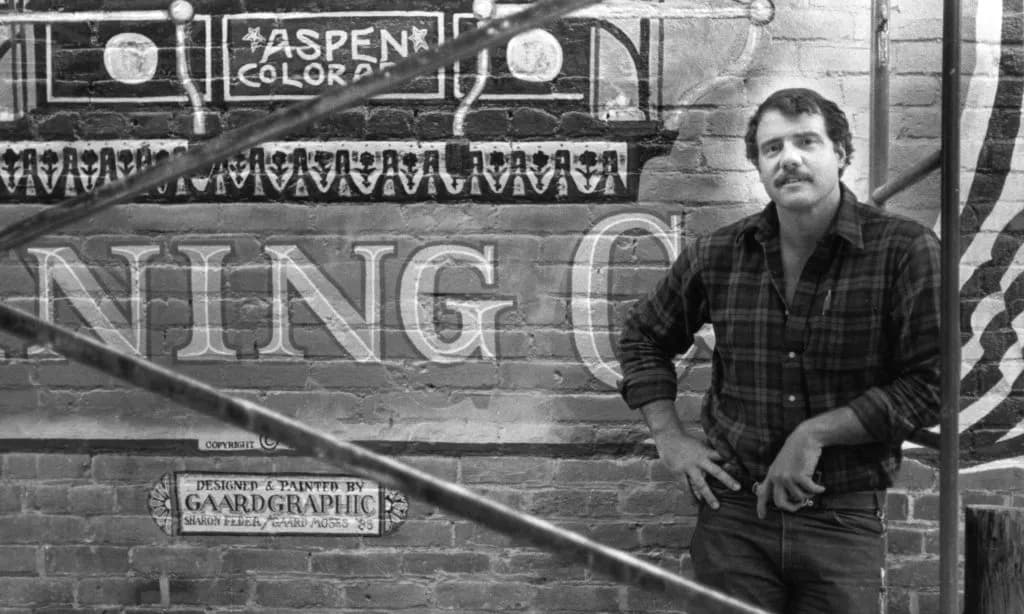
Moses’s connection to the town runs deep, particularly into mining history and claims. The book features sections on mining people like Jim Blanning and Ed Smart. It also details his relationship with Harley Baldwin, owner and remodeler of the Brand Building. The two were classmates at Syracuse University, where Moses majored in art. Baldwin commissioned a mural from Moses for the alley side of the Brand Building, a project featured in the book alongside other anecdotes.
There is another layer to Moses’s story that Willoughby brings to light. After a bout with cancer beginning in 1979, Moses moved to the Yukon. He bought land there, constructed a cabin, and worked for a graphic arts company that had customers traveling to the region.
The book is not just about signs. It is a history of Aspen, told through the eyes of someone who helped shape its aesthetic. For locals, it’s a reminder of the town’s evolution. For visitors, it’s a guide to what makes Aspen feel like Aspen.
Stand there long enough and you can see the signs. You just have to look up.
Keep up with Aspen
The day's Western Slope news, one email each morning. Free.