History Colorado Unveils Black Kettle Statue Ahead of Capitol Memorial
History Colorado Center displayed a bronze statue of Chief Black Kettle on Indigenous Peoples Day, serving as the first component of a three-figure memorial destined for the Colorado State Capitol.
One statue. That’s all you can see right now. It stands on the fourth floor of the History Colorado Center in Denver, cast in bronze at a larger-than-life scale, depicting Southern Cheyenne Chief Black Kettle.
On paper, this is a minor reveal. In practice, it’s the first brick in a wall that hasn’t been built yet. The full memorial — dubbed the Peace Keepers — is supposed to consist of three distinct figures. We have Black Kettle. We are waiting on Chief Left Hand, a Southern Arapaho leader who was mortally wounded during the attack, and a figure titled Medicine Woman, who is depicted holding a baby before a tipi frame.
Let’s do the math on the timeline. The unveiling of Black Kettle happened Monday, Indigenous Peoples Day. According to the project details, the likeness of Chief Left Hand is projected to be finished early 2027. Medicine Woman is expected to be completed sometime before next summer. So, we’re looking at a multi-year gap between the first piece and the final assembly.
Why split it up? Otto Braided Hair Jr., a Northern Cheyenne elder who has been integral to the memorial effort for about 30 years, explained the logistics. After the initial statue of Black Kettle was finished, the team faced a storage problem. “We needed a place to put him while we waited for the others,” Braided Hair said. He noted that while they could have stored the statue behind closed doors, displaying it made more sense. “Up until a couple weeks ago, we didn’t know we needed to find a place for Black Kettle. But with History Colorado, there were no questions, ifs, ands or buts. There was an immediate ‘yes,’” he said.
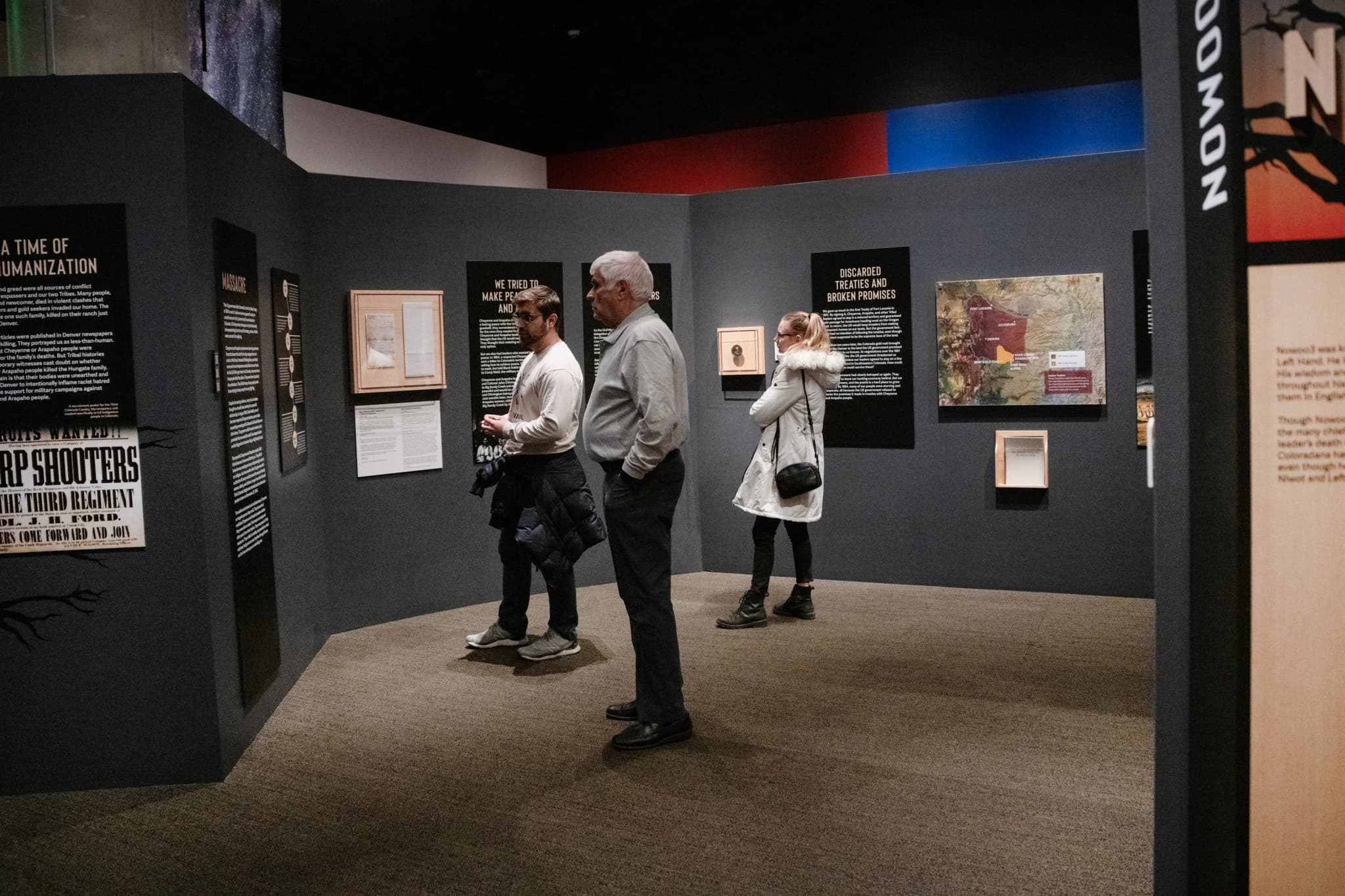
History Colorado President and CEO Dawn DiPrince confirmed the museum provided the space. She described the location as a nook that feels almost made for the statue. The exhibit is currently on display outside the main exhibition, “The Sand Creek Massacre: The Betrayal that Changed Cheyenne and Arapaho People Forever.” Visitors with general admission tickets or a History Colorado membership can view it.
DiPrince framed the display as a tangible representation of the tribal leaders’ efforts toward collective healing. “I think they are excited to share their progress in this work,” she said. “To have this really tangible evidence of all of their efforts, and we get to unveil that, is pretty great.”
The context for the memorial dates back to Nov. 29, 1864, when Col. John Chivington and his soldiers attacked a peaceful encampment at Sand Creek. More than 230 people were killed, mostly women, children, and the elderly. Black Kettle survived that specific massacre but died in battle several years later. Left Hand did not survive the attack.
The final destination for these three statues is the grounds of the Colorado State Capitol. Until then, Black Kettle remains in Denver, waiting for his companions. The project has been years in the making, and this single statue is the visible proof that the process is moving forward. For locals in Denver, it’s accessible. For the broader community, it’s a placeholder for a larger statement.
The practical impact right now is limited to the History Colorado Center. No new construction costs are hitting local taxpayers immediately, as the statues are already cast. The cost was incurred during the creation phase. What changes is the cultural footprint. One statue becomes three. A single figure becomes a group. The silence of one bronze figure breaks with the addition of two more.
This is not a finished monument. It’s a component. The contrarian take is that showing one piece early might dilute the impact of the final reveal. If you see Black Kettle alone, you understand his isolation. When Left Hand and Medicine Woman arrive, the narrative shifts from survival to community. By displaying Black Kettle now, the museum is forcing the public to confront the absence of the others. The empty space beside him is as important as the statue itself.
The bottom line: You can see the first piece of the Sand Creek Massacre memorial today at History Colorado. It costs you nothing extra if you have a ticket or membership. The other two pieces are still in the works, with Left Hand due in early 2027 and Medicine Woman by next summer. The final installation at the State Capitol is still down the road. For now, one statue stands in Denver, representing a history that is still being assembled.
Keep up with the Western Slope
The day's Western Slope news, one email each morning. Free.