Protect Colorado’s Future Delivers 157,000 Signatures to End Flat Tax
Protect Colorado’s Future delivered over 157,000 signatures to the Secretary of State, clearing the threshold to potentially replace the state’s 4.4% flat tax with a tiered system that lowers rates for lower-income households.
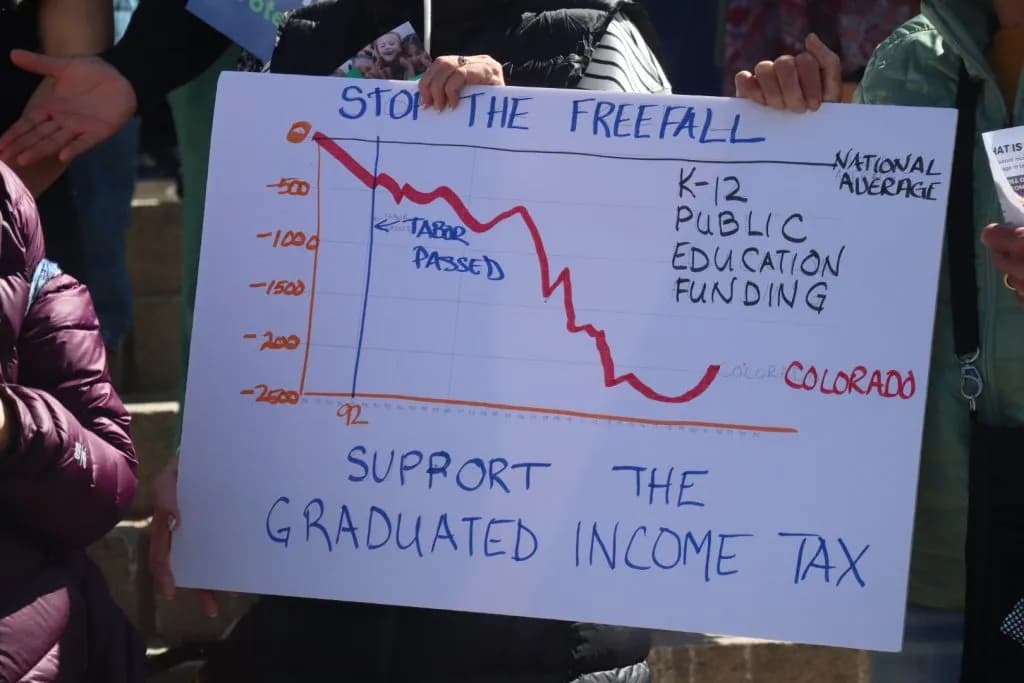
Aspen —Protect Colorado’s Future didn’t just gather signatures. They buried the flat tax.
The coalition delivered over 157,000 signatures to the Secretary of State’s office on Monday, Aug. 3. That number clears the 124,238 threshold by a wide margin. The state will now review them to decide if the measure lands on this November’s ballot.
The short version: Colorado is about to trade its uniform tax rate for a tiered system. Wealthy residents pay more. Lower-income households pay less. The current rate is 4.4% for everyone. Under the new plan, that rate drops to as low as 3.7% for the first $25,000 of income.
Kathy White, executive director of the Colorado Fiscal Institute, called it a victory for fairness. She said every signature represents a Coloradan who believes the system can be fairer. Her group is part of Protect Colorado’s Future, a coalition of more than a dozen statewide advocacy groups. They relied on 1,000 volunteers to gather nearly 70% of the signatures. The rest came from paid petition firms.
Campaign finance filings show the group raised $401,007 and spent $227,152. Major donors include the Colorado Center on Law and Policy, The Bell Policy Center, and Great Education Colorado.
Conservative groups are not sleeping. They argue this change threatens to drive out wealthier Coloradans. They say it burdens businesses and reduces overall state revenue. Advance Colorado has already submitted signatures for a competing measure. That competing effort seeks to keep the current 4.4% cap.
Colorado is one of roughly a dozen states with a flat income tax. It has one of the lowest rates in the country, according to the Tax Foundation. This measure would change that status quo.
If approved, households making $500,000 or more annually will see their taxes ratchet up. Those earning between $100,001 and $500,000 stay at 4.4%. The middle tier, between $25,001 and $100,000, pays 4.2%.
A household making $95,470 — the state’s median income, according to U.S. Census data — sees annual income taxes reduced by $316 under the new plan, according to a calculator on the coalition’s site.
Feinsinger wrote in the Aspen Times that no amount of hours, conversations, or miles was for nothing. The volunteers showed what locals can build when they work together.
Make no mistake, this is a battle for the state’s fiscal soul. The current system is simple. It applies to everyone equally. The proposed system is complex. It rewards the working class and taxes the wealthy.
The Secretary of State’s office has weeks to verify the signatures. If they clear, voters will decide in November.
The conservative counter-attack is already here. Advance Colorado’s competing measure offers a different path. It keeps the cap. It avoids the rate hike for high earners.
Locals should watch the spending. The coalition has spent more than half its raised funds so far. That leaves room for a fierce general election campaign.
The math is clear for the median earner. They save money. The wealthy pay more. Whether that translates to better schools or lower property taxes remains the real question for Western Slope residents.
White’s statement suggests the groundwork is laid. The signatures are in. Now comes the verification. And then, the fight.
Keep up with Aspen
The day's Western Slope news, one email each morning. Free.