Rio Blanco Ranchers Track Wolf Losses as CPW Monitors Small Population
Colorado Parks and Wildlife reports a lone wolf crossed I-25, but data shows the state's small population of 32 wolves remains concentrated in northwest packs, causing specific financial hits for Rio Blanco ranchers.
Aspen —Is a lone wolf crossing I-25 really the end of the world for ranchers in Rio Blanco, or just another Tuesday in the life of a recovering population?
That’s the question hanging over the high country as summer heat settles into the valleys. Colorado Parks and Wildlife says yes, a collared wolf crossed the interstate for the first time since reintroduction began. But if you look closer at the data, the story isn’t about a wolf invasion. It’s about a population that’s still figuring out where it fits in the landscape.
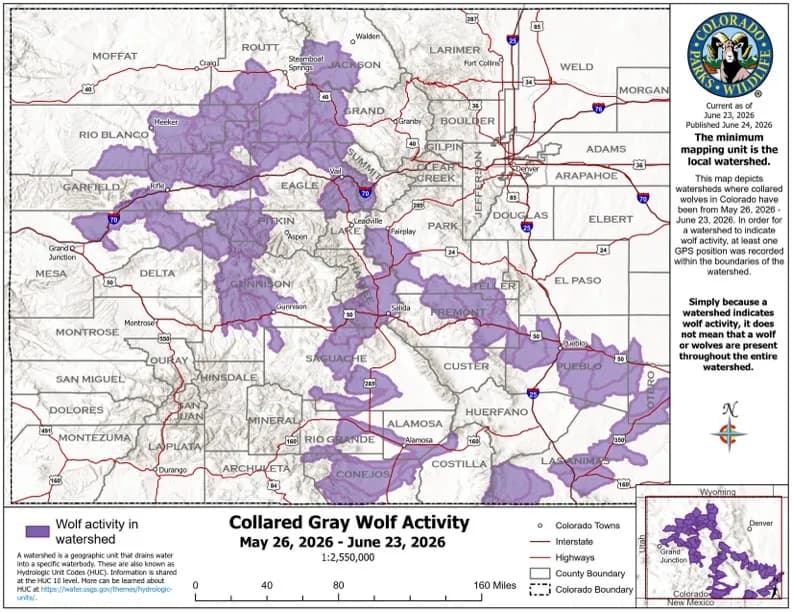
The wolf in question didn’t trek across the entire state. It moved east briefly into watersheds in Pueblo, Otero, and Las Animas counties before turning back west. That’s a short hop, not a migration. The activity map, which tracks GPS points recorded roughly every four hours between May 26 and June 23, shows this movement clearly. It highlights the broad movements made by dispersing wolves — lone animals searching for mates and quality habitat.
Here’s the thing though: the bulk of the action is still in the northwest.
Four confirmed packs hold their ground in Eagle, Summit, Grand, Jackson, Routt, Rio Blanco, Fairfield, Mesa, Pitkin, and Gunnison counties. The Copper Creek Pack in Pitkin, the King Mountain Pack in Routt, the One Ear Pack in Jackson, and the Three Creeks Pack in Rio Blanco are all active. All but the Pitkin group formed in spring 2025. The agency is still watching for new dens or packs, especially since denning season runs from mid-March through May.
The population is small. Really small. CPW estimates at least 32 wolves in Colorado this past winter. That includes 18 adults and 14 pups. It’s a nascent group, a mix of established pack members and dispersers. And with that small number comes volatility.
Take the nearly two-year-old wolf killed on June 12. This animal was born to the Pitkin group in spring 2025 but separated in September. It’s tied to attacks on at least 22 sheep in Rio Blanco and Routt counties since 2025. Its death marks the fourth wolf loss this year. One death is still under investigation from January. The other two? Both breeding adults from the King Mountain Pack died. The matriarch went down in March, shot by a ranch hand in Eagle County, purportedly while attacking cattle.
That’s a lot of drama for 32 wolves.
CPW says it’s in active communication with producers who have known wolf activity near their operations. They’re coordinating access to conflict minimization resources. But the map tells a different story than the press release. The map shows wolves moving broadly east and south, yes, but it also shows the core packs holding tight to their territories in the high alpine and subalpine zones.
The wolf that crossed I-25 wasn’t leading a charge. It was exploring. And it came back.
For folks in the valley, the news might feel like a threat to livelihoods. For the agency, it’s data. The GPS points don’t lie. The wolf was there, then it wasn’t. The sheep losses are real, though. At least 22. That’s not a rounding error. That’s a financial hit for ranchers who are already operating on thin margins.
The agency is monitoring the state’s wolves for the formation of additional packs and indication of successful reproduction. It’s a delicate balance. Too many wolves, and the conflicts escalate. Too few, and the reintroduction fails. Right now, we’re in the middle.
Picture a wolf standing on a ridge in Rio Blanco, looking east toward the plains. It’s not invading. It’s just checking the map. And then it turns around, heading back to the pack.
The sun dips below the Elk Mountains. The GPS tracker pings. One more point recorded. The wolf stays put. For now.
Keep up with Aspen
The day's Western Slope news, one email each morning. Free.

Aspen Housing Authority Seeks $590K Office Upgrade Amid Cramped Conditions

Vail Secures Water Rights for 37-Unit Montelisse Condo Project
Moffat County Commissioners Weigh Data Center Moratorium Amid Transparency Claims

Aspen Skiing Company hosts 10th annual Stars Above astronomy night

Aspen Animal Hospital Clinical Leader Dr. Anne Cooley Navigates WellHaven Ownership Shift