Summer Words panelists prove book sales thrive despite digital distractions
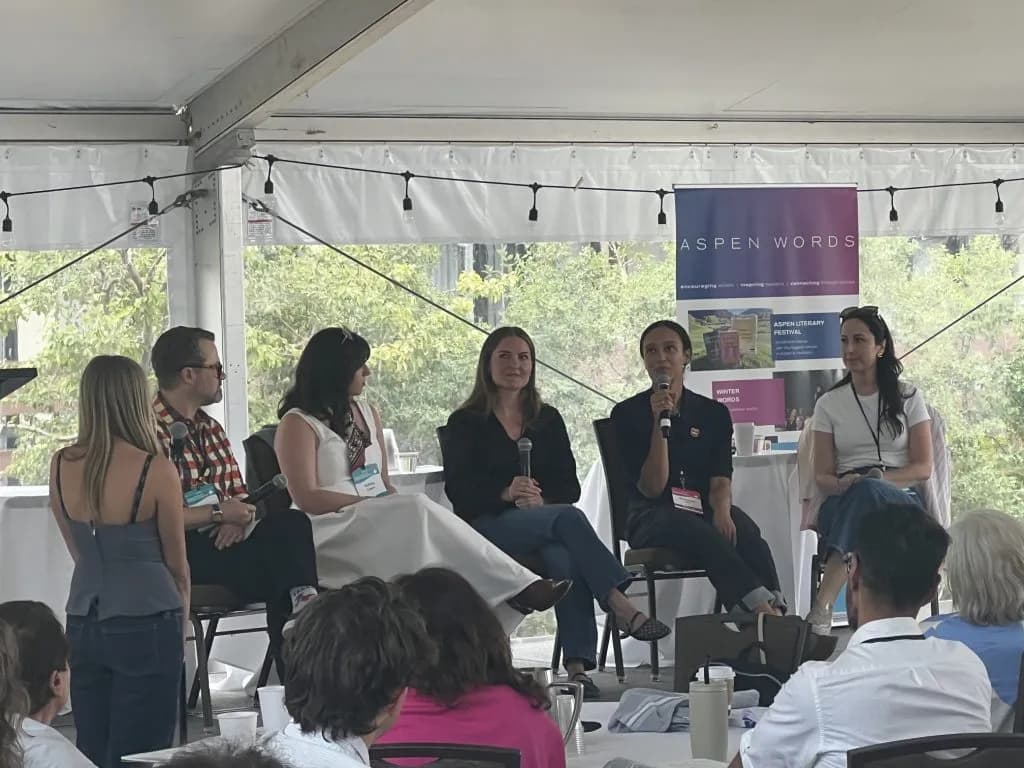
An Aspen Times analysis of the Summer Words panel reveals that book sales are booming and readers are engaging deeply, contradicting fears that digital distractions are killing print.
Aspen —A $14 million project. Twelve units.
That’s the kind of density we’re looking at when we talk about housing on the Western Slope. But let’s pivot to the Aspen Times’ latest data point, because it’s just as dense with meaning, if not dollars. The first of six public panel talks at Summer Words wrapped up on June 22. The result? Despite the naysayers screaming that video games, streaming services, and shrinking attention spans are killing print, book sales are thriving.
Let’s do the math on that. The number of readers hasn’t budged much, but the number of books published annually has increased. Publishers are making more money than ever. On paper, it’s a boom. In practice, it means the industry is adapting, not dying.
Ryan Harbage, the moderator, laid it out. The appetite for reading hasn’t vanished; it’s just shifted. People still want escape. They still want to engage deeply with a subject, even if that subject is a fantasy world or a memoir. The literary world remains relevant because it asks something of the reader that a TikTok scroll doesn’t. It asks for time. It asks for focus.
Ashley Lopez didn’t mince words during the Monday panel. “You can’t kill the book,” she said. “Books, as a form, are so important, and they can’t take that away from us.”
Think about that. Hollywood looks to us — writers — to decide what gets made into a movie or a TV show. We are the idea makers. We sit, we think, we converse, and then we bring it back to the page. The book is the source code for the visual media consuming most of our leisure time. If the book dies, the pipeline dries up. Simple as that.
Abby Walters pointed out another layer. A book endures. You can read the same book at 20 and again at 40, and the experience will be completely different because you are different. The object itself doesn’t change, but your relationship to it does. That’s a level of personalization and depth that a screen, for all its pixels, still struggles to replicate.
Then there’s the self-publishing angle. It used to be a dirty word. Now? It’s part of the ecosystem. Cece Lyra noted that traditional publishing and self-publishing aren’t canceling each other out. They’re feeding each other. The barrier to entry might be lower for some, but the barrier to success, being well-read, understanding structure, mastering perspective; remains high.
Seventy-seven writers are attending juried workshops this week. More are coming for the open panels. That’s not a trickle. That’s a current.
Katie Daniels, a Snowmass resident entering her senior year of high school, left the panel with a stark realization. She went in expecting the usual academic fluff. She left with a single sheet of paper covered in notes because she hadn’t brought enough blank pages. Compare that to her college seminar notes: a quarter-page of scribbles, three doodles, and zero actual information.
“I’m leaving the seminar with what should’ve been two pages of notes,” Daniels said. “But it’s only one because I only brought one (blank sheet).”
That’s the difference between passive consumption and active engagement. The industry is betting on that engagement. The experts on the panel agreed: avid reading is mandatory for writers. Rules can be negotiated. You can’t negotiate away the need to know what you’re talking about.
The open talks continue. June 23 covers structure. June 24 dives into perspective. It’s not just for the aspiring novelists hiding in their bedrooms. It’s for anyone who believes that ideas still matter.
For context, this isn’t just about Aspen. It’s a signal flare. While other sectors struggle with inflation and supply chains, the content engine is running hot. People are still buying books. They are still reading them. They are still paying for the privilege of being transported.
The bottom line? The naysayers are wrong. The book isn’t just alive; it’s the anchor. And as long as there are writers willing to do the work and readers willing to turn the pages, the ecosystem holds. For locals, that means more events, more workshops, and a continued cultural heartbeat in a town that often feels like it’s only beating for the tourists.
Keep up with Aspen
The day's Western Slope news, one email each morning. Free.