Vail Christian's Mary McClarrinon Records 1,000th Kill
Mary McClarrinon recorded her 1,000th volleyball kill during Vail Christian's homecoming match, drawing a roaring crowd response and highlighting her sustained individual contribution to the team's undefeated league record.
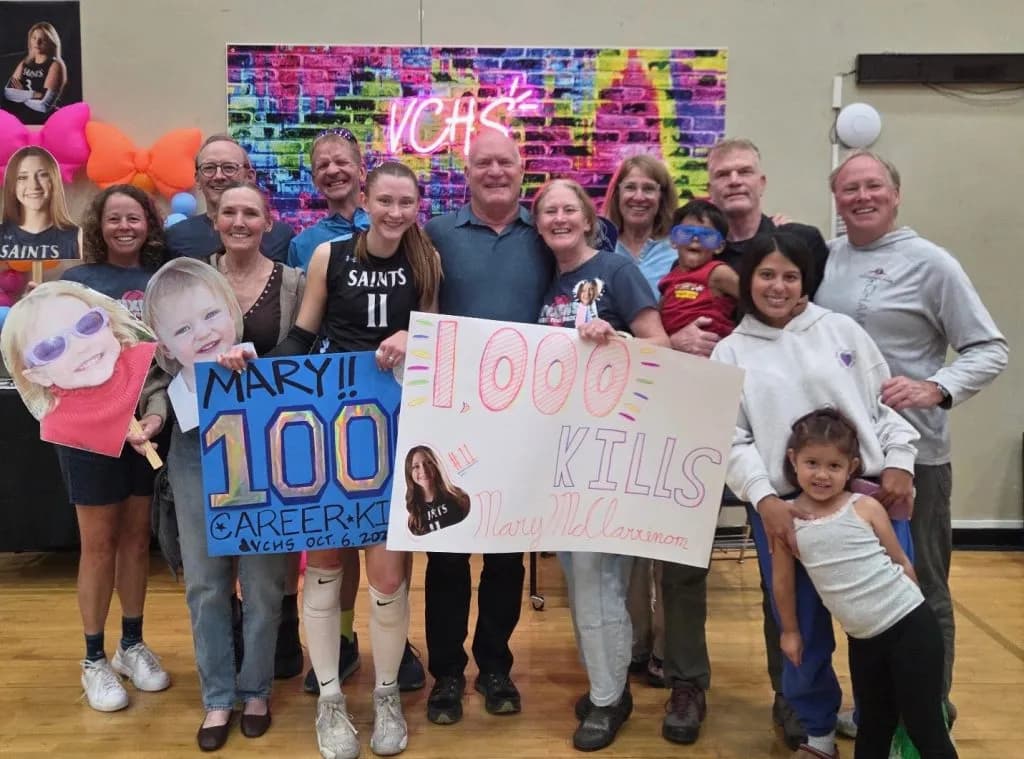
Aspen —The gymnasium at Vail Christian doesn’t just echo; it vibrates. It’s a physical weight, a pressure against your eardrums that makes the air feel thick and charged. On October 6, during the homecoming match, that vibration hit a frequency that stopped the noise cold. It wasn’t a cheer, exactly. It was a roar, sudden and absolute, erupting from a crowd that had been building in intensity all evening. In the center of that sonic explosion, Mary McClarrinon stood frozen for a split second, the ball already dead on the floor, her arm still extended from the spike. She had just recorded her 1,000th high school kill.
It’s easy to dismiss a milestone like this as a vanity stat, a number that only matters to the athlete and her parents. After all, how many people outside the volleyball world truly understand what a "kill" represents? But that’s precisely the point. This isn’t a metric designed for casual consumption. It’s a measure of sustained, individual contribution within a collective effort. And in a sport that prides itself on teamwork, singling out one player for such a feat feels almost contradictory. Yet, as the Vail Daily noted, it’s impossible to ignore the fact that McClarrinon achieved this while leading her team to a 10-0 record in league play. The number isn’t isolated from the team’s success; it’s embedded within it.
McClarrinon herself seemed aware of the tension between her individual achievement and the team’s identity. In the moments after the kill, she tried to maintain her composure, attempting to return to the service line as if nothing had happened. She wanted to project coolness, to suggest that the moment hadn’t disrupted her focus. But the crowd’s reaction made that pretense difficult to sustain. The noise was too loud, the attention too intense. As she later recalled, she was trying to act like it didn’t matter, but the reality was that it did. The crowd’s response, the coaches’ reactions, the presence of her family — all of it created a moment that demanded acknowledgment.
Her father, Scott McClarrinon, was present in the gymnasium, serving as a line judge for the match. From his position near the sideline, he had a clear view of the action, including the moment his daughter spiked the ball for her 1,000th kill. He called the point with what he described as a "little extra emphasis," a subtle nod to the significance of the play. Despite his personal connection to the athlete, he maintained his role as an official, ensuring that the game proceeded fairly. His presence in the gymnasium highlighted the close-knit nature of the Vail Christian community, where parents, coaches, and players often overlap in their roles.
The path to 1,000 kills wasn’t linear. McClarrinon’s freshman year saw her record 210 kills, a solid start but far from the pace needed to reach the milestone by her senior year. Her sophomore year brought 311 kills, a noticeable increase that suggested her skills were maturing. By her junior year, she had accumulated 305 kills, a slight dip from her sophomore total but still a strong performance. These yearly totals, when added together, formed the foundation of her career total. Each season contributed a layer to the overall picture, building toward the final count.
Her parents began tracking her progress more closely during her junior year, realizing that the milestone was within reach. They kept a simple tally, marking each kill as it occurred. This informal system helped them gauge how close she was to reaching 1,000. By the start of her senior year, they had a clear sense of where she stood. The remaining kills needed to reach the milestone were a manageable number, making the achievement feel attainable. Their early tracking provided a baseline that allowed them to monitor her progress throughout the season.
The crowd’s reaction to the 1,000th kill was immediate and overwhelming. Fans in the stands, many of whom were students and families from the Vail Christian community, erupted in cheers. The noise level in the gymnasium rose sharply, creating a deafening roar that drowned out the usual sounds of the game. Players on the court paused briefly, turning to look at McClarrinon, acknowledging the significance of the moment. Coaches on the sidelines raised their arms in celebration, signaling to the team that they had just witnessed a historic play.
McClarrinon’s reaction to the crowd’s cheers was a mix of surprise and gratitude. She had expected a normal game, with the usual sounds of bouncing balls and whistles. But the sudden burst of noise caught her off guard. For a moment, she forgot about the game entirely, focusing instead on the faces of the people cheering for her. She saw her parents in the stands, clapping and smiling. She saw her teammates, who had just finished playing a point. She saw her coaches, who were shouting instructions to the team. All of these elements combined to create a moment that felt larger than the game itself.
In the days following the match, McClarrinon reflected on the experience. She described the feeling of being in the "flow" of the game, a state where her actions became automatic. During the 1,000th kill, she wasn’t thinking about the number. She was simply executing a play. The realization that she had reached the milestone came after the ball hit the floor. That delay allowed her to process the event. She could appreciate the crowd’s reaction without being distracted from her next move. This mental separation between action and reflection is a key aspect of her playing style.
The Vail Christian volleyball team’s 10-0 record in league play provides context for McClarrinon’s individual achievement. The team’s success is a result of collective effort, with each player contributing to the overall performance. McClarrinon’s 1,000 kills represent her personal contribution to that success. The two metrics — team record and individual kills, are related but distinct. The team’s wins reflect the outcome of games, while the kills reflect the volume of scoring opportunities converted by one player. Both measures highlight different aspects of the team’s performance.
Scott McClarrinon’s role as a line judge added a layer of irony to the moment. He was responsible for determining whether the ball was in or out of bounds. When his daughter spiked the ball for her 1,000th kill, Scott had to make a call. He admitted that he was "too honest as a line judge" to let his bias influence his decision. This self-awareness demonstrated his commitment to fairness, even in a situation where his personal interests were at stake. His dual role as parent and official highlighted the complex dynamics of small-team sports.
The presence of Mary McClarrinon’s parents in the gymnasium underscored the importance of family support in her career. Scott and Celynn McClarrinon never missed a game, a dedication that Mary appreciated. Their constant presence provided a stable backdrop to the unpredictable nature of competition. When the 1,000th kill occurred, their reactions were part of the emotional landscape of the moment. Their smiles and applause were visible to Mary, reinforcing her sense of connection to her family. This support system has been a constant throughout her four years of high school volleyball.
Tim Pierson, the athletic director at Vail Christian, played a key role in amplifying the moment. After the kill, he took to the microphone to announce the significance of the play to the crowd. His voice cut through the noise, drawing attention to the fact that Mary McClarrinon had just achieved a rare milestone. This announcement transformed a good play into a memorable event. Without Pierson’s intervention, the crowd might have celebrated the point but not understood its historical context. His use of the microphone ensured that the full meaning of the kill was communicated to everyone in the gymnasium.
The homecoming match provided a fitting setting for the 1,000th kill. Homecoming games are traditionally large events, with increased attendance and heightened energy. The crowd size and enthusiasm were greater than in a regular league game. This amplified atmosphere made the moment more impactful. The combination of a big crowd and a significant play created a perfect storm of excitement. The homecoming context elevated the 1,000th kill from a notable play to a defining moment of the season. The timing of the milestone during such a prominent event added to its memorability.
Mary McClarrinon’s journey to 1,000 kills reflects the cumulative nature of athletic development. Each kill, whether in a freshman scrimmage or a senior championship game, contributes to the total. The milestone is not a single event but the sum of many. This perspective emphasizes consistency over brilliance. McClarrinon’s ability to produce kills year after year demonstrates her reliability. The 1,000th kill is the capstone of a long process, a symbol of her perseverance. It represents the fruits of her labor, a tangible reward for her dedication.
The Vail Daily’s coverage of the 1,000th kill highlighted the community’s pride in McClarrinon’s achievement. The article detailed the circumstances of the play, the reactions of those present, and the broader context of her career. This media attention amplified the significance of the milestone, bringing it to the wider public. The coverage served as a record of the event, preserving it for future reference. It also provided a platform for McClarrinon to share her thoughts on the experience, offering insight into her mindset. The media’s role in documenting and interpreting the moment enhanced its cultural resonance.
Looking ahead, McClarrinon’s 1,000 kills serve as a benchmark for future achievements. The milestone sets a standard that she can strive to exceed. Whether she aims for 1,100 or 1,200, the 1,000 mark provides a reference point. It establishes a baseline from which further progress can be measured. This forward-looking perspective transforms the milestone from a retrospective achievement into a prospective goal. It motivates continued improvement, driving her to push beyond her current limits. The 1,000 kills are not an endpoint but a starting point for new challenges.
The sensory details of the gymnasium on October 6 remain vivid in memory. The smell of floor wax and sweat, the sound of squeaking shoes and bouncing balls, the sight of brightly colored uniforms and cheering fans - all these elements combined to create a rich tapestry of experience. The 1,000th kill occurred within this sensory environment, inheriting its qualities. The physical sensations of the moment; the impact of the ball, the vibration of the floor, the heat of the lights, were integral to the event. These sensory dimensions give the milestone its texture, making it more than a numerical abstraction. They ground the achievement in the concrete reality of the game.
As the dust settles on the homecoming match, the image of Mary McClarrinon standing on the court, surrounded by the roar of the crowd, lingers. The ball lies motionless on the floor, a silent witness to the historic moment. The gymnasium slowly returns to its normal hum, the echoes of the 1,000th kill fading into the background. Yet, the memory persists, a bright spot in the season’s narrative. It’s a moment that will be recalled for years, a shared experience that binds the team and the community. The 1,000 kills are not just a number; they are a story, a record of persistence and the joy of competition.
Keep up with Aspen
The day's Western Slope news, one email each morning. Free.