Venezuela Earthquakes Kill 188 in La Guaira
At least 188 people have died after powerful 7.2 and 7.5 magnitude earthquakes struck Venezuela, causing widespread destruction in La Guaira and damaging the key airport terminal.
Aspen —What happens to a country’s infrastructure when the ground itself decides to shake it apart, and who pays the tab when the power grid is already flickering?
In La Guaira, north of Caracas, the air still tastes like pulverized concrete. It’s a dry, chalky dust that coats the eyelashes and settles into the creases of clothes worn by people who haven’t slept in two days. Here, the asphalt of the main highway is cracked, and the airport terminal — a critical artery for aid — sits dark and damaged. The scene isn’t just chaotic; it is a stark reminder of how quickly a Tuesday evening can turn into a national emergency.
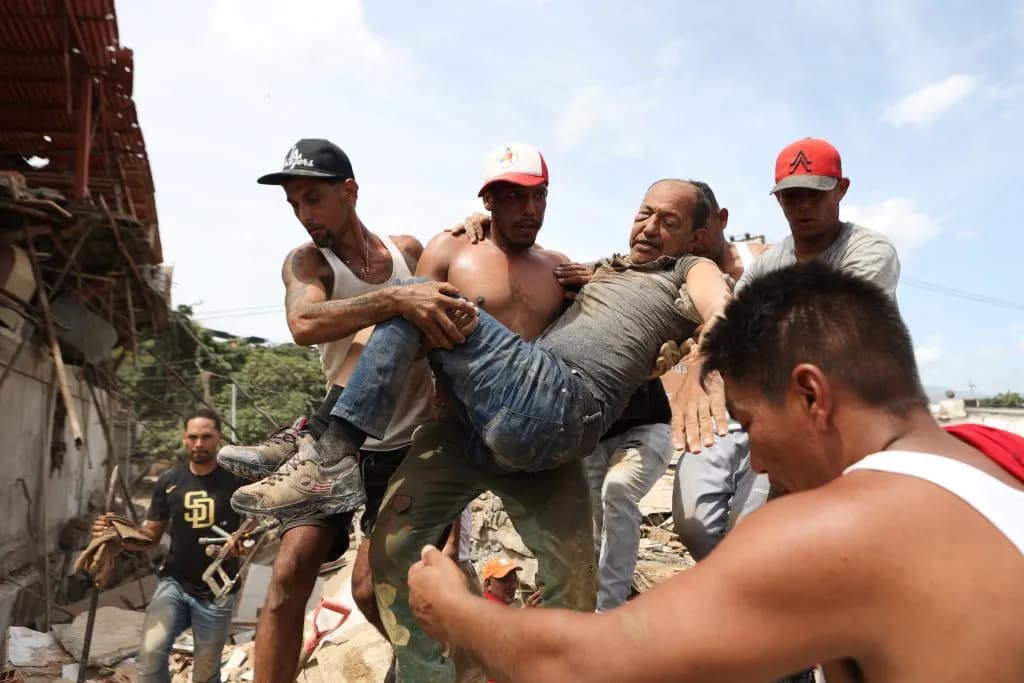
Venezuelans are currently digging through the skeletal remains of collapsed buildings, their hands raw, searching for survivors beneath the rubble of two powerful earthquakes that struck Wednesday evening. The quakes, measuring 7.2 and 7.5 on the magnitude scale, were among the strongest recorded in the South American nation in over a century. They didn’t just rattle windows in Caracas; they sent shockwaves through the region, felt as far away as Brazil’s Amazon.
The death toll has climbed to at least 188. More are feared dead. Over 1,500 people are injured. Thousands remain unaccounted for.
Picture this: a mother in La Guaira, her face streaked with dust and tears, sobbing as the bodies of her three- and ten-year-old children are wrapped in blankets and carried away. Nearby, others scream the names of loved ones into the din of heavy machinery. It’s visceral. It’s immediate.
Juan Alberto Mendaño, a retired schoolteacher, climbed through the wreckage to find a woman trapped and signaling for help. He didn’t have a crane or a hydraulic jack. He had his voice and his hands. “May God rescue her as quickly as possible,” Mendaño said. “When we heard the scream, there was nothing we could do.”
That phrase, “nothing we could do”; hangs heavy in the humid coastal air. It speaks to the fragility of the infrastructure and the overwhelming scale of the disaster. The coastal region of La Guaira suffered some of the heaviest damage, complicating aid efforts because the main airport was damaged and closed. Rescue teams are being diverted from other parts of the country to this area, which is no stranger to natural disasters. A mudslide in 1999 killed thousands here. This time, the earth moved.
The political backdrop adds another layer of complexity to the recovery. Acting President Delcy Rodríguez, who took office in January after the capture of Nicolas Maduro, is now managing a natural disaster on top of a decade of economic disarray. She appealed to businesses to make heavy construction equipment available for rescue operations, referring to La Guaira as a “disaster zone.” Meanwhile, offers of help are pouring in from around the world, including from the United States, which recently seized Maduro in a surprise military operation.
Jorge Rodríguez, the president of Venezuela’s National Assembly and brother of the acting president, provided updated figures on the dead, trapped, and injured. But the numbers don’t tell the whole story. The story is in the dust. It’s in the 1,500 injured people waiting for care in a system that has been stretched thin for years. It’s in the thousands of missing people whose fates are still unknown.
The United Nations spokesperson said search and rescue teams were just hours away. But hours can feel like days when you’re standing in the rubble, waiting for a signal that might never come. The region sits near multiple fault lines, straddling the South American and Caribbean plates, making strong earthquakes a geological inevitability. The question now is whether the infrastructure can hold, and whether the political will can mobilize fast enough to pull people out before the sun sets on another night of waiting.
Keep up with Aspen
The day's Western Slope news, one email each morning. Free.
Aspen Housing Authority Seeks $590K Office Upgrade Amid Cramped Conditions
Vail Secures Water Rights for 37-Unit Montelisse Condo Project
Moffat County Commissioners Weigh Data Center Moratorium Amid Transparency Claims

Aspen Skiing Company hosts 10th annual Stars Above astronomy night

Aspen Animal Hospital Clinical Leader Dr. Anne Cooley Navigates WellHaven Ownership Shift