Beavers Restore Two Months of Water at Aspen's Cozy Point Ranch
Beavers returning to Aspen's Cozy Point Ranch provided two extra months of water during a severe drought, offering a natural alternative to expensive infrastructure for drought resilience.
Aspen —Why did a drought-stricken Aspen area suddenly have two extra months of water last year?
The answer isn’t a new reservoir or a federal grant. It’s beavers.
Three years ago, these rodents returned to Cozy Point Ranch, the headquarters of The Farm Collaborative. Since then, the effect has been transformative. Eden Vardy, who founded the nonprofit in 2008 to tackle climate change, says the change is visible in the water table, the wildlife, and the soil.
“This year, when we were anticipating our smallest year of water ever — which it still is, we are now starting to go dry — we had easily two months of more water than we thought we would this year as a result of really the storage systems that the beavers developed for us,” Vardy said.
Let’s put that in context. Pitkin County and much of north-central Colorado faced an exceptional drought through most of the spring and summer. Historically low snowpack and record-setting heat drove streamflows to critical lows. Yet, at Cozy Point Ranch, the water held.
The beavers are acting as ecosystem engineers. They aren’t just building dams; they are building storage. By slowing down the flow of water, they allow it to seep into the ground rather than rushing to the lowest point.
“In the West we have this almost addiction to get water to the lowest point as quickly as possible,” Vardy said. “For beavers, it’s not about getting it where it’s going; it’s about slowing it down along the way.”
That slowing builds groundwater storage. It improves soil health. And it brings predators back. Vardy reports seeing golden eagles, bald eagles, more coyotes, and foxes exploring the riparian area. The birds are returning because the habitat is recovering.
This isn’t just a local curiosity. Scientists and water providers are increasingly recognizing beavers as a tool for drought resiliency. Rocky Mountain National Park has a project mimicking beaver behavior with early success. Colorado Parks and Wildlife, which Vardy served on the commission for, released beavers into two state wildlife areas near Rifle in July, using man-made structures to help them establish.
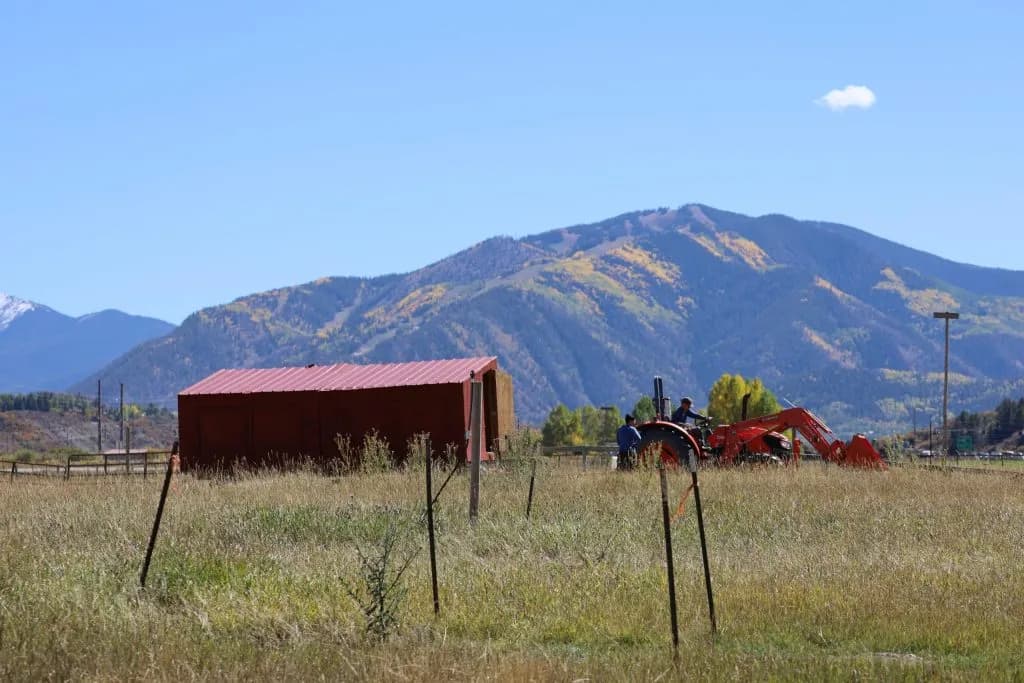
Cozy Point Ranch is owned by the city of Aspen. The Farm Collaborative uses it as a regenerative farm, a camp, a school, and a resource center. Vardy, who immigrated from Israel in 1988, grew up in employee housing across from the ranch. He watched it transition from a bison ranch to a cattle ranch before the collaborative took over in 2010.
When beavers returned in 2023, it signaled that the regenerative practices were working. The land was ready for them.
The financial implication for locals is subtle but significant. Instead of spending millions on infrastructure to manage drought or flood, nature is doing the heavy lifting. The beavers are maintaining the water table that keeps the local ecosystem, and the agricultural operations - alive during dry spells.
Vardy’s observation is simple: the beavers know how to store water better than most human-engineered systems. In a region where water is the primary currency, that’s a return on investment that doesn’t show up on a balance sheet but shows up in the soil.
Keep up with Aspen
The day's Western Slope news, one email each morning. Free.