BLM Gathers 301 Wild Horses in Sand Wash Basin
The BLM captured 301 wild horses in the Sand Wash Basin over six days, returning 55 to the range. The operation concluded without deaths, contrasting with recent Piceance Basin losses.
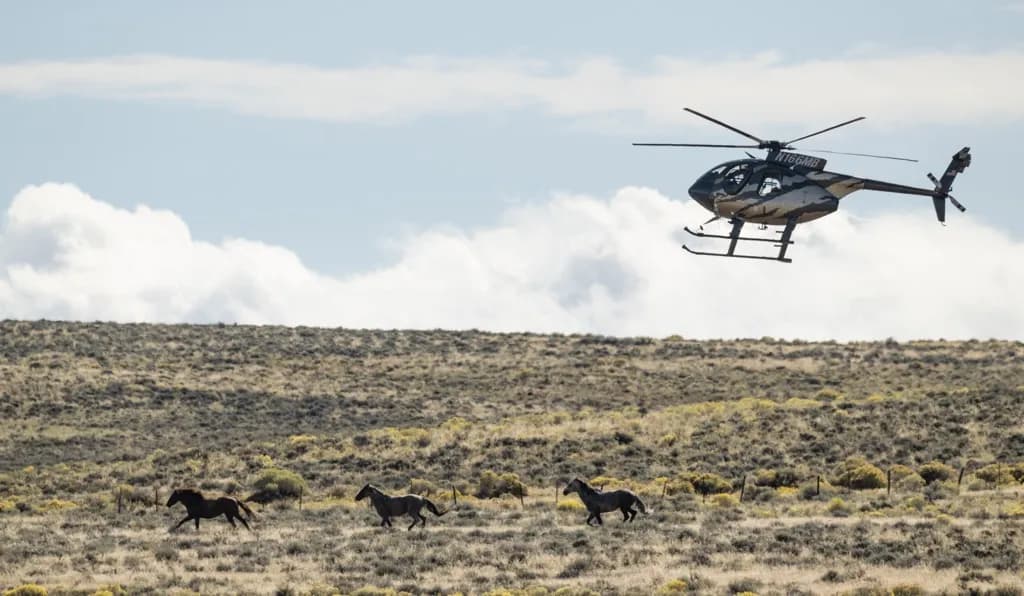
Steamboat Springs —The rotor wash flattens the sagebrush before the helicopter even touches down. In the Sand Wash Basin, the dust hangs low, coating the windshield of the trucks parked near the staging area. It is quiet now, the kind of silence that follows the chaos of a helicopter drive-trap.
The Bureau of Land Management (BLM) concluded its wild horse gather operations in Northwest Colorado on Friday, Sept. 25. According to the agency’s website, crews gathered 301 horses across six days of active operations. This was significantly faster than the initial projection of 11 days. The quick turnaround is a notable shift from the lengthy operations seen elsewhere in the state.
The breakdown of the 301 captured animals includes 133 stallions, 130 mares, and 38 foals. Not every horse left the range. Fifty-five horses were returned to the Sand Wash Basin. Of those, 22 were scheduled to receive fertility control treatment to help slow future population growth. However, the BLM later clarified that only eight mares actually received the treatment during this specific round. The agency stated that 14 of the 22 selected for return had either been treated in prior years or were no longer reproducing, making additional intervention unnecessary at this time.
The remaining 245 horses were shipped out of the basin. These animals were transported to the Rock Springs Wild Horse Holding Facility in Rock Springs, Wyoming. There, they will undergo veterinary care, vaccinations, and identification. Eventually, horses deemed suitable for placement will become available for adoption through the BLM’s Wild Horse and Burro Program. No deaths were reported during the Sand Wash Basin operations, a stark contrast to the recent events in the Piceance Basin.
That last detail matters. Just weeks ago, the BLM completed a helicopter gather in the Piceance-East Douglas/West Douglas Herd Management Area. That operation took roughly 31 days and resulted in the capture of 894 horses. But nine horses died during that process. The loss sparked immediate backlash. Following the Piceance Basin gather, Gov. Jared Polis and U.S. Rep. Joe Neguse publicly called on the BLM to “immediately halt” helicopter gathers of wild horses. The pressure is real, and it hangs over every subsequent operation.
In the Sand Wash Basin, the decision to release 55 horses was not made in a vacuum. The BLM worked closely with the Sand Wash Basin Wild Horse Advocate Team to determine which animals would stay. In a Monday social media post, the advocate team announced the names of all horses removed in the September gather, listing them alphabetically. They also explained the criteria used to select the 55 released horses. The agency required that the returned group consist of 60% stallions and 40% mares. The advocate team noted that their choices were built around four primary goals: maintaining rare bloodlines, ensuring a variety of colors and markings, providing a variety of sizes and builds, and including a range of ages.
“No single trait decided any horse’s fate,” the advocate team wrote. “Each horse was weighed on all of these together, and many wonderful horses came down to very close calls.”
It is a nuanced approach, one that tries to balance population management with the preservation of genetic diversity. Whether it satisfies the critics who demanded a halt to helicopter operations is another question entirely. For now, the helicopters are grounded, the dust has settled, and the 55 released horses are back on the range. The work is done, at least for this season.
Keep up with Steamboat Springs
The day's Western Slope news, one email each morning. Free.
Craig Hosts Only Regional Special Olympics Bowling Competition
Routt County Fields Turn Emerald After Rare August Rain