BLM Reviews Rocky Mountain Industrials' Limestone Quarry Expansion Near Glenwood Springs
The U.S. Bureau of Land Management has deemed Rocky Mountain Industrials' plan to expand its limestone quarry north of Glenwood Springs 'complete,' triggering a technical review of the company's bid to mine the unstable overhanging cliff above I-70.
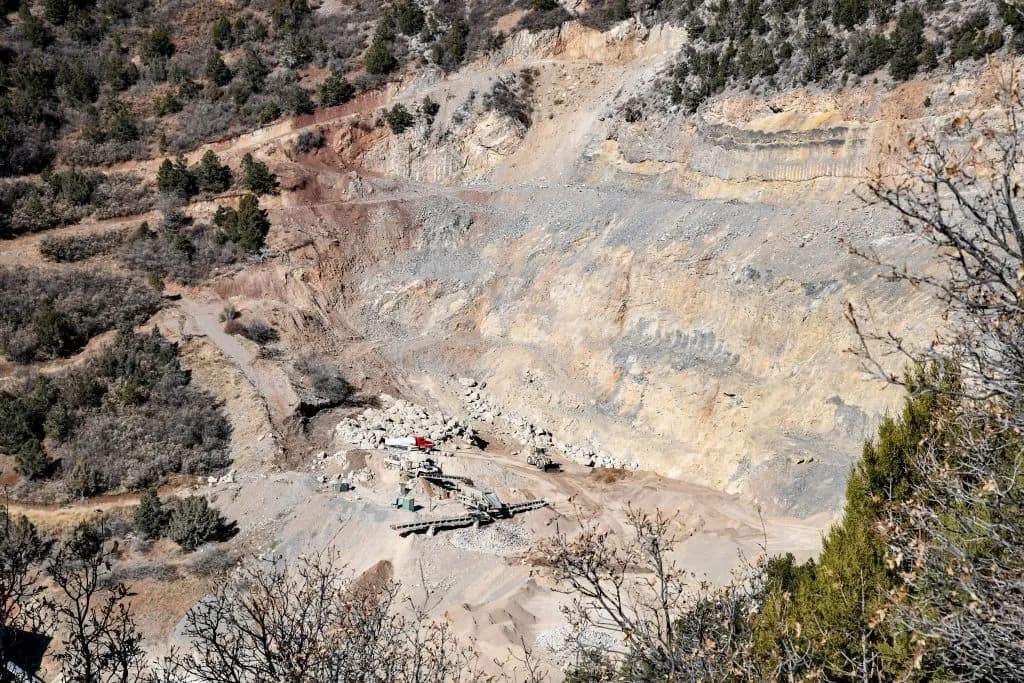
Glenwood Springs —What happens to the cliff hanging over your head when the company in charge decides to blast it down?
That’s the question locals are asking as the U.S. Bureau of Land Management (BLM) moves the needle on Rocky Mountain Industrials’ (RMI) latest bid to expand its limestone quarry north of Glenwood Springs. The BLM has deemed the company’s plan “complete.” That’s bureaucratic code for: we got the paperwork, now we’re going to see if it makes sense. It is not an approval. It is not a final decision. It is the starting gun for a technical review that could fundamentally alter the geology above I-70.
Let’s look at the scale. RMI wants to more than triple the federally approved acreage. We are talking about jumping from a modest 16 acres to 56.1 acres. They aren’t just digging deeper; they are mining several hundred feet upslope from the existing operation. The specific target? The unstable, overhanging cliff left behind by the west headwall collapse in 2023.
The state of Colorado is already watching closely. The Colorado Division of Reclamation, Mining and Safety (DRMS) rejected an earlier attempt by RMI to expand its boundary via a simple technical revision. The state said, essentially, you can’t sneak this change in the back door. You need a full amendment. And before you can do that, you need federal approval from the BLM, which manages the land itself.
So, what is RMI doing now? They are paying the toll. In April, the DRMS increased RMI’s reclamation bond by $704,000. That money is ring-fenced for rock-bolting the overhanging cliff. It’s a specific fix for a specific problem: keeping the rock from falling on the quarry floor or, potentially, on the highway below. The state forced the issue, and the company paid up. Now, the BLM is reviewing whether the plan to mine that slope and bolt that cliff actually works.
Heather McGregor, vice president of the Glenwood Springs Citizens’ Alliance, puts it in plain terms. “Complete just means that the way it’s been explained to us, it means that all the required elements are present in the application, but it does not assess their impacts,” McGregor said.
Translation: The BLM has the puzzle pieces. They haven’t put the picture together yet. They haven’t decided if the picture is a beautiful landscape or a pile of rubble. McGregor notes this is an important step because it gives the agency something concrete to work with. But she’s right to caution neighbors. Completeness is not safety. Completeness is not approval.
This is RMI’s third attempt to submit a modified plan of operations. The first two didn’t cut it. This time, they provided the “remaining information needed” to meet regulatory requirements. The BLM compared the process to confirming all pieces of a puzzle are present before beginning to put it together. It’s a safe metaphor. It’s also a slow one. Technical reviews take time. Questions will be asked. Gaps will be found. Revisions will be demanded.
For context, consider the $704,000 bond increase. That is money sitting in a state account, waiting for the day the rocks actually need bolting. It doesn’t cover the blasting. It doesn’t pay for the trucks. Nor does it account for the dust that settles on your windshield. It only covers the stabilization of that specific overhang. If the expansion goes ahead, the footprint of the quarry grows. The volume of limestone extracted grows. The traffic on the access roads grows.
The BLM hasn’t said yes. They haven’t said no. They’ve said, “We’re looking.” And in the meantime, the cliff above Glenwood Springs remains, waiting for the next blast.
Keep up with Glenwood Springs
The day's Western Slope news, one email each morning. Free.