Colorado Amendment 87 Ballot Confuses Voters With Wrong Income Data
Colorado's Amendment 87 ballot measure contradicts the state voter guide by using federal AGI instead of state taxable income, causing confusion among voters regarding potential tax increases.
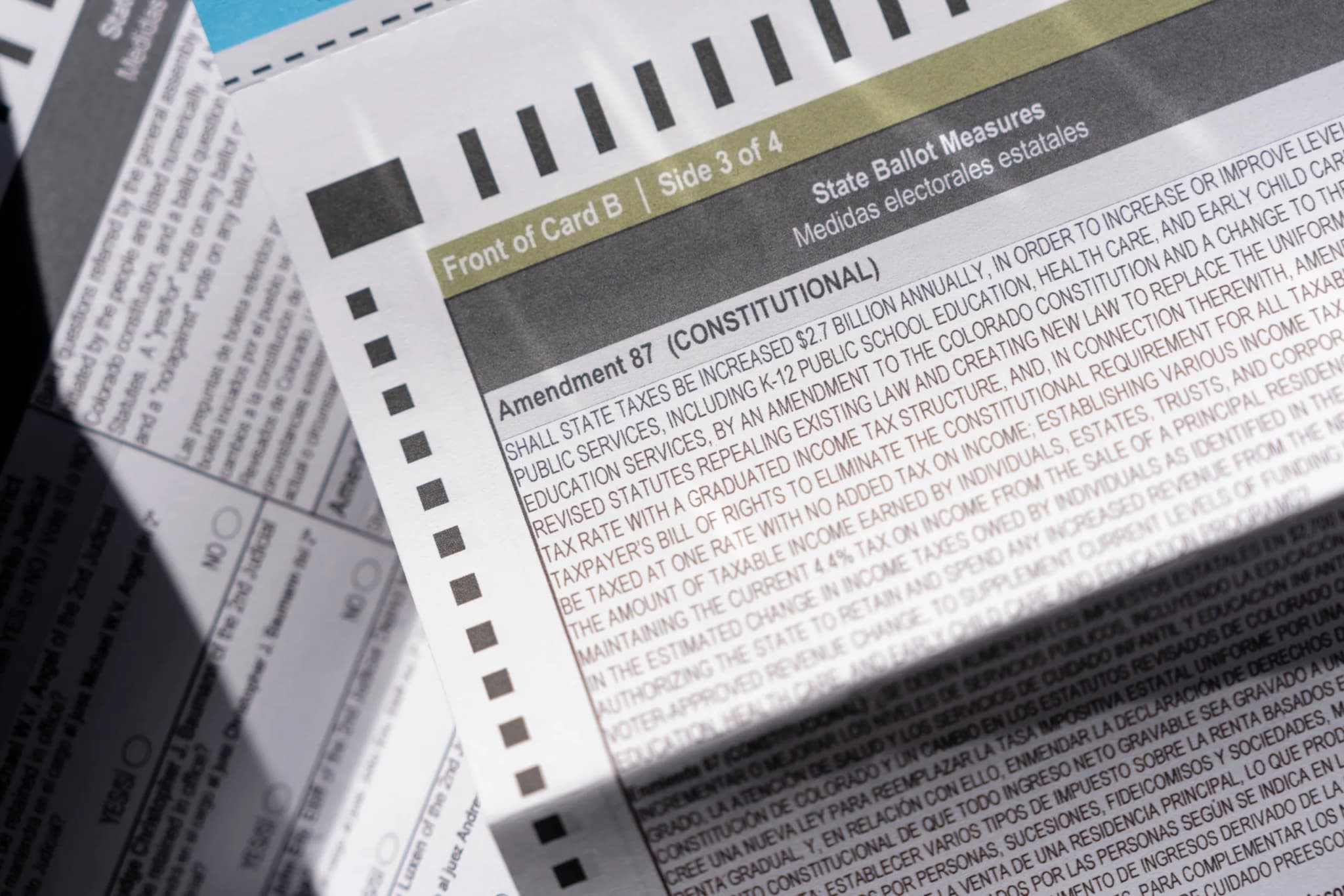
The parking lot at the Mesa County Fairgrounds fills early on a Tuesday morning, the asphalt still holding the chill of an October night. Cars idle in long lines as people wait for a coffee before heading into the county building, their breath visible in the thin air. Inside, the fluorescent lights hum over rows of voters clutching pamphlets, trying to decipher a single page that promises one thing while the state’s official guide says another.
This is the scene playing out across the Front Range and the Western Slope as Amendment 87 hits the ballot. The measure would swap Colorado’s flat income tax for a graduated system, charging higher rates to those who earn more. But the numbers on the ballot and the numbers in the state’s nonpartisan voter guide, known as the blue book, tell two different stories. And that matters because it’s confusing people who just want to know if their paycheck will shrink.
The Colorado Sun broke down the discrepancy in a recent explainer, noting that both charts are technically correct but measure different things. The blue book looks at state taxable income, which is what actually gets taxed under the new rates. It shows taxes going up for Coloradans earning $500,000 or more in state taxable income. The ballot, however, uses federal adjusted gross income (AGI). According to the paper, the average person making $500,000 to $1 million in AGI actually makes a little less than $500,000 in Colorado taxable income. That gap means they’d get a tax cut of about $325 if the measure passes.
Why such a disparity? The Sun reported that many of the state’s highest earners are part-time residents who pay taxes in other states, so only a slice of their income hits Colorado’s books. State deductions for things like Social Security benefits and college savings accounts also shrink the taxable number. In 2021, lawmakers passed House Bill 1321, requiring voters to see how tax changes affect people at different income levels. But they based those groupings on federal AGI, not state taxable income. For most folks around here, the difference is negligible. The bill’s authors just didn’t anticipate this specific scenario where high AGI doesn’t equal high state taxable income.
There’s another piece of the puzzle that has opponents spinning their wheels. The Sun noted that both Democratic Gov. Jared Polis and conservative group Advance Colorado have claimed Amendment 87 would eliminate tax breaks for Social Security recipients and military veterans. That claim is simply not true. The measure wouldn’t touch those exemptions. The confusion stems from a misleading interpretation of the text, but the bottom line is that seniors and veterans keep their deductions.
Stand there long enough in a voting line, and you can see the fatigue set in. People aren’t looking for a debate on legislative drafting errors; they’re looking for clarity on their own wallets. The part everyone skips past is the definition of "income" used in each chart. One measures what you earn federally; the other measures what Colorado actually sees after deductions and residency splits.
The ballot measure is a test of whether voters will trust the state’s nonpartisan math over the simplified, if misleading, table printed on their ballot. It’s a test of how much weight people give to the AGI number versus the state taxable income figure. For a neighbor in Grand Junction or a commuter in Durango, the difference might be a few hundred dollars. But when you’re staring at two contradictory charts on a cold morning, the uncertainty is its own tax.
The Sun’s reporting makes clear that the state law required the AGI breakdown, but it didn’t account for the reality of part-time high earners. Now voters have to decide if they trust the blue book’s taxable income model or the ballot’s AGI average. The measure moves forward, and with it, a lot of second-guessing about what "income" really means in Colorado.
Keep up with the Western Slope
The day's Western Slope news, one email each morning. Free.