Colorado School of Mines Doctoral Candidate Tracks Microplastics in Denver's South Platte River
Anne Marie Mozrall leads a team using kayaks and nets to collect primary data on microplastic types and sources in Denver's South Platte River, aiming to establish a scalable workflow for global urban waterways.
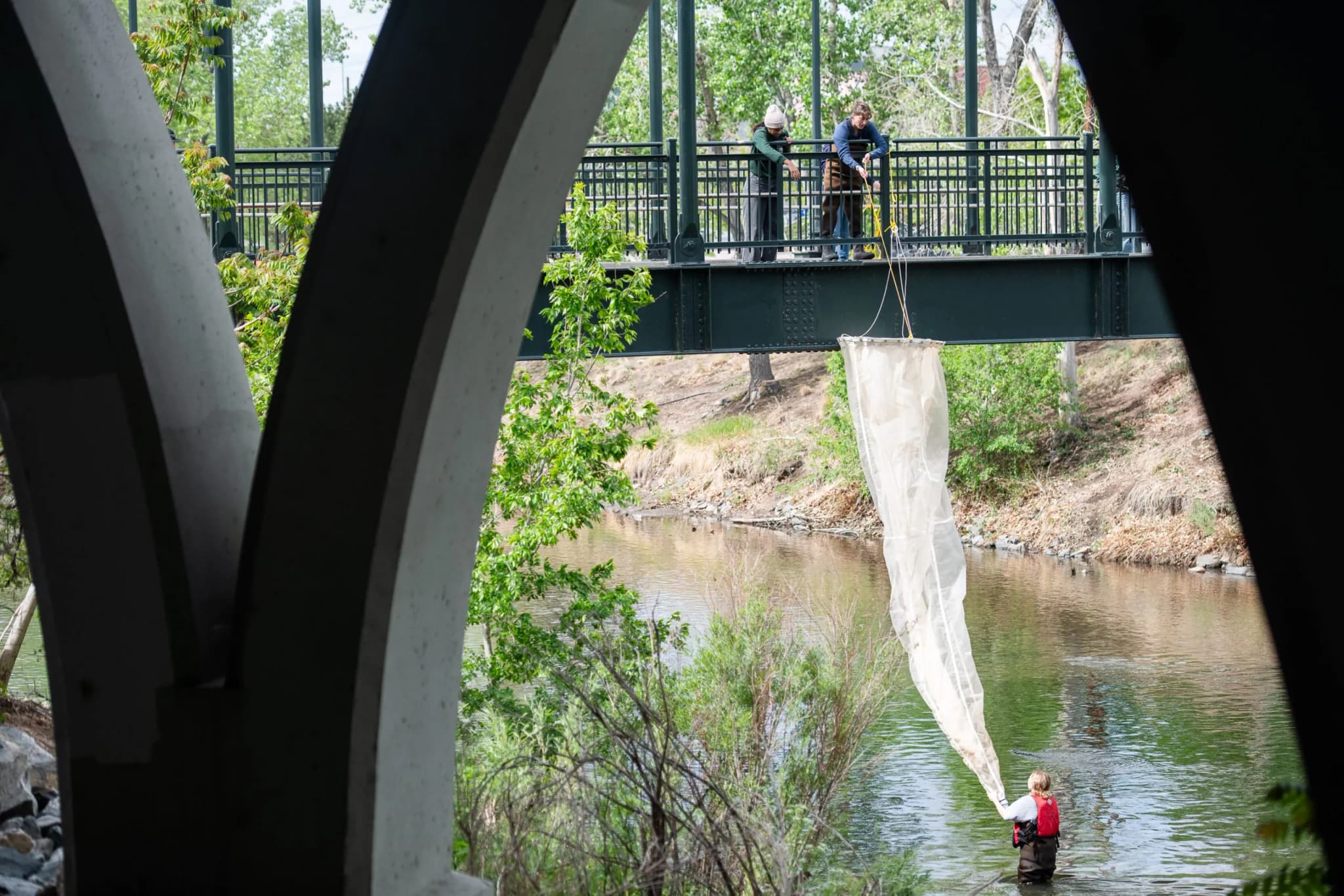
Colorado —Anne Marie Mozrall is standing on the Old 17th Avenue pedestrian bridge in downtown Denver, watching her team inflate a small kayak. They aren’t fishing. They’re looking for microplastics.
It’s a spring morning, the kind where the low hum of interstate traffic mixes with birdsong. Runners and dog-walkers slow down to stare as workers unpack a 20-foot-long cone of nylon netting and slip into chest-high waders. One onlooker actually asks if they’re trying to catch fish.
“No,” Mozrall says, essentially. “We’re trying to catch the stuff that’s already in the water.”
Mozrall, a 28-year-old doctoral candidate at the Colorado School of Mines, is leading a project that could reshape how we understand pollution in urban rivers. Her team is gathering data on the South Platte River to determine exactly how many microplastics — particles less than 5 mm long — are floating in the current.
The question is whether this local data can solve a global problem. Mozrall thinks so. She’s using this stretch of the South Platte as a testing ground for a workflow that will eventually extend to oceans, beaches, drinking water, and even soil.
“There’s still a huge need for primary data, and we can’t model these plastics,” Mozrall says. “We can’t establish risk or impacts from microplastics without really understanding where they are, how they move and what’s going on with them.”
The team isn’t just counting particles. They’re identifying types and sizes. They’re trying to figure out where the material comes from. Is it tire wear? Synthetic clothing? Industrial runoff?
Reese Erwin, a microplastics researcher with the team, is out in the kayak gathering water samples near Empower Field at Mile High. The visibility of plastic litter along the west bank is obvious to anyone walking the path. But the invisible stuff, the microscopic fragments; is harder to pin down. That’s where Mozrall’s work comes in.
The project grew out of Mozrall’s dissertation. It started with a simple goal: quantify the basic questions. How many microplastics end up in the river? What kinds? How big are they? And secondarily, where do they come from?
The answer isn’t just in Denver. Mozrall has forged a collaboration with Instituto Tecnológico de Santo Domingo, known as INTEC, a private university in the Dominican Republic. Researchers at both schools are now expanding their work to include the Ozama River, a larger and more polluted urban waterway.
This isn’t just about Denver. It’s about establishing a method that works in different environments. If the team can track microplastics in the South Platte and the Ozama, they can compare urban stressors across continents.
The students involved - undergraduates and master’s candidates. are learning a workflow that will serve them long after graduation. They’re calibrating instruments, stretching nets, and analyzing samples. They’re building a system for future research.
The implications for locals are direct. The South Platte flows through the heart of the city. It’s near the stadium, near the pedestrian bridges, near the homes and businesses that line its banks. If microplastics are infiltrating the waterway, they’re infiltrating the ecosystem that supports local wildlife and potentially human health.
Mozrall notes that awareness of microplastics as a health concern has grown, but gaps remain. We know they’re everywhere. We don’t always know where they’re coming from in specific urban settings. This research aims to fill those gaps.
“Primary data is the only way to move forward,” Mozrall says, referring to the need for direct observation over modeled estimates. “We’re also striving toward understanding them at large better and how they interact with our urban river systems.”
The team is working now. The kayak is in the water. The net is deployed. The data is being gathered. It’s not just about counting plastic. It’s about understanding the flow.
“We can’t establish risk or impacts from microplastics without really understanding where they are,” Mozrall says. “And we’re trying to get that understanding, one sample at a time.”
Keep up with Colorado
The day's Western Slope news, one email each morning. Free.
Federal Report Sets 200,000 Acre-Foot Water Conservation Target for Upper Basin
Colorado Parks and Wildlife Deploys Precision Drones for Weed Control