Erie Author Carter Wilson Transforms Garage Into Halloween Horror Stage
Erie author Carter Wilson converts his garage into a narrative-driven Halloween horror stage, blending pop culture references with theatrical design to create memorable trick-or-treat moments for local families.
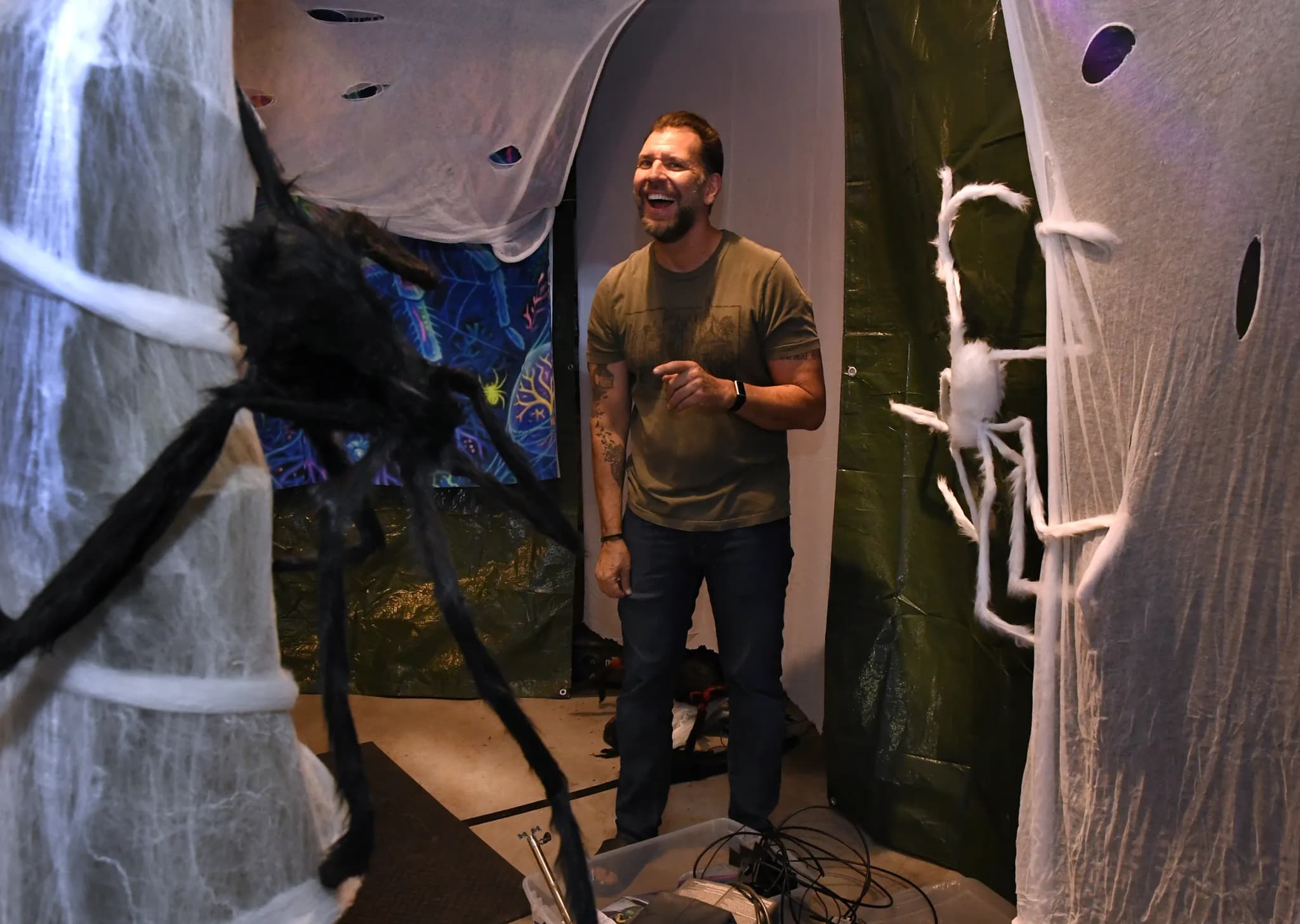
The green-and-purple Victorian house stands out against the Erie landscape, its white trim cutting sharply through the darkening October evening. Inside the garage, the air is thick with the scent of paint and old wood, where hundreds of kids and their parents gather to experience a tense buildup punctuated by a shocking plot twist.
This is the domain of Carter Wilson, a 56-year-old author whose creative knack for the creepy has propelled him to success. Wilson has written 11 complex and compelling psychological thrillers, winning five Colorado Book Awards along the way. Last year, his novel Tell Me What You Did gained enough literary traction to launch him into the realm of full-time authorship, finally allowing him to drop the corporate job in the hospitality industry that had balanced his writing life for years.
But the house itself is a separate entity, a destination for locals seeking a specific kind of Halloween experience. Wilson treats the garage as a stage, constructing displays with an eye for story and audience. He tracks popular culture closely, shifting his themes to match what is currently capturing the public imagination. When The Walking Dead was dominant, he went all-in on zombies. When Stranger Things landed, he constructed an entire underworld in the garage, complete with a leaping Demogorgon monster and a wormhole connecting a small Indiana town with another dimension.
These installations are not just decorations; they are narrative devices. One year, he employed devilish mannequins in ’70s regalia behind “a bar from hell,” piping in the infectious beat of “Disco Inferno” beneath a mirror ball. These two setups — the zombie era and the Stranger Things underworld — rank among his personal favorites. He designs the displays with a finger on the pulse of what people are going to look at, asking what the story behind it is.
The target audience is nuanced. While the kids provide the raw energy, screaming, running, reacting - the real appreciation often comes from the adults. Wilson explicitly designs for the parents, noting that they are the ones who truly appreciate the craft. “I design it for their parents because the parents are the ones who appreciate it,” he says. He acknowledges that some analytical kids enjoy deconstructing the setup, comparing it to previous years, but the best feedback comes from the grown-ups. “The best is when the kids are screaming and the parents are like, ‘Dude, this is awesome,’” Wilson says. “I do it for those comments.”
The experience is fleeting but intense. It all happens within minutes on Halloween night. The sequence moves quickly: the initial shock, the screams, and then the sweet denouement of candy plopped into a bag. It’s a rapid-fire emotional arc, compressed into a single trick-or-treat stop.
Wilson’s goal is to create a lasting memory, specifically the kind associated with a standout house. “You always have that memory of trick or treating at that one house, right?” he says, standing in the garage he annually transforms into a gauntlet of horror. He references the childhood desire to be the person who creates that distinct impression. “That one house that does something; and it doesn’t even have to be much, but they stand out. I always remember thinking that was cool, and I wanted to be that person someday.”
The effort is driven by a desire to stand out in a sea of generic costumes and front-porch decorations. It’s about creating a moment that lingers, a specific sensory imprint tied to a location. For the families visiting, it’s a brief interlude in a longer route, but for Wilson, it’s the culmination of months of plotting and building. It’s a small-scale production with high stakes: the reaction of the crowd.
The house serves as a physical anchor for this annual ritual. It’s not just a residence; it’s a venue. The transformation of the garage into a horror gauntlet is a deliberate act of curation. Wilson applies the same skills he uses in his novels - building tension, managing pacing, delivering a payoff; to his physical space. The result is a localized attraction that relies on word-of-mouth and repeat visits. People come back because they want to see how the story evolves, how the twist changes, how the setup improves.
In practice, this means the display is never static. It shifts with trends, with seasons, with Wilson’s own evolving tastes. The zombie theme gave way to the Stranger Things theme, which will likely give way to something else entirely next year. The constant is the intent: to surprise, to scare, and to delight. To make the parents nod in recognition and the kids jump in surprise. To be that one house that stands out.
For the neighbors in Erie, this translates to a predictable yet variable annual event. It’s a known quantity regarding location and timing, but a variable quantity regarding content. You know where to go and when to go, but you never know exactly what you’ll see. That uncertainty is part of the appeal. It keeps the experience fresh for both the creator and the audience. It prevents the display from becoming stale or predictable. It ensures that even repeat visitors find something new to react to.
The financial and logistical impact is contained but significant for the host. It requires dedicated space (the garage), dedicated time (annual transformation), and dedicated resources (materials, labor, creativity). It’s a hobby that borders on a profession in terms of effort, but it’s driven by passion rather than profit. The return on investment is measured in reactions, not dollars. The smiles, the screams, the nods of approval from the parents. The memory created. The story told.
This is the practical bottom line: Carter Wilson’s Halloween display in Erie is a localized, annual, pop-culture-driven horror installation that relies on narrative structure and audience reaction. It costs him time, money, and energy, but it buys him community recognition, personal satisfaction, and the status of being “that one house.” It changes the Halloween experience for locals by providing a high-intensity, high-quality alternative to standard trick-or-treating. It adds a layer of cultural engagement to a traditional holiday activity. It makes the event memorable, shareable, and repeatable. It’s a small investment with a large return in community spirit and individual joy. It’s a win-win: the creator gets to express himself, and the audience gets to be entertained. It’s a simple equation with a complex answer. It’s art, it’s entertainment, and it’s a neighborhood tradition. All wrapped up in a green-and-purple Victorian house with white trim.
Keep up with the Western Slope
The day's Western Slope news, one email each morning. Free.