How May Day May Pole Dancing United Aspen for Decades
Tim Willoughby researches the history of Aspen's May Day May Pole dance, a civic ritual sponsored by the German Social Club and Ladies G.A.R. from 1886 to the 1960s, suggesting a modern revival.
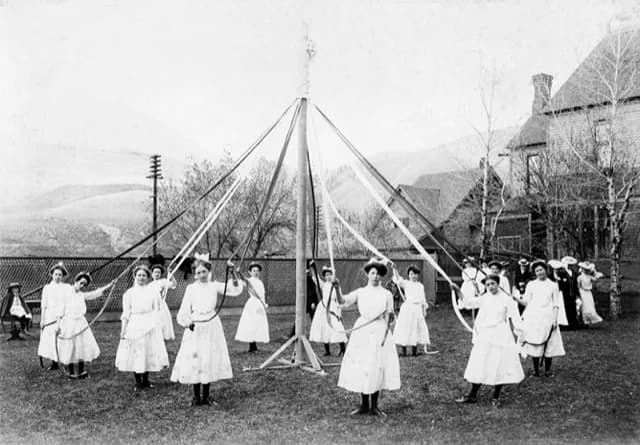
Aspen —The dust hangs heavy in the air at the Armory Hall, or at least it did when the last of the streamers were packed away in 1945. You can almost hear the rustle of tulle and the nervous laughter of young girls circling a tall, slender pole, their movements synchronized by decades of tradition. It wasn’t just a dance; it was a signal that winter was losing its grip on the valley.
Tim Willoughby has spent years digging through the archives to prove that this wasn’t some fleeting fad unique to a few eccentric locals. It was a civic ritual. The photo in his family collection, taken by John Bowman, sits on his desk as a silent witness to a time when May Day was a patriotic event that doubled as a celebration of the season’s turn. Aspen didn’t just endure the winter; it celebrated the transition to summer with ribbons and rhythm.
The tradition didn’t start in a vacuum. It arrived with the German Social Club in 1886, sponsored by folks who wanted to bring a piece of their homeland to the high country. That first event featured eight couples winding gaily colored streamers around the pole with a grace that still sounds impressive in black and white. But it was the Ladies Grand Army of the Republic (G.A.R.) who turned it into an annual institution. Starting in 1901, they took the reins, pitching the event as something traced back to colonial times that every young lad and lass looked forward to.
The scale of the participation tells you how deeply this was embedded in the community’s fabric. In 1895, sixteen young girls danced at the Wheeler Hotel, with local businesses sponsoring individual performers. The Aspen Dry Goods Company put up the money, and the balcony seating offered a prime view for shoppers and socialites alike. By 1903, the focus shifted to high school girls, with groups ranging from twelve to twenty-four dancers. They practiced for the May Day event at the Armory Hall, then performed again on the high school lawn before the school year ended.
It wasn’t always the high schoolers taking the stage. In 1904, first- and second-grade girls from the Washington School took over. Two years later, the event moved to the Jerome Hotel, where "little tots took evident pride in their different movements." The continuity is striking. From 1901 through 1945, the Ladies G.A.R. sponsored a May Day celebration with a May Pole dance nearly every single year. It served as a reliable anchor in the civic calendar, a bright spot in the ledger of local history.
After the war, the tradition didn’t vanish overnight. The last recorded instance in The Aspen Times appeared in the 1960s, arranged by kindergarten teacher Mrs. Price for a May Day Tea. Photos of that event still sit in the Aspen Historical Society archives, showing that the impulse to celebrate with ribbons and poles persisted long after the G.A.R. era ended.
Willoughby’s research highlights a community that valued shared cultural touchstones. The sponsorship models shifted from the German Social Club to the Dry Goods Company, then to the G.A.R., and finally to individual teachers and schools. The money came from different pockets, but the result was the same: a public spectacle that brought people together. It wasn’t just about the dance; it was about who was willing to pay for it and who was willing to watch.
Now, Willoughby is asking the obvious question that lingers in the quiet of the archives. Wouldn’t it be worthwhile to reestablish this fun and colorful seasonal tradition? The history is there, documented in newspapers and preserved in photos. The infrastructure of community support existed once, and it could exist again. The streamers are just waiting to be unwound.
Keep up with Aspen
The day's Western Slope news, one email each morning. Free.
Aspen's ACES Returns Annual Harvest Party to Rock Bottom Ranch
Glenwood Ghostwalk Brings Frontier History to Life in Linwood Cemetery