Longmont Rancher Builds Regenerative Beef Empire Amid Import Threats
A Boulder County rancher has built a million-dollar regenerative beef business using daily herd rotation, offering a resilient model as Trump’s new import tariffs threaten to flood the U.S. market with cheap foreign meat.
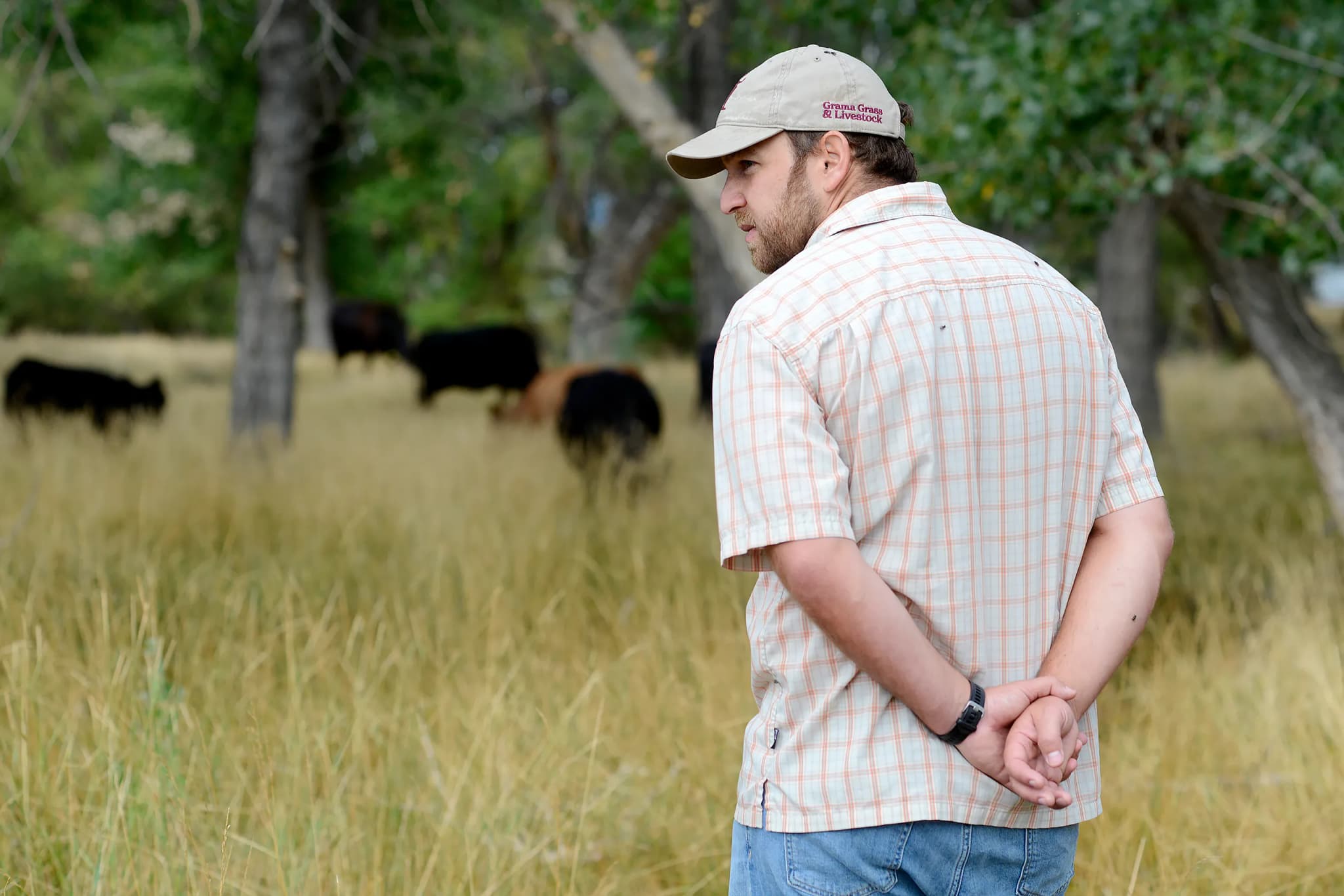
Andy Breiter stopped walking. He cocked his head to the side and listened to the sound of cattle eating grass.
“It’s peaceful listening to them munch their salad,” he said.
It was breakfast time on a patch of land off the Diagonal Highway in Boulder County. Breiter, a first-generation rancher, owns Grama Grass & Livestock in Longmont. He raises beef for a living. His cows are between four and six years old. He calls this stage "hospice." They are gorging on tasty grasses, living large, and slowly moving toward the butcher.
The Colorado Sun reported Tuesday that Breiter’s operation has grown from a 25-cow start in one pasture to an average herd of 90 cows grazing 700 acres across 20 pastures. He moves them daily. They never graze the same ground twice in 24 hours.
This isn’t just about feeding animals. It’s a regenerative agriculture business model. Breiter rotates his herd across public and private land under contract with owners, including the city of Boulder’s Open Space and Mountain Parks Department and the city of Louisville. The arrangement is a trade. Landowners get manure, soil aeration, and nutrient recycling. Breiter gets cheap, high-quality feed.
The financials back the model. In 2025, Breiter sold 85,000 pounds of beef. His business is now a million-dollar enterprise. He sells meat to the Coperta restaurant in Denver, the Rang Tang Craft Barbeque food truck in Longmont, Lucky’s Market in Boulder, and the Organic Sandwich Company in Louisville.
Make no mistake: This is a rare bright spot. The rest of the cattle industry is in disarray.
President Donald Trump’s return to office hit the sector hard. First came tariffs. Then skyrocketing import duties. On Aug. 21, Trump announced on social media that he would flood the U.S. cattle market with 300,000 metric tons of imported beef.
The short version: Cheap foreign meat is coming to American tables, and domestic producers are bracing for the impact.
For folks around here, this hits close to home. We pay property taxes that fund the open space departments Breiter partners with. We eat at the restaurants he supplies. When import duties shift, the ripple effect touches grocery prices and local farm viability.
Breiter’s strategy relies on efficiency and land access, not scale alone. He pays a sliding-scale fee to landowners based on parcel size, grass quality, water access, and distance from his headquarters. He doesn’t own all the land he uses. He works with it.
The larger industry struggles because many ranchers can’t absorb the cost of imported competition or the volatility of feed prices during drought. Breiter’s model buffers against that. His daily rotation keeps grass healthy and cheap for his herd. It builds soil health, which sequesters carbon over time.
Read that again. His cows are a tool for land management as much as meat production. That dual benefit is why municipalities partner with him.
Trump’s plan to import 300,000 metric tons of beef is a direct attack on domestic pricing power. It assumes American consumers will switch to cheaper imports when prices rise. For a small-scale producer like Breiter, the margin for error is thin. He can’t outspend a multinational importer.
But he doesn’t have to. His cost structure is built on relationships and rotation, not just volume. He’s already weathered droughts and rising input costs since founding Grama Grass in 2020.
The question isn’t whether imported beef will hit the market. It’s whether it will undercut local operations like Breiter’s enough to break them before they can adapt.
Breiter is still strolling his pastures. The herd is still eating. The grass is still growing back.
For now, the model holds.
Keep up with the Western Slope
The day's Western Slope news, one email each morning. Free.