Longmont Workers Learn ASL to Connect With Deaf Warehouse Lead
Longmont city workers now gather weekly to learn American Sign Language, breaking decades of isolation for Steve Martinez, a deaf warehouse lead who relied on written notes to communicate with colleagues.
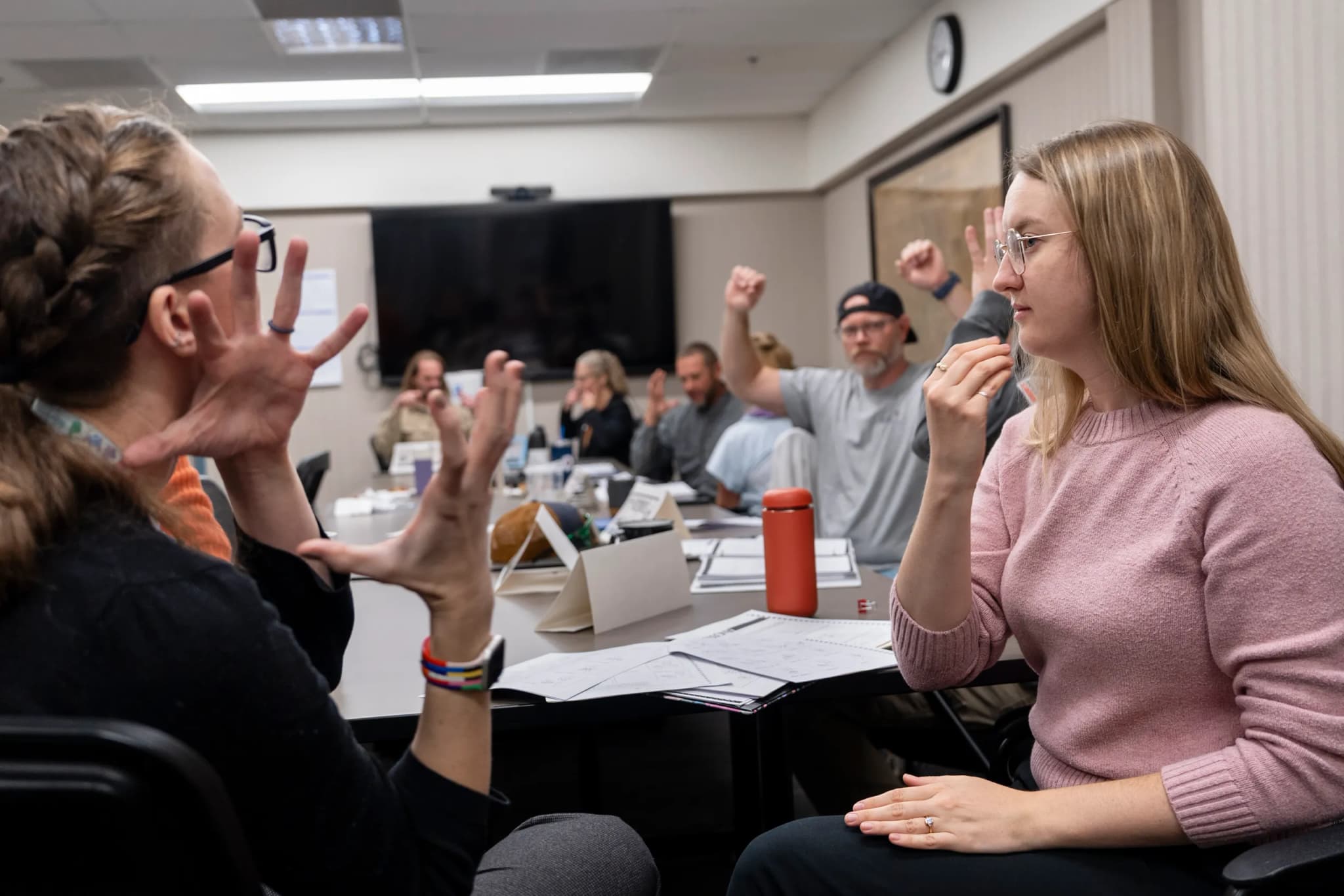
The fluorescent lights in the City of Longmont Service Center hum at a low, constant pitch. At 7:00 a.m., before the rest of the city has fully shaken off its sleep, up to 18 people squeeze into a conference room. They are not there to discuss budgets or infrastructure projects. They are there to sign.
Steve Martinez stands near the back, watching them go through their drills. He is 61 years old and has been the lead warehouse worker for Longmont Power and Communications for 36 years. He is also deaf, a fact that has defined his professional existence for three decades.
For most of those years, Martinez’s world inside the warehouse was defined by silence and isolation. He knows exactly where to find every single one of the nearly 2,800 spare parts and supplies for departments across the city. Need a transformer? He finds it by memory. Need extra batteries? He locates them without looking at labels. But while he could navigate the shelves, he struggled to navigate the people who used them.
Polished notes passed back and forth were his primary tool. He even developed a system of "home signs" — gestures that aren’t part of American Sign Language but helped bridge the gap. If he needed to discuss an elbow joint, he pointed to his own elbow. It worked for transactions. It didn’t work for connection.
"It used to be I would just walk through every day and it was like a silo here," Martinez told The Colorado Sun through an interpreter. "I would never have any interaction with anyone."
That dynamic shifted in February, when a small group of city workers began learning ASL specifically to communicate with him. What started as a practical attempt to bridge a communication gap has since ballooned into a weekly ritual. Now, the class is open to anyone in the city workforce who wants to join.
The change is visible. Martinez no longer feels like he is on the sidelines of his own job. He notes that the interaction has moved beyond logistics into something more personal. "And it’s not just about communicating warehouse needs," he said. "It’s also about communicating who you are as a person, understanding who my coworkers are and who their families are."
The ripple effect extends into the hallways. Coworkers stop for conversations in ASL, a shift that suggests the language is becoming a shared tool rather than a specialized skill. For Martinez, who was born deaf and has spent most of his life trying to fit into a world designed for people with hearing, the shift is profound. He doesn’t have to try so hard anymore.
The warehouse remains a labyrinth of neatly stocked shelves, and Martinez still relies on memory to navigate it. But the silence that once filled those aisles is breaking, replaced by the quiet, rhythmic movement of hands.
Keep up with the Western Slope
The day's Western Slope news, one email each morning. Free.