Margaret Durrance Postcard Reveals Aspen Amphitheater Design Differences
A Margaret Durrance postcard reveals structural differences between Ero Saarinen’s and Herber Beyer’s Aspen Amphitheater designs, highlighting architectural shifts from 1950 to the present.
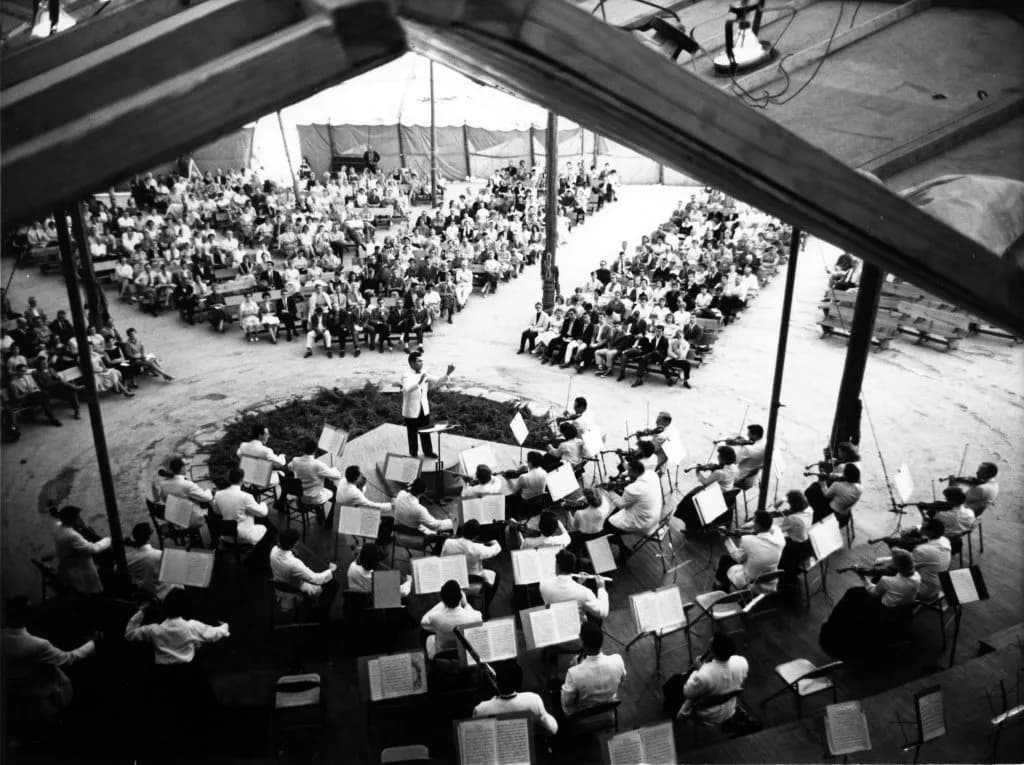
Aspen —Aspen’s first amphitheater, built for the 1950 Goethe Bicentennial, was a seasonal tent designed by Ero Saarinen that featured a bowl dipping below ground level and four tall wood poles.
The structure stood in stark contrast to the Herber Beyer version that replaced it in 1965. Beyer’s design utilized a steel superstructure, permanent redwood benches, and a hexagonal geometric shape. While Saarinen’s tent was taken down entirely each year, Beyer’s canvass covers and cushions were removed, but the benches remained to weather the winter.
The distinction between these two early iterations of the Aspen Amphitheater has emerged through a postcard by Margaret Durrance, which captures details often overlooked in standard concert photography. Photographers typically faced the conductor and audience from the front. This specific image was shot from behind the back wall of the stage, looking through a large gap between the acoustic wall and ceiling.
The photo reveals the four tall wood poles that primarily supported Saarinen’s structure. It also shows the large bowl shape, rectangular with circular corners, which dipped below ground level to enhance acoustics for symphony performances.
Saarinen’s design criteria included seasonal use, large seating capacity, and suitability for symphony music. He had recently won the competition for the Gateway Arch in St. Louis, and he and his wife Lilian were frequent winter ski visitors to Aspen in the 1930s. Lilian served as an alternate for the first U.S. Olympic Alpine team in 1936.
The Herber Beyer version maintained similar criteria but delivered different results. As a Bauhaus artist, Beyer favored geometric shapes, incorporating a hexagon throughout the design rather than Saarinen’s rectangular bowl.
Seating also differed significantly. Saarinen used wooden benches specially designed for the slope; they were moved to storage at the end of each season. Beyer installed permanent redwood benches supported by steel frames, allowing them to withstand the winter elements without full removal.
The stage was perhaps the most critical difference. Saarinen’s stage featured four levels with a wood floor and a large empty space beneath it, providing excellent acoustics for orchestras. Beyer created a larger stage to accommodate the growing Festival Orchestra, mimicking Saarinen’s shape but with key adjustments.
Beyer’s stage ceiling was parallel to the steep slope of the canvas tent, with the audience end positioned much higher above the stage floor. In Saarinen’s design, there was less slope, keeping the audience end closer to the listeners. The back of the orchestra sat much further back in Beyer’s version compared to Saarinen’s, creating distinct acoustic environments that conductors had to adjust to.
The postcard by Durrance, now part of the historical record, offers a clear visual comparison. It captures the interior of the Beyer tent, showing its design features without people to obscure the view. The image confirms the structural differences that defined Aspen’s musical history for over two decades, from 1950 to the present day.
The story of these first two versions is not just about architecture. It’s about how the community adapted to its own growth. Saarinen provided a temporary, elegant solution for a bicentennial celebration. Beyer built something more permanent, reflecting the stability of a town that was no longer just visiting but staying.
The photo sits in archives, quiet and unassuming. It shows a tent, yes, but also the bones of what Aspen became.
Keep up with Aspen
The day's Western Slope news, one email each morning. Free.
Aspen's ACES Returns Annual Harvest Party to Rock Bottom Ranch
Glenwood Ghostwalk Brings Frontier History to Life in Linwood Cemetery