Mesa County Naloxone Kiosks Distribute 9,500 Boxes in First Year
Mesa County Public Health reports that 17 distributed naloxone kiosks have dispensed over 9,500 boxes since December 2024, providing free, stigma-free access to life-saving medication across the valley.
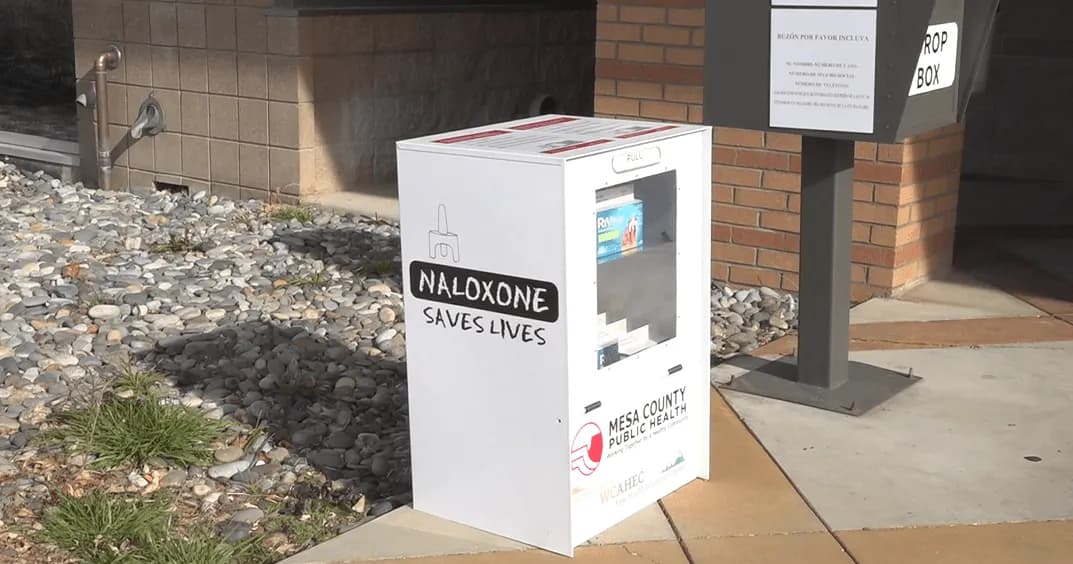
Grand Junction —The air in the Mesa County Criminal Justice Services treatment center still carries that specific, sterile sharpness of antiseptic and old paper, but tucked near the intake desk sits a quiet testament to a different kind of urgency. It’s a simple box, mounted on the wall, waiting for a hand to reach out and take what it needs. No ID required. No clerk asking if you’re sure. Just the immediate, unmediated access to a life-saving medication.
That is the reality of the new naloxone kiosk program, and according to the first annual impact report released by Mesa County Public Health (MCPH), it is working. Since launching in December 2024 alongside the Western Colorado Area Health Education Center, the program has seen residents take more than 9,500 boxes of naloxone. That averages out to about 17 kits every single day.
“198 people in our community lost their lives to overdose between 2020 and 2024,” said Chhavi Attri, MCPH Community Health Planner, in the report. “And that’s not statistics, those are our neighbors, family members and coworkers. This report is what we’re doing to stop that and the fact that it’s working.”
It’s easy to look at a kiosk and wonder if it’s just another bureaucratic box-checking exercise, but Attri argues the design is intentional. They removed the friction. They removed the stigma. “We designed it that on purpose because we know that stigma is a big barrier and a very real barrier, and we didn’t want anything standing between a person and a life-saving medication,” Attri noted. The result is a network of 17 kiosks spread across the county, including five added just within the past few months. You can find them in the most unexpected places: the Clifton Branch Library, the detention lobby of the Sheriff’s Office, the University Center at Colorado Mesa University, and even at Family Health West in Fruita.
The survey data from community partners and residents who use these kiosks suggests they are seen as essential infrastructure, much like a fire extinguisher or a first-aid kit. When asked if the kiosks were useful in an emergency, the feedback was unanimous. But the most striking quote came directly from the people manning the kiosks. “The kiosk hosts told us directly that if these were to be removed tomorrow, lives would be lost,” Attri reported.
There’s a practical clarity to the medication itself, too. Naloxone doesn’t get you high; it doesn’t do anything unless opioids are in your system. It simply reverses the respiratory depression. “All it does is save a life,” Attri said. “The only message we’re sending is that we value the lives of people in our community, and the figures prove it.”
For the folks driving down Highway 6 or navigating the back roads of Palisade, the physical presence of these kiosks is a small thing. They’re just boxes on walls. But when you look at the list of locations — from the GVT Clifton Transfer Facility to the Lighthouse Program on Orchard Avenue — you see a web of safety netting being woven across the entire valley. It’s not centralized in one clinic; it’s distributed, accessible, and free.
The full impact report is available on Mesa County Public Health’s Opioid Prevention and Recovery Resource page, offering a clear picture of how the program is performing.
Thousands of boxes gone. Thousands of chances taken. And in a county where overdose deaths have been climbing, that accessibility feels less like a policy update and more like a lifeline thrown into the water.
Outside the Colorado Health Network on Wellington Avenue, the afternoon light hits the brickwork at a sharp angle, and inside, the kiosk stands ready, waiting for the next person to walk in and take a breath.
Keep up with Grand Junction
The day's Western Slope news, one email each morning. Free.