Morgan Sierra Mae Sings Farewell to Vanished St. Mary’s Glacier
Musician Morgan Sierra Mae performed a farewell song on bare rock after St. Mary’s Glacier vanished completely for the first time, marking a sudden ecological loss.
Aspen —“I melt away, I melt away, I melt away — don’t forget my name.”
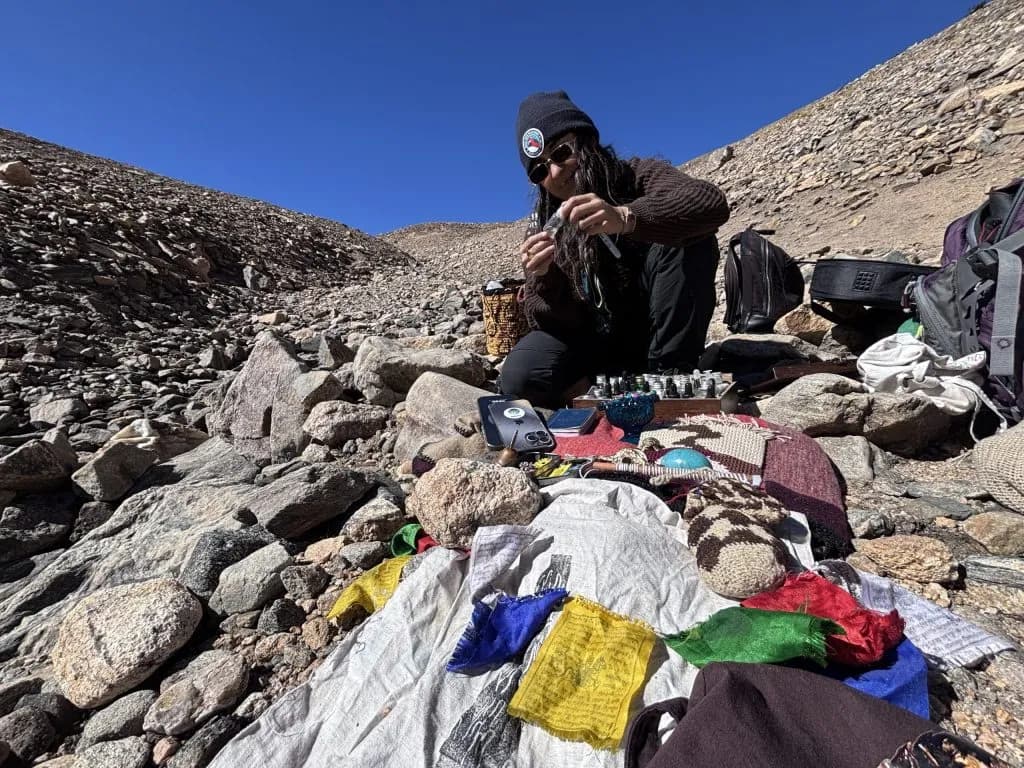
Morgan Sierra Mae sang the words with her guitar on Friday, Oct. 2, sitting cross-legged on bare rock in a valley that looked unrecognizable to anyone who had visited it in the last century. The strumming mixed with the babble of a stream and the whistle of wind, echoing off the stone faces that had been carved by ice for thousands of years.
Mae grew up in Evergreen, less than an hour from the site. For as long as she could remember, St. Mary’s Glacier had been there. It was a summer destination for skiers and snowboarders, a place that promised snow when the rest of Colorado was baking in the sun. But this September, for the first time in recorded history, the ice melted completely.
The Vail Daily reported on the event, noting that while the site is called a glacier, scientists clarify it has not been a true glacier in recent history. A true glacier is defined by ice dense enough to move under its own weight via gravity. St. Mary’s was a perennial snowfield, not a moving body of ice. Now that the snow is gone for good, it isn’t even that. It’s just a place. Or perhaps, as Mae suggests, a spirit.
The ceremony on Oct. 2 was hosted by Glacier Nation, an international climate movement, and The Green House Connection Center, a Denver-based nonprofit. At the trailhead, about eight people formed a circle, holding hands and lowering their heads in prayer. Marcela Fernandez, the founder of Glacier Nation, said the practice is common in her home country of Colombia. She had been attending New York City Climate Week, the largest climate gathering in the world, when she saw headlines about St. Mary’s disappearance. She canceled plans to visit glaciers at Mount Shasta in California to come here instead.
“Who accompanies St. Mary’s now? Who is with her? Who’s listening and capturing the last drop of water, or what she wants to tell us?” Fernandez said. “We believe that every time that a glacier or a perennial snowfield will disappear, what we should be able to collect are the lessons that we need to learn.”
The question is whether a song in an empty valley translates into policy change. To hear Fernandez tell it, the disappearance is not just a local loss; it’s a signal. Glaciers and perennial snowfields are disappearing from Columbia to Colorado. The math of climate change is not abstract when the landscape you grew up on vanishes in a single season.
Mae said art and music help her process the grief she feels for the ecological harm that industrialization and pollution have done to places like St. Mary’s. She isn’t the only one feeling that weight. For neighbors in the Front Range, St. Mary’s was a tangible proof of a different climate system — one where summer snow was a given, not a memory.
The Vail Daily noted that the site had always been known to last year-round until this year. That timeline matters. This isn’t a slow fade over decades that people can ignore; it’s a sudden, total absence. The snowfield didn’t shrink. It vanished.
Fernandez said the movement is about collecting lessons from these disappearances. She sees each lost snowfield as a data point in a larger story of warming. The ceremony wasn’t just about mourning; it was an attempt to assign meaning to the loss, to make sure the silence of that valley is heard.
As the group finished their prayer and stepped back onto the trail, the empty rocks remained. The stream still ran, but the snow that had fed it for a century was gone.
Fernandez left with a clear outlook on what comes next. “We believe that every time that a glacier or a perennial snowfield will disappear, what we should be able to collect are the lessons that we need to learn,” she said.
Keep up with Aspen
The day's Western Slope news, one email each morning. Free.