Rifle SRO Josh Allison Returns to Patrol After Four-Year School Term Ends
Rifle Police officer Josh Allison concludes his four-year assignment as a School Resource Officer for Garfield Re-2 and returns to a rotating patrol schedule due to departmental policy.
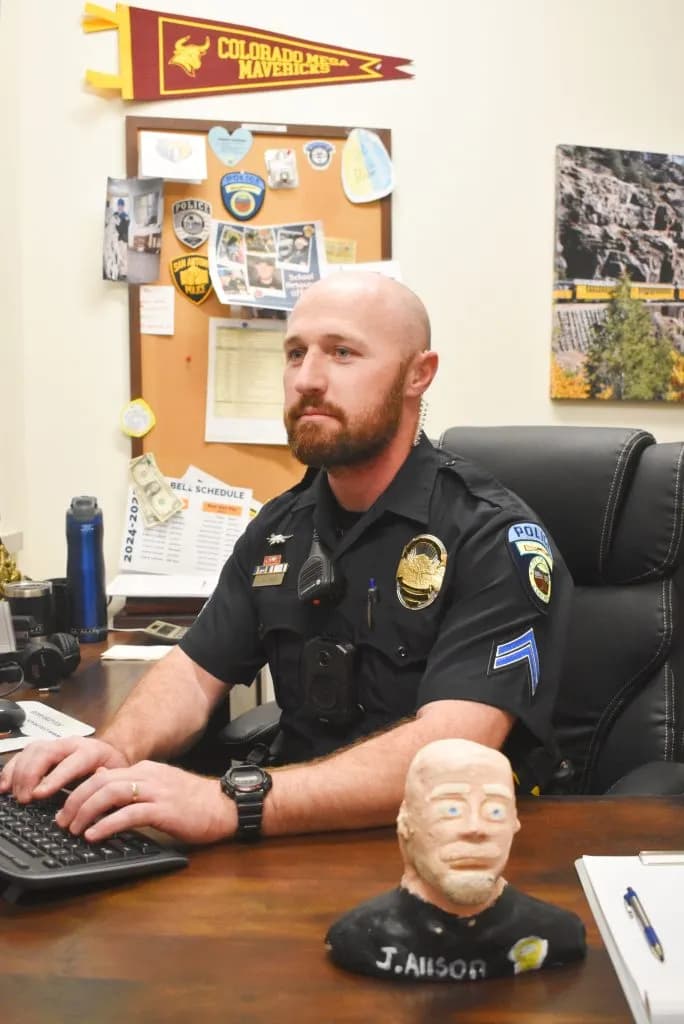
Rifle —Why is the Rifle cop who spent his mornings in school hallways now back on patrol?
Because policy says so.
Josh Allison ends his four-year run as Rifle School Resource Officer (SRO) not because he failed, not because he wanted out, but because the Rifle Police Department’s internal clock hit zero. He served in Garfield Re-2 schools from fall 2022 until the end of this school year. He was assigned to Rifle High School and Rifle Middle School. That was the job. Now, he’s back to a rotating patrol schedule as a supervisor.
The short version: Allison is leaving the schools. The department is keeping him. The community loses a familiar face in the hallways.
Allison has been a Rifle Police officer for seven years. This is his first and only agency. He was an SRO before, pulled back to patrol, then returned to the schools in 2022. He says he’d be an SRO for the rest of his career if the assignment didn’t have a four-year limit due to policy.
That limit is the only reason he’s moving.
The work itself was high-stakes. Allison handled the difficult calls. The serious ones. In 2024, a threat to Rifle High School was reported regarding a man with a rifle outside the school, planning to walk in and start shooting. Allison responded urgently. The school went into lockdown. Numerous law enforcement officers responded from several agencies.
It was a false alarm — a swatting incident. But the worry was real. The stress was real.
“The collective stress of having a school on lockdown and making decisions during what we thought would become a critical incident made it a difficult situation,” Allison said. “I’m proud of our overall response, especially from the staff and students of Rifle High School.”
He notes the lessons learned. He doesn’t sugarcoat the pressure. Peace officers and schools alike had to prove their mettle.
But it wasn’t all lockdowns and swatting. Allison remembers the quiet moments too. He recalls a trip to Wamsley Elementary School. He was sent for an unknown reason. The principal told him to run toward her down a quiet hallway. He walked into the gym to a sudden, loud roar of appreciation from the students during an assembly.
“I felt like a celebrity.”
That’s the balance of the job. Policing and K-12 education. Two worlds Allison enjoyed. He’ll miss working closely with administrators at each school and at the district level. He’ll miss pursuing school safety projects. He’ll miss the consistent schedule that allowed him to spend more time with his family when he was off duty.
Allison says the students inspired him. They made him focus more on empathy as a patrol officer. They made him a better father.
“Their influence on my child is something I carry with me,” he said.
Now, the uniform changes. The location changes. The four-year window closes.
Locals will notice the absence. Kids walking to class won’t see the familiar face in the hallway. Parents won’t get the quick update from the cop who knows the building’s quirks. The department gets a supervisor who knows the streets. But the schools lose the dedicated resource who spent years embedded in their daily rhythm.
The policy dictates the departure. The community dictates the memory.
Allison is still a Rifle cop. He’s just not their cop anymore. Not in the way that matters for the next four years.
The question isn’t whether he’ll stay in law enforcement. He will. The question is whether the next SRO will get the same four-year window. Or if the department will keep rotating them out every time the clock runs out.
Allison leaves with a clear head. He’s done his time. He’s handled the threats. He’s earned the applause. He’s going back to the patrol car.
And the schools will have to adjust.
Keep up with Rifle
The day's Western Slope news, one email each morning. Free.
Steamboat Recommends E-Motorcycle Education to Clarify Rules
BLM Clears 113 Roan Plateau Parcels for December 2026 Oil and Gas Lease Sale