Routt County Mental Health Team Handles 128 Crises Since Launch
Routt County’s new mental health co-response team handled 128 crises since launching last fall. Deputy Dawn Smith and social worker Tracy Dierksen aim to de-escalate situations before they reach the ER.
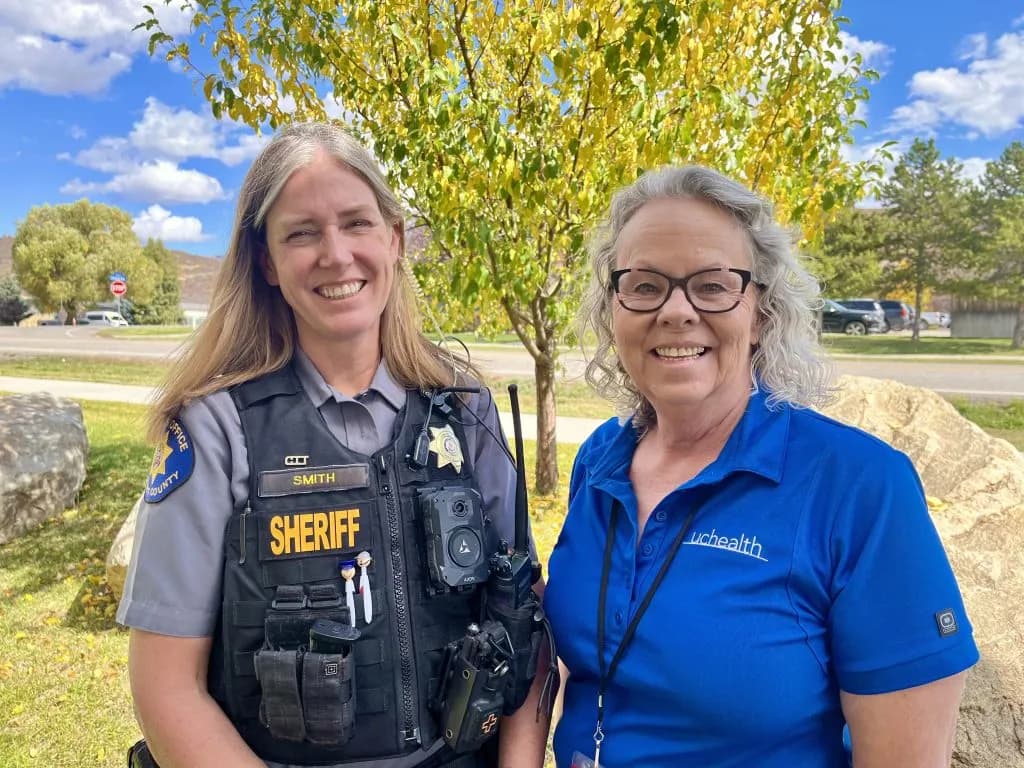
Steamboat Springs —Deputy Dawn Smith and licensed clinical social worker Tracy Dierksen are the two people who show up when a neighbor in Routt County is having a mental health crisis. They don’t carry handcuffs and gowns; they carry training, patience, and a specific protocol designed to de-escalate before the system kicks in.
To hear them tell it, and according to the data presented by Assistant County Manager Melina Bricker at the Oct. 12 work session, this partnership is working. The team has handled 128 calls for service through August of this year, a figure that represents real people in Steamboat Springs and the surrounding valley who needed help but didn’t necessarily need a police arrest or an immediate ER intake.
The team is just over a year old, but its roots go back to January 2022. That’s when then-Undersheriff Doug Scherar, now the sheriff, told his staff to look for a better way to handle mental health crises. For 18 months, Smith scoured the state for a model that fit Routt County’s specific needs. By February 2023, Scherar and Smith had a plan for the commissioners. The funding didn’t arrive until June 2024, when the Sheriff’s Office secured a grant from the Colorado Behavioral Health Administration. Smith was appointed full-time by September 2024, and after a year spent building policies and finding a clinical partner in UCHealth Yampa Valley Medical Center, the team launched last fall.
The question is whether a two-person team can actually make a dent in the county’s behavioral health infrastructure. The math holds up, at least for now.
Bricker explained that the team’s schedule has shifted based on actual call volumes. When they launched, they worked 11 a.m.-9 p.m. on Tuesdays and Wednesdays, and 9 a.m.-7 p.m. on Thursdays and Fridays. That didn’t match the rhythm of crises in the valley. The current schedule is 8 a.m.-6 p.m., Tuesday through Friday. It’s a narrower window, but it aligns with when calls are coming in.
Calls can come from anywhere: dispatch, self-referrals, community partners, or a responding officer who sees a situation that needs more than just law enforcement. The team arrives, de-escalates, evaluates, and connects the individual to services. If the person is at imminent risk of harm to themselves or others, either Smith or Dierksen can initiate a temporary hold.
“In a temporary hold, they go to the emergency room for a full bio-psychosocial, and then from there — if it is determined that they do need inpatient care — that discharge planning can sometimes include the co-response team being willing to [help],” Bricker said.
For many residents, that last part is the critical piece. Inpatient care in Grand Junction is a long drive from Steamboat Springs, and discharge planning is often where patients fall through the cracks. Having a local clinician already involved in the process can bridge that gap.
The initiative is still young, and Bricker noted that law enforcement officers have shared perspectives on both how the effort is going and where improvements can be made. The data presented in October was the first substantive look at the team’s impact, and it showed a clear demand for this specific type of response.
As the team moves into its second year, the focus is on refining those connections and ensuring that when Smith and Dierksen are on scene, they have the resources to keep people out of the ER when possible and into treatment when necessary.
“It’s about meeting them where they are,” Bricker said. “And making sure that the next step is clear.”
Keep up with Steamboat Springs
The day's Western Slope news, one email each morning. Free.