Tribal members bless Mount Blue Sky summit for Colorado sesquicentennial
Tribal members and youth hikers gathered at the summit of Mount Blue Sky to bless the mountain during Colorado’s 150th birthday celebration, reclaiming the peak’s history and honoring Indigenous heritage.
“‘It’s about the next 150 years, and humanity in general at a 30,000-foot level. How best to do that than at the top of these mountains?’”
Ernest House Jr., an enrolled member of the Ute Mountain Ute Tribe, asked that question as he watched a group of young hikers crest Mount Blue Sky. The answer, it seemed, was written in the smoke of rolled tobacco and the sound of drums echoing off Clear Creek County’s granite.
The state marked its 150th birthday on Aug. 1 with an ambitious logistical feat: placing roughly 500 people on the summits of Colorado’s highest peaks. For locals in the Western Slope, the celebration wasn’t just about counting candles on a cake. It was about who got to stand where, and what names hung in the air above them.
At Mount Blue Sky, formerly known as Mount Evans until its 2023 renaming to remove the title of a territorial governor whose policies contributed to the Sand Creek Massacre, the air felt different. Heavier with history. Lighter with possibility.
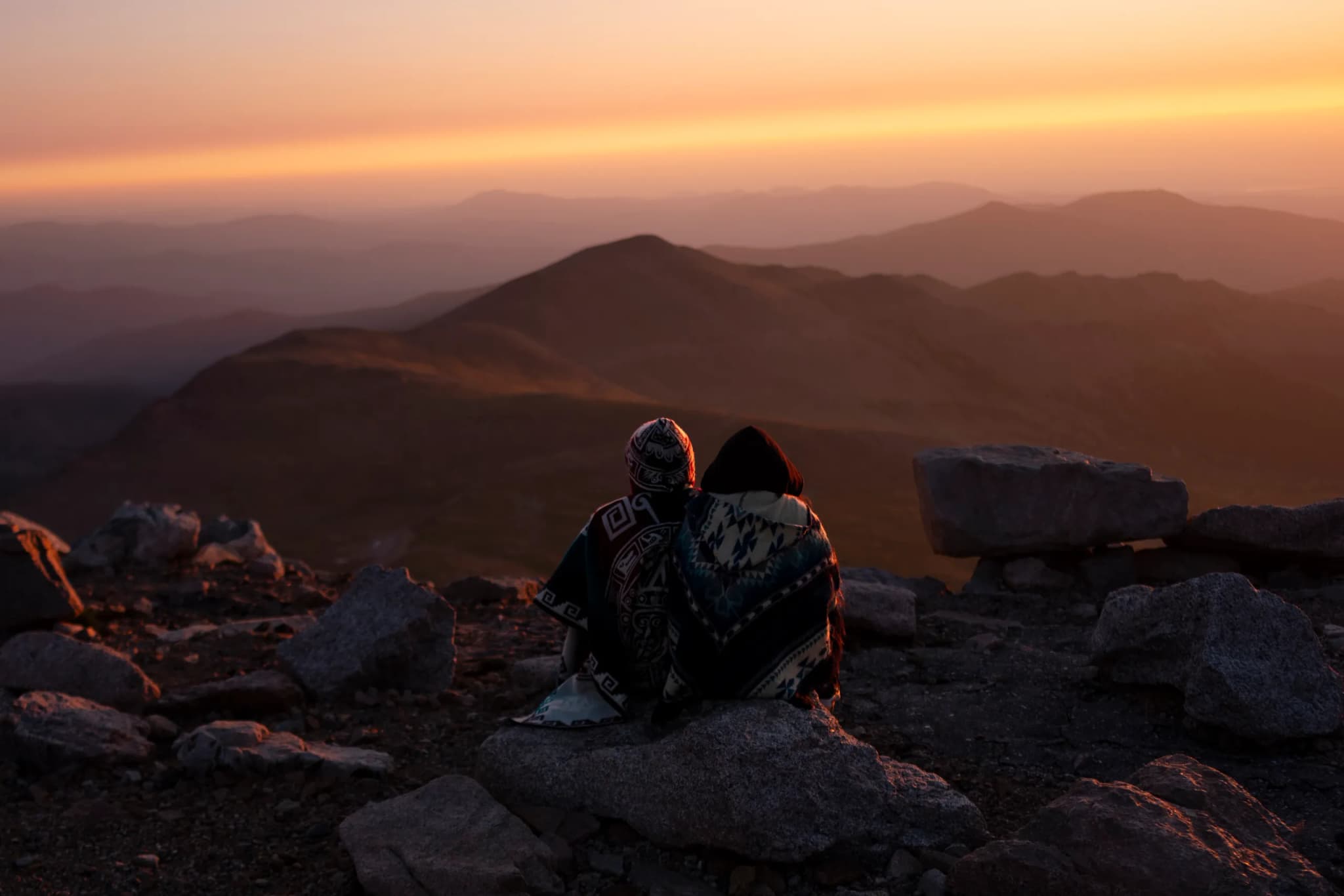
Devin Encinias, 23, and Hannah Victoria Lucero, 25, stood on the summit watching the sunrise. They were part of a tribal youth hiking team making their way through all 58 of Colorado’s 14,000-foot peaks. The goal was recognition — for the state’s sesquicentennial, yes, but also for the Native American communities whose presence here predates the statehood by centuries.
The hike began before dawn, around 2 a.m., in the dark of Arapaho National Forest. City lights twinkled far below, small and distant against the vastness of the mountain. As the sky brightened, hikers shared rolled tobacco. They paused to rest. They climbed.
Cheyenne Arapaho artist Lewis TallBull, 40, moved upward under the beam of a headlamp. He held a feathered staff at the summit during the blessing, his face illuminated by the rising sun. Joseph Fletcher, 15, stood nearby with a staff topped with a bird’s head. He was young enough to inherit the next 150 years, old enough to carry them.
The group on the mountain was not a monolith. It included members of the Ute, Pueblo, Yaqui, Mexika, Southern Cheyenne, Arapaho, and Northern Arapaho tribes. Many were strangers before they met on the trail. They became a community by 6 a.m., when the drums started and the chanting rose above the wind.
Standing near the sign marking the Mount Blue Sky Interpretive Area, tribal historian Chester Whiteman, 71, held the flag of the Cheyenne and Arapaho Tribes. He is a descendant of Sand Creek Massacre victims, the event in 1864 that claimed mostly women, children, and elderly Cheyenne and Arapaho people. His presence on the peak was not accidental. It was a reclamation.
House, who helped organize the ascents, emphasized that the blessing was less about the physical act of hiking. It was about looking forward. The mountain, stripped of its controversial namesake and restored to a name reflecting the land’s Indigenous roots, served as a vantage point for that future.
Photojournalist Cheney Orr joined the Mount Blue Sky hike, capturing images of the event for The Colorado Sun. She documented hikers sharing tobacco, artists holding staffs, and historians holding flags. The images tell part of the story. The silence between the drumbeats tells the rest.
Not exactly a quiet birthday party. A loud, deliberate statement made in thin air at 14,259 feet.
And that matters because names have power. Place names shape how we see our landscape, and who we see in it. When a governor’s name comes down, another rises to take its place. The Sand Creek Massacre was not just a historical footnote for those standing on the summit. It was a living memory, carried up by descendants who refused to let it stay buried in the valley.
The sun broke over the Eastern Plains, illuminating the group on Mount Blue Sky. They stood together — young and old, strangers and kin, hikers and historians. The drums faded. The smoke cleared. The mountain remained.
Keep up with the Western Slope
The day's Western Slope news, one email each morning. Free.