UA Professor Jessica Tierney Uses Ice Cores to Explain Deep Time Climate Change
University of Arizona professor Jessica Tierney tells a packed house at Eagle River Presbyterian Church that understanding climate change requires looking at deep time archives like ice cores, not just recent decades.
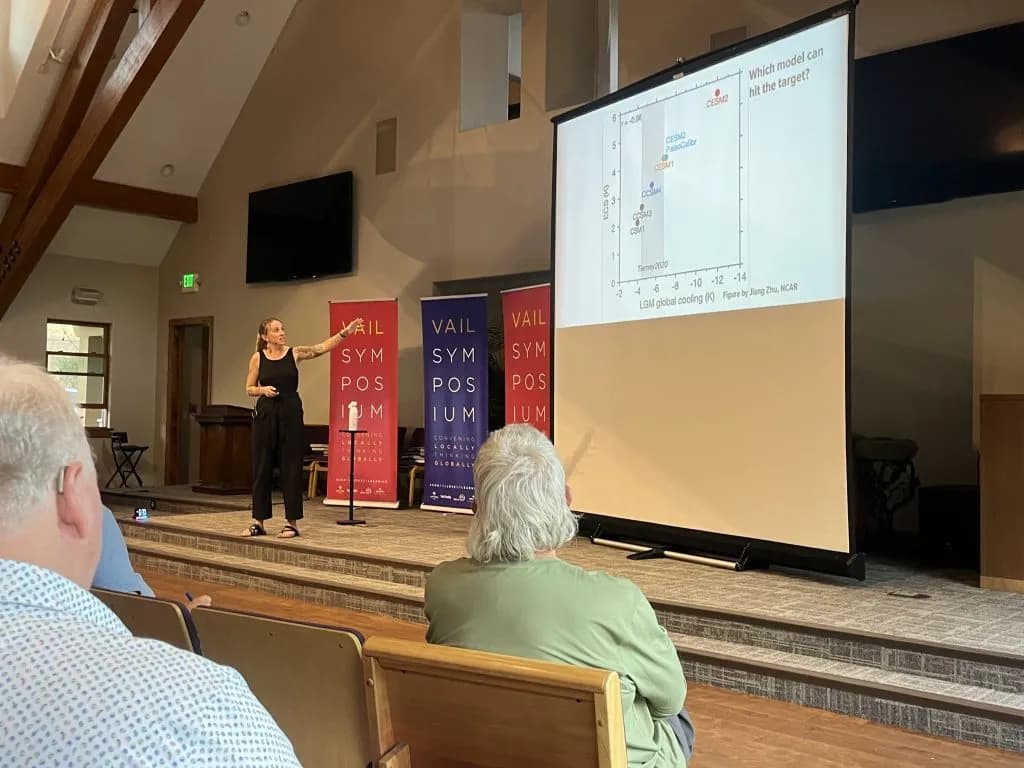
Aspen —The air inside Eagle River Presbyterian Church was still thick with the weight of a packed house, the kind of quiet that follows a speaker who knows exactly how to dismantle your assumptions. Jessica E. Tierney stood at the front, not pointing at a slide of rising thermometer lines, but at the deep time of the planet itself.
For context, the Intergovernmental Panel on Climate Change declared in 2021 that human influence is making extreme climate events more frequent and severe. That’s the headline. The subtext, delivered Tuesday by the University of Arizona professor and lead author on the IPCC Sixth Assessment Report, is that we’ve been looking at the wrong clock.
“Trying to understand climate change by observing only the last few decades is like trying to understand the rules of a game after watching a few plays,” Tierney told the crowd.
She’s right. If you only look at the last 50 years, you’re seeing a blip. You’re missing the structural integrity of the system. To get the full range of change, you have to go deeper. You have to look at what happens when the planet actually gets hot, or cold, or dry, on a geological scale.
Tierney doesn’t have a time machine. She has natural archives.
Tree rings show drought. Coral rings and cave stalagmites record temperature shifts through chemistry. Sediment at the bottom of oceans and lakes holds the history of accumulation. But the ice cores are the standout. They are ancient databases. When snow falls and solidifies, it traps bubbles of the atmosphere from thousands of years ago. You can measure the CO2 concentration directly from the air that was trapped when that layer of ice formed.
“The ice cores give us this really important context about how different human-caused climate change is from the natural climate cycles that dominated in the ice age world,” Tierney said.
This isn’t just academic trivia for folks who like rocks. This data constrains the key metrics used in computer models. It improves the projections. It reveals patterns of temperature and precipitation that matter regionally. If the models are wrong about how the earth behaves in radically different climates, our predictions for the Western Slope’s water supply are just guesses.
Tierney and her team are already using this deep time data to predict how the summer monsoon season may change. They analyzed leaf wax. The chemical makeup of that wax changes depending on the rainfall and moisture the plant experienced. By learning about past monsoons, they can make predictions about future ones. It’s a direct line from a dried leaf in a sediment layer to the irrigation ditches in your backyard.
In another project, her team was tasked with reconstructing the planet’s temperature back 485 million years. That’s not a typo. Half a billion years.
The Vail Daily reported the symposium details, but the point is logistical. We are spending millions on infrastructure for a climate that might not exist in 2050 if we rely on short-term data. We need the long-term baseline. We need to know how the earth actually reacts when the knobs are turned up.
Tierney’s work doesn’t just tell us what happened. It tells us what’s possible. And for a region built on snowpack and seasonal shifts, knowing the upper and lower bounds of that shift is the only way to plan for the next century.
Keep up with Aspen
The day's Western Slope news, one email each morning. Free.