Vail Keeps Flock Cameras While Denver Abandons Them
Vail retains its Flock license plate recognition system while Denver ends its contract. Vail Police Chief Ryan Kenney argues the national network better tracks vehicles leaving the valley, contrasting with Mayor Mike Johnston's local strategy.
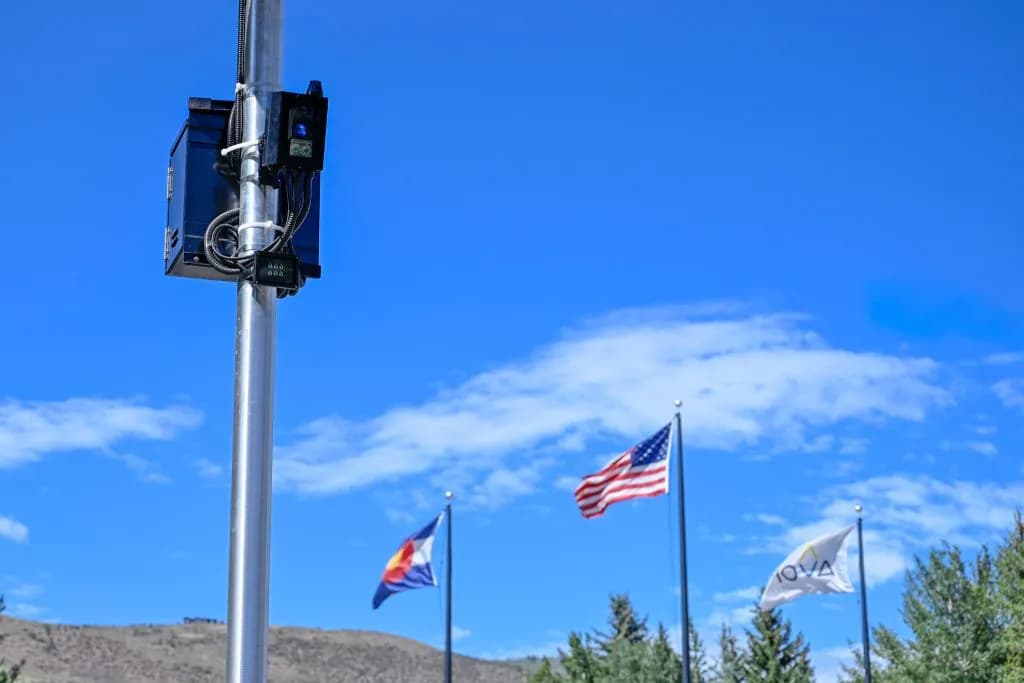
Aspen —Denver just kicked its Flock license plate recognition cameras to the curb. The city council voted 7-6 last spring to stop renewing the contract, shooing away the nationally networked system despite Mayor Mike Johnston’s personal preference to keep them.
Yet, in Vail, fewer than 5,000 residents strong, the birds are still circling.
It’s a geographic irony that feels less like coincidence and more like a policy glitch. Denver, a metro area of over 700,000 people, has moved on. Vail, a high-altitude resort town with a fraction of the population and a different set of logistical headaches, is doubling down on the exact technology Denver just abandoned.
The reason? Mike Johnston.
The current Denver mayor is a Vail native. He went to Vail Mountain School. His late father, Paul, was Vail’s mayor. In his recent reelection bid, Johnston has been busy crowing about his administration’s success in lowering crime, specifically auto thefts, which have dropped 65% since 2022. He’s touting a mix of strategies: a voluntary GPS tracking system for car owners, an undercover Auto Theft Team, and a general crackdown on repeat offenders.
Let’s look at the math on the cameras. Denver now relies on fewer than 50 closed-looped Axon cameras. They’ve traded the broad, net-casting Flock system for targeted, local recording. It’s a shift from "we know who left" to "we know who’s here right now."
Vail Police Chief Ryan Kenney isn’t buying the idea that Vail needs to follow Denver’s lead just because the mayor is from here. He argues Flock is a "force-multiplier" for intelligence gathering, not just a passive recording device.
“Flock is a combined law enforcement database for intelligence,” Kenney said in a phone interview earlier this summer.
He pointed to a specific incident from last spring to prove the point. A resident put their car on a car hauler to ship it back east. The car never arrived. Without Flock, that’s a mystery. With Flock, police tracked the car and the hauler simultaneously. They saw the vehicle move almost directly from Vail over the border. The theft was solved because the system connected the dots across a wider geographic area, not just within a single precinct.
Denver’s office argues that license plate readers are just one tool in a bigger box. They emphasize that their auto theft drop happened even without the Flock cameras, driven by the GPS decals and the undercover team. It’s a valid argument for a city where you can track a stolen Toyota Camry via an app on your phone.
But Vail isn’t Denver. The logistics of a car theft in the valley are different. The distance to the border, the reliance on haulers, and the spread of traffic make a localized, closed-loop system potentially less effective for tracking vehicles that leave town quickly.
For context, Denver’s strategy is about volume and data integration. Vail’s strategy, under Kenney, is about precision and connectivity to the wider network. If you’re stealing a car in Denver, you’re likely staying in the metro area. If you’re stealing a car in Vail, you’re trying to get it out of the valley before the owner realizes it’s gone.
The contrast is stark. Denver is betting that its new tech stack makes the old Flock network redundant. Vail is betting that the "force-multiplier" effect of a national database is still worth the cost.
The bottom line for locals is simple: Denver residents are paying for a system that tracks cars within the city limits. Vail residents are paying for a system that tracks cars leaving the county. One is a net; the other is a trap. Chief Kenney thinks the trap is still necessary. The city council needs to decide if they agree, or if they’re just following the mayor home.
Keep up with Aspen
The day's Western Slope news, one email each morning. Free.