410,000 Protesters Force Tear Gas in Paris Against Macron
Over 410,000 demonstrators flooded French streets Saturday, challenging President Macron as tear gas and water cannons erupted in Paris, Marseille, and Lyon amid fierce disputes over education funding and soaring living costs.
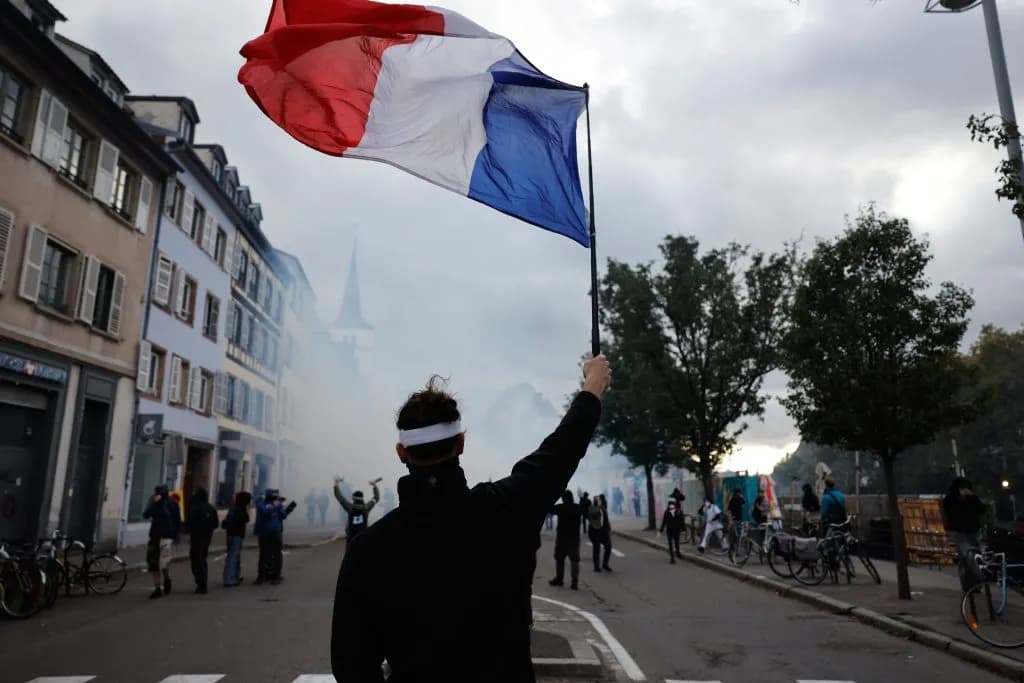
Aspen —The air in eastern Paris hangs thick with the acrid bite of tear gas, a white haze that blurs the cobblestones and turns the twilight into something hostile. Water cannons scream, a deafening roar that drowns out the megaphones of officers demanding order. It is Saturday, and the calm that held for most of the day has shattered near the march’s endpoint.
This is not a distant European drama unfolding in a foreign capital; it is a pressure cooker that has been simmering for over a month, and the lid just blew off. More than 400,000 people took to the streets across France on Saturday, a massive challenge to President Emmanuel Macron’s authority in his final months before the May election. The Interior Ministry counted 410,000 participants nationwide, a figure that includes 110,000 in Paris alone. The CGT union, which helped organize parts of the rally, claims the number was nearly 800,000. The discrepancy matters less than the reality: people are angry, and they are not going home quietly.
The unrest began as a local grievance — a staff shortage at one high school southeast of Paris — and metastasized into a national movement against soaring living costs and underfunded education. In Vail, we watch these stories from a distance, but the mechanics of how a specific workplace complaint becomes a political crisis are familiar to anyone who has ever felt ignored by local government. The stakes here, however, are national. Marine Le Pen’s National Rally party is urging citizens to channel their anger into votes for her, while far-left candidate Jean-Luc Mélenchon has backed the demonstrators, criticizing police tactics that have left some teenage protesters with life-changing injuries.
The violence on Saturday was concentrated at the edges of order. In Paris, masked protesters hurled objects and fireworks at police as the march neared its end in the city’s southeastern edge, a location authorities chose specifically to keep the crowd away from the center. Officers answered with sound grenades and jets of water. Some demonstrators panicked as canisters landed in their midst, scattering with screams while veteran protesters shouted, “Don’t run!”
It wasn't just Paris. As dusk fell, street fires burned in Marseille and Lyon. Police deployed tear gas in Clermont-Ferrand, Strasbourg, and Bordeaux, and water cannons in Nice and Nantes. In Nice, far-right extremists fought with demonstrators downtown, resulting in 11 arrests. Interior Minister Laurent Nuñez said police made nearly 1,000 arrests but noted the number is expected to increase significantly. He credited a "beefed-up" policing effort, 70,000 officers backed by helicopters and armored vehicles - with preventing a repeat of the widespread looting seen the previous weekend.
The part everyone skips past is how fragile the peace actually was. A week after rioting and looting across the country, Saturday’s march began peacefully. It stayed peaceful until it didn’t. The government is betting that a heavy police presence can contain the economic anxiety of its citizens, but the sheer scale of the turnout suggests that containment is a losing game.
In Paris, Bénédicte Pittion, a 46-year-old teacher, marched. She is one of the many educators demanding more funding for their schools and support for workers facing rising costs for fuel and necessities. Her presence, like the thousands of others, is a quiet but firm rejection of the status quo.
The sun sets over a city still smelling of smoke and chemical irritants. The police line holds, for now, but the distance between the officers and the crowd remains tense, a thin membrane separating order from chaos.
Keep up with Aspen
The day's Western Slope news, one email each morning. Free.