Aspen Firefighters Contain Kittle Blaze and Extinguish Downtown Structure
Aspen crews contained the 25-acre Kittle Fire near Ruedi Reservoir and extinguished a residential roof blaze on East Cooper Avenue, while managing airport flight restrictions amid heavy smoke.
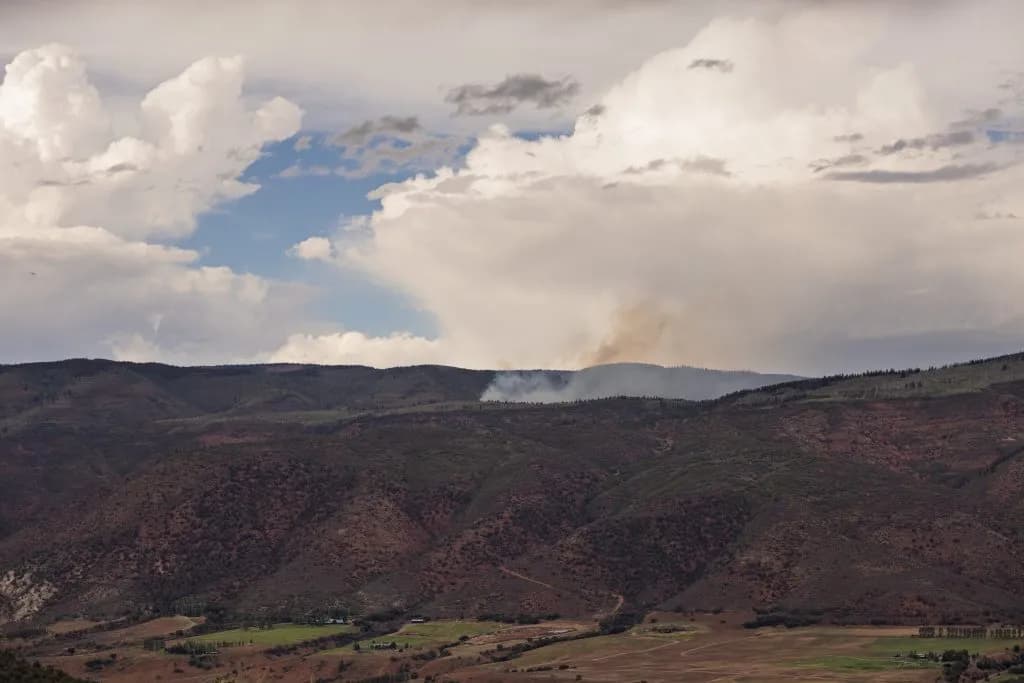
Aspen —Smoke hung low over Aspen on Thursday morning, thick enough to blur the line between the sky and the rooftops along East Cooper Avenue. Just southwest of town, near Ruedi Reservoir, a lightning-caused wildfire was holding its ground against the heat.
Firefighting crews spent the day managing two distinct but simultaneous challenges: containing a roughly 25-acre blaze known as the Kittle Fire, while simultaneously extinguishing a structure fire in downtown Aspen.
The Kittle Fire, which broke out Wednesday afternoon near the Triangle Peak area close to Lenado, had been fully encircled by retardant lines by 3 p.m. on Thursday, according to an Aspen Fire Department update. No evacuations were ordered, and no structures faced immediate threat.
The scale of the response was visible in the air. Four single-engine air tankers, a heavy-lift helicopter, and an air attack coordination plane worked above ground crews, which included four smokejumpers and four heli-rappellers.
The activity had a direct impact on local travel. A Temporary Flight Restriction was in place at the Aspen/Pitkin County Airport from 7 a.m. to 9 p.m. on Thursday.
Kelsey Petersen, Airport Communications Specialist, confirmed the restriction in an email to The Aspen Times.
“USFS is working with the airport to minimize impacts as much as possible,” Petersen wrote. “Our agencies are working closely together to keep airport operations functioning as normally as possible.”
While SkyWest had canceled all flights for the remainder of Wednesday, Thursday saw a return to normalcy for most travelers, provided they checked with their airlines. The public was also asked to refrain from calling 911 for smoke reports in the specific area of the Kittle Fire.
Meanwhile, just a few miles away, a different kind of emergency unfolded in the 800 block of East Cooper Avenue.
At approximately 3:02 a.m., police officers spotted flames on a three-story residential building and began evacuating occupants before firefighters arrived. All residents were safely evacuated with no injuries reported.
Firefighters quickly extinguished three-to-five-foot flames visible from the roof, which had partially melted a skylight serving an upper-level residence. Inside, however, there was no significant fire activity.
Sander Olson from the Aspen Fire Protection District noted that while the blaze primarily involved a stockpile of roofing construction, the exact cause remained under investigation.
The incident highlighted a critical safety gap in the building’s upper levels. Battalion Chief Charlie Curtis pointed out that crews discovered there were no smoke alarms in the top floor.
To hear them tell it, the dual fires were manageable but required careful resource allocation. The Kittle Fire’s perimeter containment allowed crews to pivot attention to the residential structure without leaving the larger wildfire unchecked.
For locals, the key takeaway was coordination. The USFS and airport authorities worked to keep flights moving, while fire crews balanced aerial support for the Kittle Fire with ground response in downtown Aspen.
As of Thursday evening, the math held up: 25 acres contained, zero structures lost in the Kittle Fire, and one roof repaired in Aspen. The question now is whether the dry conditions will allow crews to maintain these lines as temperatures rise, or if new hotspots will emerge.
Olson remains focused on the details, ensuring that as investigations into causes wrap up, the community understands what went wrong and how to prevent it.
Keep up with Aspen
The day's Western Slope news, one email each morning. Free.