Aspen Music Festival Turns Cardboard Dragon Into Opera Success
Director Paula Suozzi used cardboard props and witty narration to make Mozart’s Magic Flute work in a 2,100-seat tent. The festival closed its season with a Beethoven Ninth Symphony honoring American ideals.
Aspen —Will the 2,100-seat tent actually work for opera?
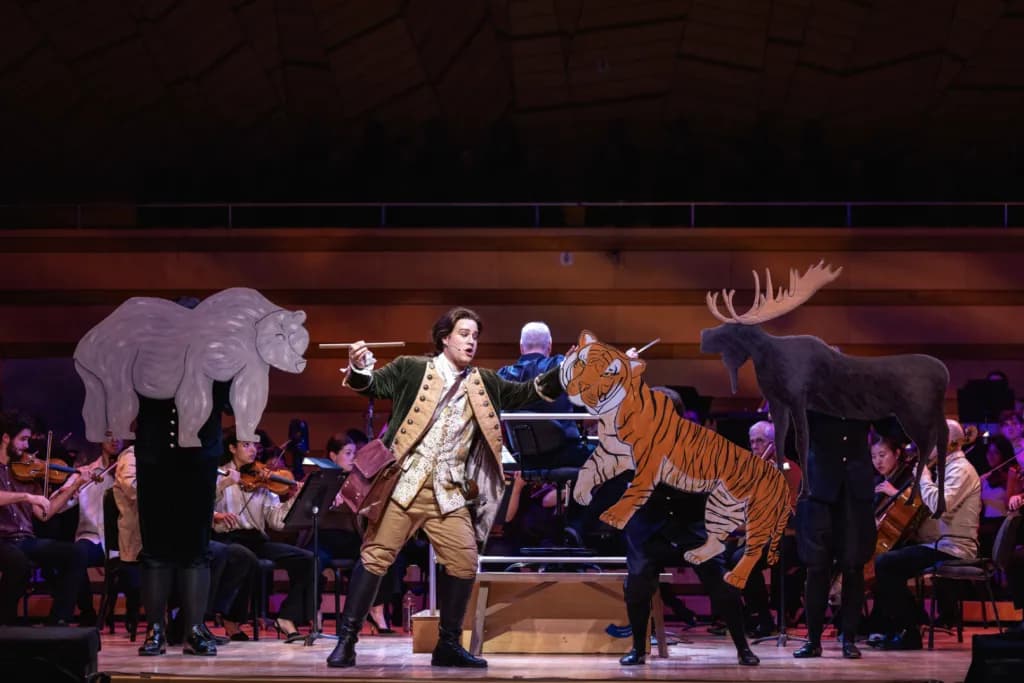
It’s a fair question to ask. You’re cramming an entire orchestra, a full cast of singers, and a dragon monster into a space not designed for stage machinery. On paper, it looks like a logistical nightmare. In practice, the Aspen Music Festival pulled it off with a production of Mozart’s The Magic Flute that turned those spatial constraints into its greatest asset.
According to the Aspen Times, director Paula Suozzi — currently the executive stage director at the Metropolitan Opera — didn’t fight the tent. She leaned into it. The production ran for two and a half hours, but because festival CEO Alan Fletcher replaced the traditional dialogue and recitative with witty narration, the momentum never dipped. There were no awkward pauses while props were wheeled in or out. The comedy landed, and the emotional core of the story stayed intact.
Let’s do the math on the production design. Suozzi didn’t have a Broadway budget or hydraulic lifts. So, everything was made of cardboard. The dragon in the opening scene? Cardboard. Tamino’s flute and Papageno’s magic bells? Those weren’t sound effects from a speaker bank; they were played by members of the orchestra sitting right there on stage. It’s a low-tech solution that kept the focus on the music rather than the spectacle. The audio design by Hank Burns-Pavlik was remarkably clear, which is critical when you’re amplifying voices in a large tent.
The cast delivered. Lyric soprano Chea Kang’s Pamina and coloratura soprano Binny-Supin Lang’s Queen of the Night hit their big arias with precision. Lyric tenor Brett Michael Hunter as Tamino and Jacob O’Shea as Papageno brought the necessary energy. Patrick Summers conducted the regular Friday Chamber Symphony with vigor, balancing an all-student cast that brought genuine pizzazz to Mozart’s score.
The Sunday Finale: A Political Statement in Music?
The following day, the festival closed its orchestral season with a program titled “For all.” The theme was explicit: celebrating the 250th anniversary of the United States’ Declaration of Independence by focusing on American composers and those who wrote music expressing ideals associated with the country.
The program opened with Verdi’s Overture to La forza del destino. The Aspen Times noted, “Make of that choice what you will with today’s politics.” It was a deliberate opening. The festival’s assistant conductor, Ken Yanagisawa, led the piece with precision, though the review noted it came up a bit short on urgency.
The main event was Beethoven’s Ninth Symphony, specifically the “Ode to Joy” movement with its calls for freedom and brotherhood. It was preceded by Leonard Bernstein’s Chichester Psalms, settings of Old Testament songs of praise. Music director Robert Spano stepped back, and David Robertson took the podium. Robertson had already produced a thrilling Brahms Symphony No. 2 on Aug. 15, so the bar was set high. The performance lived up to its promise, neatly summarizing the season’s thematic arc.
For locals, this week wasn’t just about entertainment; it was a test of the festival’s adaptability. The Magic Flute proved that you don’t need a $50 million opera house to make Mozart work. You need smart direction, clear audio, and a cast that commits to the narrative. The Beethoven finale proved that even in a polarized political climate, music can still serve as a unifying statement.
The practical impact? The festival is wrapping up its season on a high note, but the real question for next year is whether this model of low-tech, high-impact production becomes the standard. If it does, you can expect more cardboard dragons and less spectacle, but arguably better music. For now, the tent worked. The audience was there. The story told itself.
Keep up with Aspen
The day's Western Slope news, one email each morning. Free.