Basalt Adds Deer and Child Silhouettes to Stop Signs
Basalt police recorded 67 stop-sign violations in a single month, prompting the town to launch BaSTOP. The campaign adds animal and child silhouettes to signs to force drivers into a safety-conscious pause.
Aspen —"Not stopping at a sign will only save a driver seconds in getting to a final destination," Basalt Chief of Police Aaron Munch said, his words carrying the weight of frustration mixed with a plea for common sense. It’s a sentiment that resonates with anyone who has ever sat idly behind a car that rolled through a red light or, more dangerously, a stop sign in a quiet residential neighborhood.
The Aspen Times reports that the town of Basalt is rolling out a creative initiative called BaSTOP, a campaign designed to use visual art and strategic sign placement to force drivers to actually look at the signs. The urgency is backed by hard numbers: in just the last month, Basalt Police made 186 traffic stops, and 67 of those were specifically for stop-sign violations. That’s nearly 36% of all stops for a single infraction.
If you’ve driven through Basalt recently, you might have noticed something odd at intersections like E. Valley at Evans or Two Rivers at Cottonwood. New stop signs are now placed directly in the middle of the road, not just on the side. This visual restriction narrows the perceived width of the lane, creating a subtle psychological cue that tells your brain, "Slow down. Something is here."
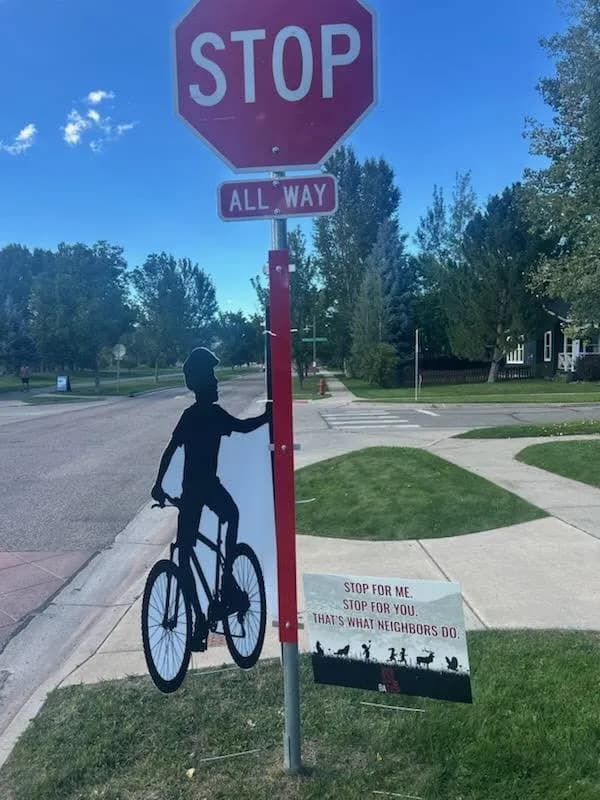
But the most striking part of the campaign isn’t the infrastructure; it’s the art. At locations like Willits at Meadow and Two Rivers at Midland, standard octagonal signs have been adorned with black silhouette cutouts. One shows a child holding a balloon. Another depicts a bicyclist. A third features a deer. These aren’t decorative flourishes. They’re warnings. The campaign’s goal, as Town Manager Gloria Kaasch-Buerger explained, is to create a "visual interruption" in the monotony of driving. When you see the silhouette of a deer on a stop sign, you don’t just see a traffic control device. You see a potential hazard. You see the wildlife that shares this valley with us.
There’s a warmth to this approach because it doesn’t just rely on fines or citations. It relies on empathy. It asks drivers to imagine who might be crossing that street. Is it a kid chasing a ball? Is it a neighbor walking their dog? Or perhaps a deer stepping off the trail?
The distinction between a "legal stop" and a "safety stop" is crucial here. Legally, you must come to a complete halt before the crosswalk. But safety requires more than just stopping; it requires checking. Looking left, right, and left again. Making eye contact with pedestrians. Ensuring the path is clear before moving forward.
As the summer sun beats down on the asphalt, making the air shimmer above the pavement, these small silhouettes stand out in sharp contrast against the white background of the signs. They are simple, stark, and impossible to ignore. In a world of constant motion, they demand a pause. A few seconds of stillness. A moment of awareness. And in those seconds, lives are saved.
Keep up with Aspen
The day's Western Slope news, one email each morning. Free.