Climbers Maintain Harvey Carter's Historic Weller Slab Route
Explore the history and technical challenge of Weller Slab's Ultra Edge route, pioneered by local legend Harvey Carter, where vintage pitons and modern bolts meet on a steep Quartz Monzonite wall.
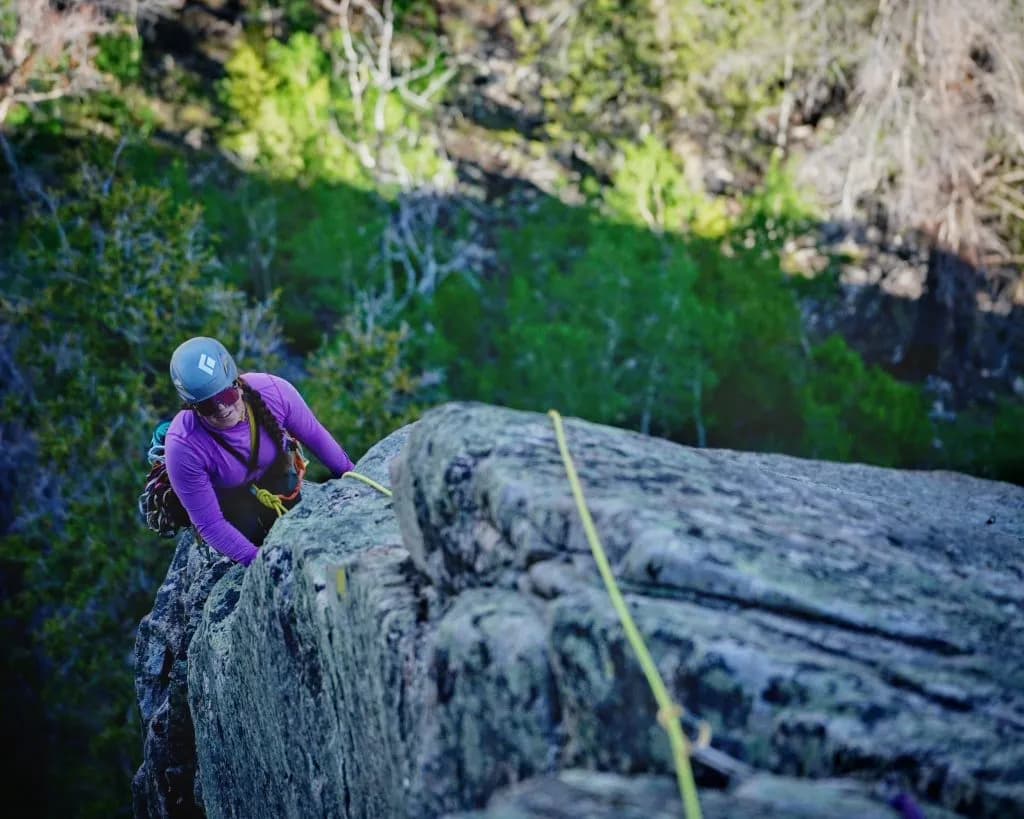
Aspen —Weller Lake sits quietly below a massive, smooth wall of Quartz Monzonite that rises 300 feet straight up. To the untrained eye, it’s just a steep rock face. To climbers, it’s a puzzle of loose stone and finger-width cracks waiting to be solved.
This is Weller Slab, visible from Highway 82, and it’s home to roughly 15 distinct climbing routes. The difficulty ranges from 5.7 — a jog for seasoned hikers — to 5.11d, which requires serious strength and precision. But the real history, and the real danger, is locked in the lines pioneered by Harvey Carter.
Carter was a prolific local climber who helped put Independence Pass on the map. He first ascended “Ultra Edge” in 1970 with Tom Merril. It’s a 5.9 R-rated route. That “R” stands for “runout,” meaning if you fall at certain points, you’re not falling a few feet onto a pad. You’re falling 30 feet or more onto loose rock. A serious injury is on the table.
Carter often climbed with pitons, metal spikes hammered into cracks and left behind. Many still litter Weller Slab. According to local climber Zala Smalls, who climbed the route on Monday, “Ultra Edge” retains two of those vintage pitons. One might support a fall. The other likely wouldn’t. They’ve been there since the early 70s, hanging in the rock like relics of a harder, slower era of climbing.
The rest of the route relies on modern bolts and traditional protection. Climbers place cams and nuts; small metal pieces that fit into cracks - themselves as they ascend. The second pitch is widely considered the best part. It features difficult moves with few holds and 30-foot sections of finger cracks. You don’t just grip the rock; you jam your fingers into cracks thin enough for only one finger. It’s a specific technique. It’s exhausting. It’s classic.
The route is split into two pitches, or rope lengths. The leader climbs partway up, anchors, and brings up the second climber. Then they repeat the process. It’s a two-stage climb, not a sprint.
For locals who drive past Weller Lake every day, this is just scenery. But for the community of climbers, it’s a living history book. Carter’s pitons are still in use. The routes are still being climbed. The risk is still real.
There’s no new development here. No new fees. No new regulations announced. Just rock, steel, and gravity. The infrastructure is the rock itself. The maintenance is done by climbers cleaning loose rock and replacing worn protection. It’s a self-sustaining system that has worked for over 50 years.
The cost to locals? Nothing, directly. The cost to the climber? Time, skill, and the potential for injury. The value? A piece of Western Slope history that’s still climbable, still challenging, and still visible from the road.
Zala Smalls cleaned some dangerous loose rock near the top of “Ultra Edge” on Monday. She didn’t just climb it; she maintained it. That’s the job. That’s the reality. The rock doesn’t care about your resume. It only cares if you place your gear correctly.
Keep up with Aspen
The day's Western Slope news, one email each morning. Free.
Aspen's ACES Returns Annual Harvest Party to Rock Bottom Ranch
Glenwood Ghostwalk Brings Frontier History to Life in Linwood Cemetery