Colorado Proposition 134 Splits State as Transgender Athlete Ban Remains Unclear
Colorado voters left Proposition 134 statistically undecided with 73% of ballots counted, leaving the fate of a statewide transgender athlete ban in gendered sports uncertain.
52.2%. That’s the number that mattered at midnight Tuesday, with 73% of Colorado ballots counted. Proposition 134, a measure that would ban transgender athletes from competing in gendered sports from kindergarten through college, was statistically too close to call. The remaining 27% of votes could easily flip the result, given that the measure only needs a simple majority to pass.
The Colorado Sun reported on the tight race, noting that the measure doesn’t just tweak a rulebook; it rewrites state law. If it passes, the General Assembly could later amend or eliminate it entirely. That distinction matters because a constitutional amendment is much harder to undo than a statutory change.
On paper, the language is specific. The measure defines “girls” as people with female reproductive organs and “boys” as those with male reproductive organs. It requires every school to classify its teams as male, female, or co-ed. A female team cannot have participants the proposition defines as male. A boys’ team cannot have female participants, unless no corresponding female team is offered for that sport. Transgender students would be permitted to play on co-ed teams, but not on the single-gender teams that align with their gender identity if it conflicts with their sex assigned at birth.
In practice, this hits every public school district in the state that receives funding. For context, this isn’t a niche debate about elite college athletics. It applies to the middle school in your town, the high school league, and any sports association with a state check.
The face of the campaign is Erin Lee, a mom in Wellington who leads Protect Kids Colorado. She said her 12-year-old daughter was invited to a gender and sexuality awareness art club at her middle school, which Lee said led her daughter to believe for about a year that she was transgender. Lee’s group raised about $300,000 for the issue committee supporting Propositions 133, 134, and 135. Donors included Athletes for Action ($100,000), the Church for All Nations, Pikes Peak Citizens for Life in Colorado Springs, and Jeff Coors of the Coors brewing family.
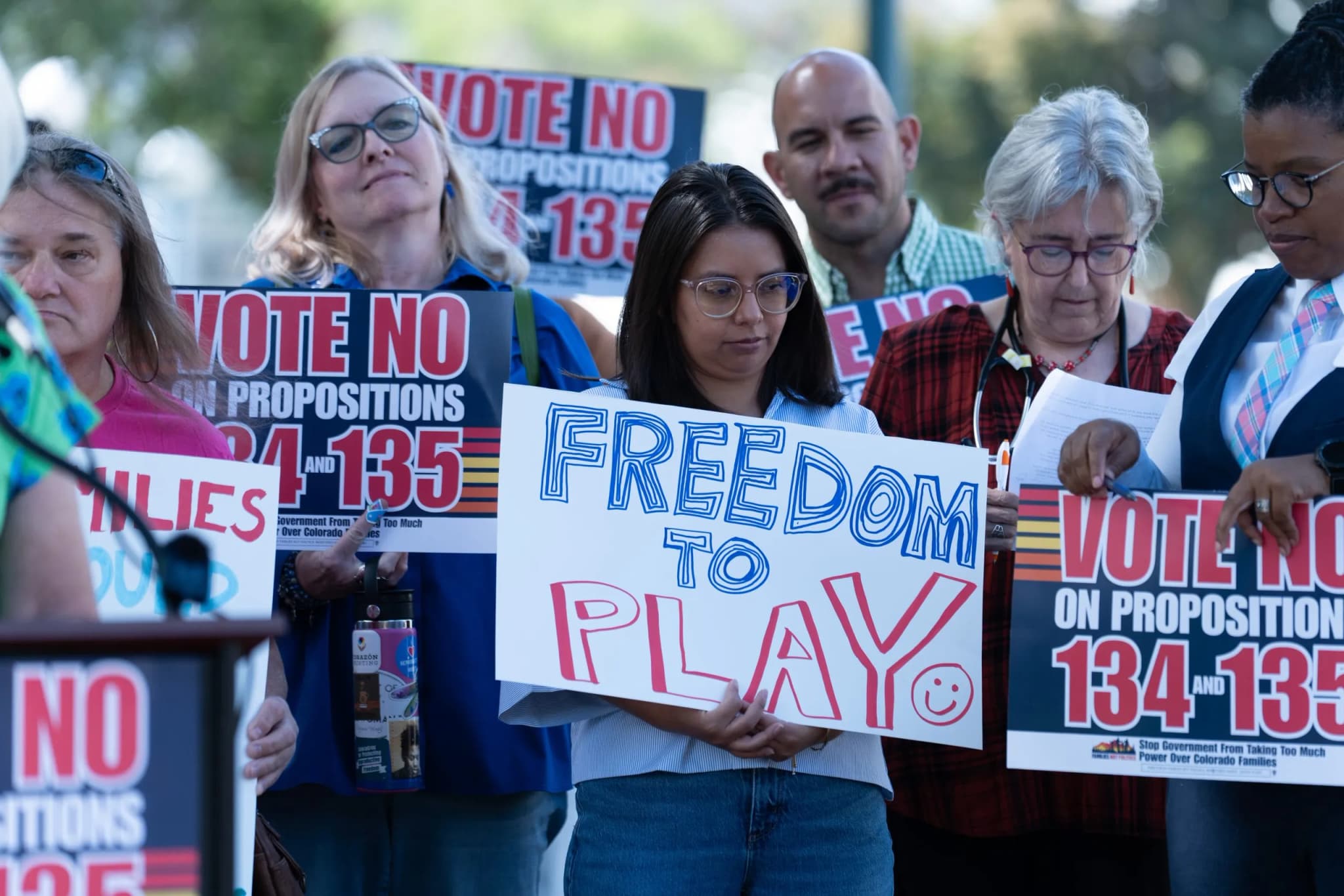
The opposition had a significantly larger war chest. Families Not Politics, the main group fighting Propositions 134 and 135, raised about $3.5 million during the election cycle. Their major donors included Planned Parenthood, Cobalt Advocates, and the ACLU. Other groups opposing the measure included Hands Off Colorado, One Colorado, and Bread and Roses Legal Center. They argued the law would lead to genital checks of student-athletes, triggered by complaints that an athlete on a girls’ team is stronger, faster, or has masculine features.
Proposition 134 was one of three measures on the ballot from Protect Kids Colorado. Proposition 135 would ban surgeries that change sex characteristics for minors, and Proposition 133 would increase the punishment for child sex trafficking to life imprisonment.
Let’s do the math on the local impact. If Proposition 134 passes, every school district in Colorado must adopt a policy classifying its teams. That’s an administrative burden on top of existing athletic department work. For a small district in the valley, that means hiring or training staff to enforce binary definitions based on reproductive organs rather than gender identity. For a larger district, it means potential legal challenges and the cost of defending them in court.
The measure doesn’t just affect high school varsity teams. It reaches down to kindergarten. A child assigned male at birth who identifies as female would be required to play on a boys’ team or a co-ed team, not a girls’ team. The reverse applies for children assigned female at birth who identify as male.
The practical bottom line is that this changes the rules of participation for every student-athlete in a state-funded program. It doesn’t just ban transgender athletes; it redefines eligibility based on anatomy for all students, regardless of their identity. If the measure passes, local athletic directors will have to implement these classifications immediately, likely before the next school year. If it fails, the status quo remains, and the legislature can revisit the issue in a future session. The tight margin means the final count will determine whether thousands of students across Colorado’s public schools see a change in how they are allowed to compete.
Keep up with the Western Slope
The day's Western Slope news, one email each morning. Free.