Colorado Rail District Puts $2.7B Pueblo Line to November Vote
Colorado voters in 13 counties will decide in November whether to approve a 33-cent sales tax hike to fund the $2.7 billion expansion of passenger rail service from Denver to Pueblo.
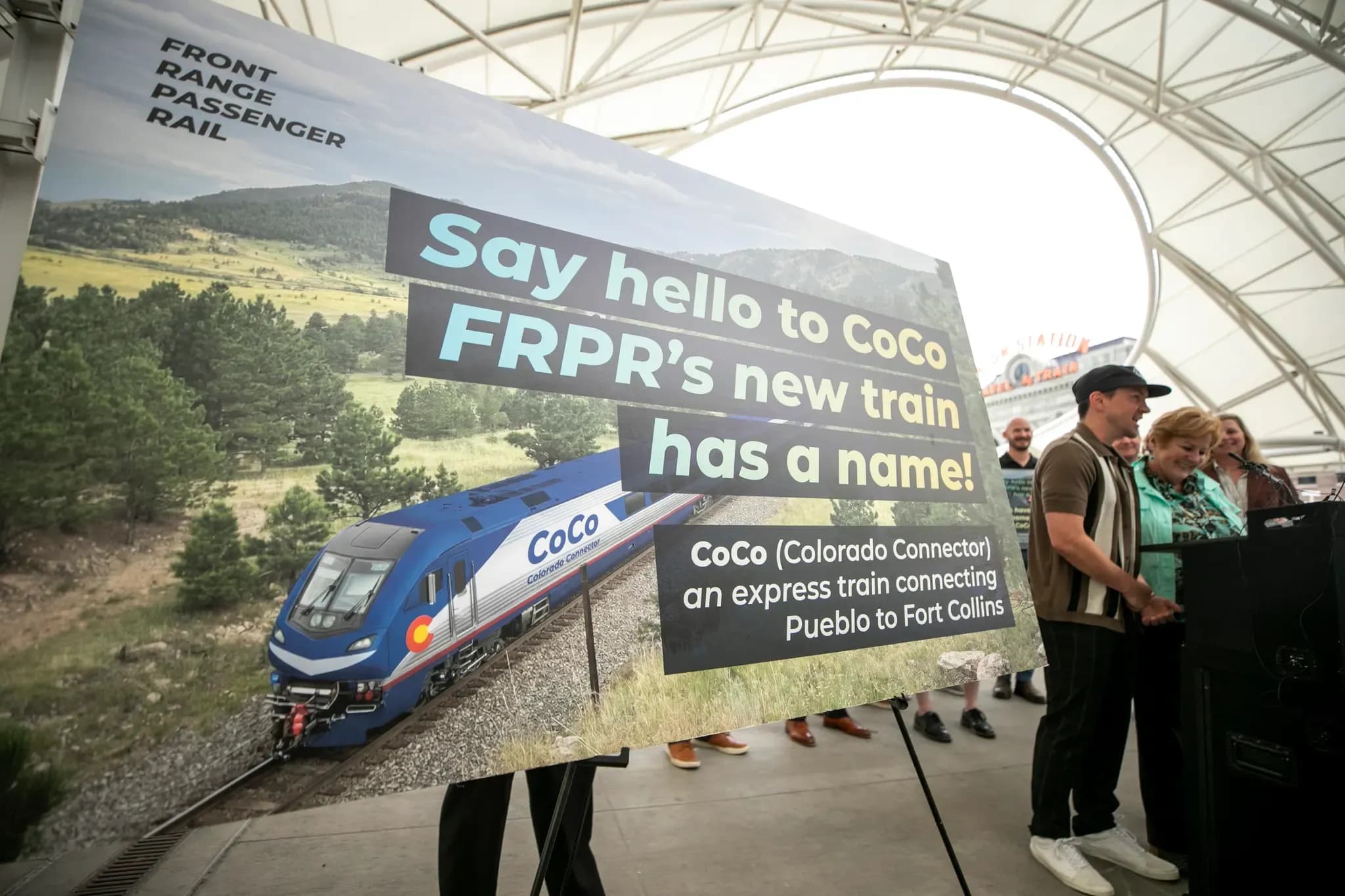
The Front Range Passenger Rail District tells Colorado residents it already has enough money to launch a passenger rail service by 2029, running three round trips daily between Denver and Fort Collins.
But in November, voters across the corridor will decide whether to add a 33-cent sales tax increase on every $100 spent to expand that service further, adding more trips and extending the line south to Pueblo.
The Colorado Sun reported on how Measure 7A works, who supports it, and where the tax would apply.
The measure asks 2.4 million voters in roughly 30 communities across 13 counties to approve a 0.333% increase in the sales tax, on top of existing state and local sales taxes they already pay. The district projects this would generate $295 million annually in new revenue. It also seeks permission to issue $580 million in bonds.
Measure 7A will appear only on ballots within the district’s boundaries. The district includes municipalities and special districts where at least 20% of the population lives within five miles of a planned station. That list includes Pueblo, Colorado Springs, Sterling Ranch, Littleton, Denver, Westminster, Broomfield, Louisville, Boulder, Longmont, Loveland, and Fort Collins.
The district says the initial $332 million phase will be funded by a state transportation innovation fund and RTD money reserved for FasTracks rail lines north of Denver that were never built. The state and RTD would share operational costs, estimated at $30 million to $36 million per year for that limited phase.
The full expansion to Colorado Springs and Pueblo, branded as the Colorado Connector or CoCo, would cost $2.7 billion and take five years to complete if Measure 7A passes. That fully funded system would offer more frequent service along the entire route, with annual operating costs between $85 million and $116 million.
The part everyone skips past is the geography of this vote. It’s not a statewide measure. If you live in Grand Junction, you won’t see it on your ballot. But if your commute takes you through Denver or Boulder, or if your property taxes are already funding RTD expansions that never materialized, this is the vote that determines whether those funds stay locked in a limited corridor or unlock a full spine of passenger rail from Pueblo to Fort Collins.
And that matters because the $295 million in projected annual revenue isn’t just for trains. It’s the financial engine that would allow the district to issue those $580 million in bonds, effectively leveraging future tax revenue to build infrastructure now. The district argues the state and RTD are already on the hook for the initial phase, so this tax is purely for expansion. Critics, as reported by the Colorado Sun, question whether a 33-cent tax hike is the right price for service that may not fully materialize until 2034.
The district’s own language is careful. It says it has “sufficient funds” for the 2029 launch, not that the project is fully funded. The distinction is real. Three round trips a day between Denver and Fort Collins is a start, not a system. The jump to Pueblo requires new money, and that new money comes from your next grocery run, your next gas fill-up, your next coffee.
Stand there long enough and you realize the ballot question isn’t really about trains. It’s about whether voters in 13 counties are willing to accept a permanent tax increase for infrastructure that the state has already partially promised but never delivered. The $332 million phase is funded. The $2.7 billion expansion isn’t. And the difference between those two numbers is 33 cents on every $100 you spend.
The Colorado Sun noted that the district includes communities where at least 20% of residents live within five miles of a planned station. That’s a low bar for inclusion, and it means the tax will apply to people who may never board a train but whose spending habits will fund one. The district didn’t say that explicitly, but the math implies it.
Voters in the region will cast their ballots in November. The district says the initial service launches by 2029 regardless of the vote’s outcome. What changes with a “yes” is the scale, the frequency, and the southern terminus at Pueblo. What doesn’t change is the fact that this is a regional decision with regional consequences, and the only people who get to vote on it are those who live inside its lines.
Keep up with the Western Slope
The day's Western Slope news, one email each morning. Free.