Colorado Wolf Map Confirms Pack Stability Across Western Slope
Colorado Parks and Wildlife data confirms 45 wolves remain stable across Western Slope counties, with new activity noted in southern watersheds near tribal lands.
Aspen —The wind off the Continental Divide cuts through the jacket lining, carrying the dry, pine-scented chill that defines late autumn on the high plains. It’s a quiet kind of cold, the sort that settles into the bones before the sun even clears the ridgeline. But beneath that stillness, something else is moving. Something with teeth.
Have you wondered if the wolves are still there?
That’s the question that keeps coming up at the coffee shop in Steamboat, in the back rooms of the galleries in Aspen, and in the truck stops along I-70. After months of speculation, after the maps went blank and the headlines turned anxious, folks around here wanted to know if the animals had simply vanished into the whiteout of winter. The answer, it turns out, is yes. They’re still here. And they’re staying put.
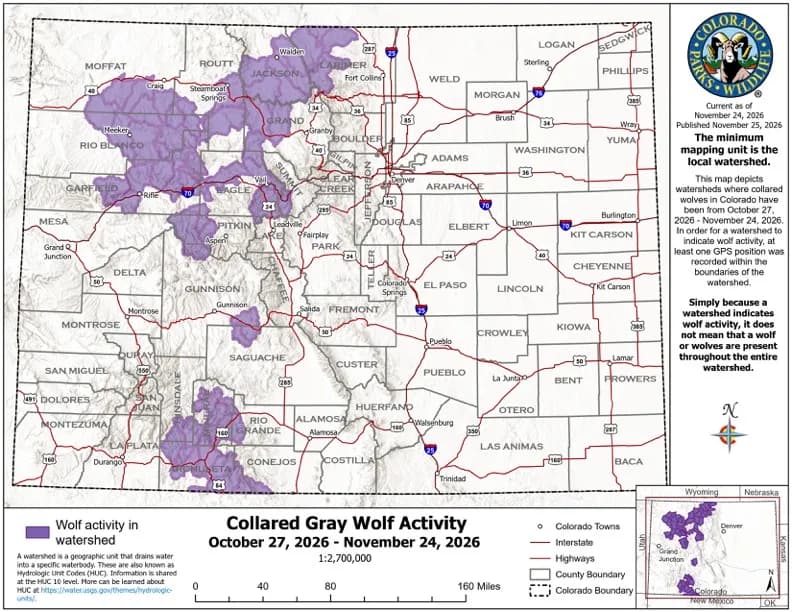
According to the latest gray wolf activity map released by Colorado Parks and Wildlife, the state’s collared wolves maintained a tight footprint in familiar Western Slope watersheds between October 27 and November 24. The data shows activity persisting mostly in the northwestern reaches of the state, spanning portions of Pitkin, Garfield, Eagle, Summit, Grand, Routt, Moffat, Jackson, and Larimer counties. These are the same regions that align with the territories of Colorado’s known wolf packs. If you look closely at the map, the clusters of GPS points hug the valleys, following the water sources that the animals rely on for survival. There’s a warmth to seeing those dots reappear in the same places month after month; it suggests stability in a landscape that is otherwise prone to sudden shifts.
But the story doesn’t stop at the northern boundary. Additional activity was flagged during the month in watersheds further south, including Gunnison and Saguache counties, as well as portions of Mineral, Rio Grande, Archuleta, and Conejos counties. This southern reach brushes up against the Colorado-New Mexico border and touches Southern Ute tribal lands. That proximity matters. The agency has an agreement with the Southern Ute Indian Tribe, as well as a separate one with the Ute Mountain Ute Tribe, that guides the management of gray wolves on the tribe’s lands. These agreements formalize that the two federally recognized tribes have sovereignty to manage the species within their reservations, subject to the federal protections under the Endangered Species Act and the special 10(j) rule issued by the U.S. Fish and Wildlife Service. For locals, this means the wolves aren’t just roaming freely; they’re navigating a complex web of jurisdictional lines that can determine whether an animal is protected, managed, or even culled.
One detail stands out because of what it implies about the limitations of the tracking technology. The November map does not show activity brushing up against the Utah border, despite the department announcing that one of its collared, reintroduced wolves died in Utah on November 7. That death marks the ninth Colorado wolf to die this year and is currently under investigation by the U.S. Fish and Wildlife Service in coordination with state wildlife agencies. Why is the wolf absent from the map near the border? It’s likely a function of how the data is received. GPS points are recorded roughly every four hours, and wolves can travel large distances in short periods of time. So, a gap in the highlighted areas doesn’t necessarily mean the wolves were stationary; it might just mean the collar didn’t transmit a signal during that specific window. This nuance is important. It prevents us from over-interpreting the silence on the map as absence.
The population count provides context for these movements. On September 24, the agency reported that there were around 45 wolves in the state. About half of these animals are collared and tracked via the monthly map. Twenty of these wolves are pups born this spring to the state’s four reproducing packs: the Piney Ridge Pack in Eagle County, the One Ear Pack in Jackson County, and two others whose territories overlap with the areas highlighted on the November map. The presence of these young animals suggests that the packs are not just surviving; they are growing. That growth puts pressure on the resources available in these watersheds, which is why the animals stay close to the streams and rivers.
So, are they staying? Based on the November data, yes. The wolves are maintaining their foothold in the watersheds where they’ve been established. They’re not migrating en masse to new territory; they’re holding their ground. That consistency is reassuring for those who have watched the maps evolve over the past few months. It tells us that the ecosystem is adjusting to their presence, and the animals are finding a rhythm that works for them.
As the temperature drops and the snow begins to accumulate on the peaks, the wolves will continue to move through these landscapes, guided by instinct and the need for food. Their collars will keep sending signals back to the state, creating a digital trail that mirrors their physical journey. Whether they’re hunting elk in the meadows of Pitkin County or resting in the caves of the San Juan Mountains, they are part of the fabric of this place now.
You can feel it when you stand on the ridge at dusk, listening to the wind. There’s a hush in the air, a sense of anticipation. Somewhere down in the valley, a pack is gathering. The alpha is calling, a low, resonant bark that echoes off the rock faces. The response comes quickly, a chorus of voices rising into the twilight. It’s a sound that has been heard on this land for millennia, long before humans drew lines on maps to divide it. Now, those lines matter less than the water running through the creek beds. The wolves follow the water. They always have.
The final image is simple: a single paw print in the fresh snow, crisp and defined, leading away from the viewer toward the darkening trees. No other tracks nearby. Just that one mark, pressing into the white surface, disappearing into the shadow of the forest. It’s a small detail, easily overlooked. But it’s enough. It proves they were here. It proves they’re still here. And for now, that’s all anyone needs to know.
Keep up with Aspen
The day's Western Slope news, one email each morning. Free.