How Urban Noise Forces Local Birds to Change Pitch
Urban development and concrete reflectivity disrupt natural sound waves, forcing local birds like the great horned owl and Western Meadowlark to alter their pitch and volume to be heard.
Aspen —The great horned owl doesn’t shout. It doesn’t need to. It leans into the deep, slow hoo of its call, a low-frequency sound wave long enough to slip around tree trunks and through dense leaf canopies, traveling over half a mile to find a mate or defend territory. That’s the physics of the forest. High-pitched sounds get blocked by twigs. Low ones move through obstacles. It’s a natural acoustic engineering that has played out over generations.
But then you hit the city.
Concrete and glass don’t absorb sound; they reflect it. They create harsh echoes that interrupt the signal. Add in the constant low-frequency rumble of traffic and human life, and you’ve got a wall of noise. A recent study in Vienna found that urban blackbirds have to sing 2.5 decibels louder than their forest-dwelling cousins just to be heard. When looking at their most common pitches, that difference doubles to 6 decibels — a volume increase of almost 10 percent.
That’s not just a tweak. That’s a struggle.
Here’s the thing though: this isn’t just about noise. It’s about how the landscape itself writes the music.
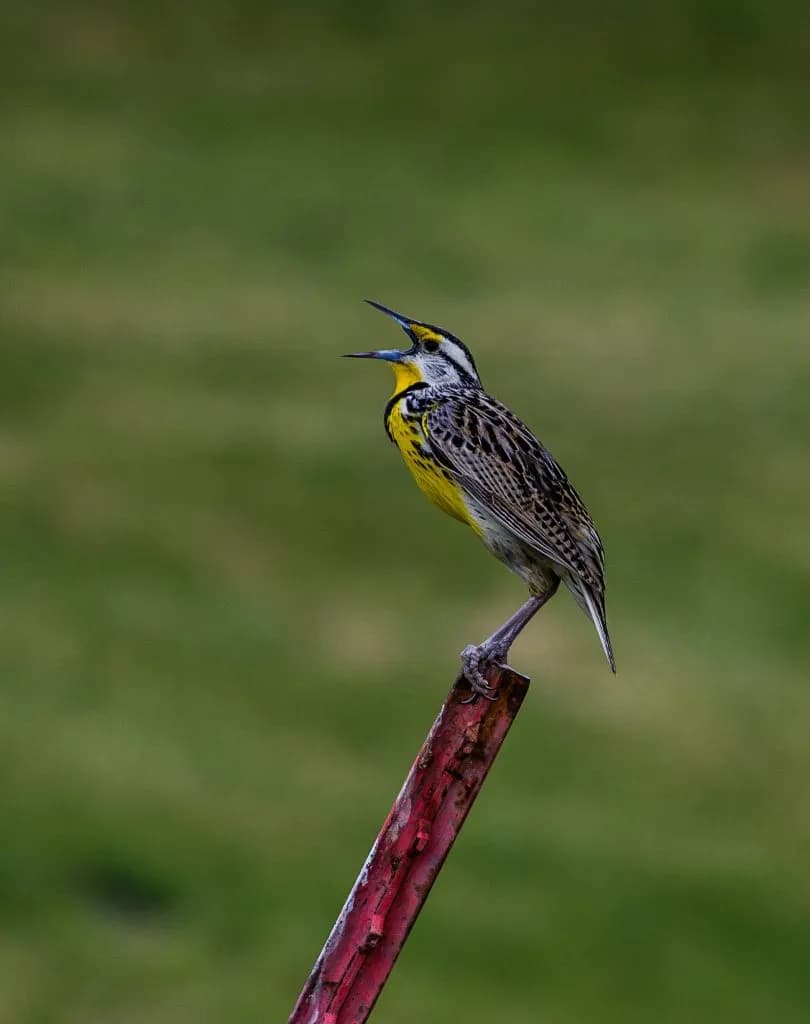
Picture a Western Meadowlark in an open grassland. Fewer trees. Fewer trunks to block the way. High-pitched sounds cut straight across the field. They’re precise. They carry more information. So the meadowlark packs its calls with quick notes and intricate shifts in pitch, knowing the message won’t get tangled in leaves. It’s a different language, born from a different environment.
Locals know this. You hear it when you’re out on the trail near Delta or driving down Highway 92. The birds aren’t just singing because it’s spring. They’re singing because the land tells them to.
Take the northern flicker, the hairy woodpecker, the downy woodpecker. These are your local residents. They don’t just peck; they drum on snags — hollowed-out trees. Those hollow bodies act as amplifiers. They transmit messages long distances, using the landscape as an instrument. It’s a strategy refined over millennia.
Now, look at what we’re doing.
Human development reshapes the landscape. We replace soft, absorptive leaves with reflective concrete. We introduce artificial architecture that disrupts these well-established strategies. The obstacles change. The sound changes.
And the birds? They adapt. Or they don’t.
The source material notes that birds that have spent mill... (the text cuts off there, but the implication is clear: they’ve spent millennia adapting to natural acoustics, and now they’re scrambling to adjust to ours).
It’s not just about volume. It’s about distortion. It’s about whether your signal gets through or gets lost in the echo.
Think about your own commute. You’re driving down a road lined with new subdivisions. The trees are young. The lots are smaller. The noise from the houses blends with the traffic. The birds up there? They’re working harder. They’re singing louder. They’re changing their pitch. They’re adapting to the new landscape we’ve built.
It’s a quiet crisis. No sirens. No press conferences. Just birds trying to be heard over the hum of our lives.
The great horned owl still calls from the dense forests. The Western Meadowlark still sings its intricate song across the open prairie. But in the spaces between, in the suburbs, in the towns, in the places where the forest meets the pavement; the music is changing. The landscape is changing. And the birds are paying the price.
It’s not a tragedy yet. It’s a fact. Sound waves interact with their surroundings. High pitches get blocked. Low pitches travel far. But when the surroundings change, the pitch has to change too.
That’s the curious nature of it. We think of birdsong as just noise. Background chatter. But it’s a message. A precise, calculated message. And we’re making it harder to send.
Keep up with Aspen
The day's Western Slope news, one email each morning. Free.