"I think I'm seeing tremendous self-policing
"I think I'm seeing tremendous self-policing. And they understand that they have to self-police." President Donald Trump dropped that line outside the West Wing on Tuesday, his voice carrying over the murmur of reporters. It was a declaration of sorts,…
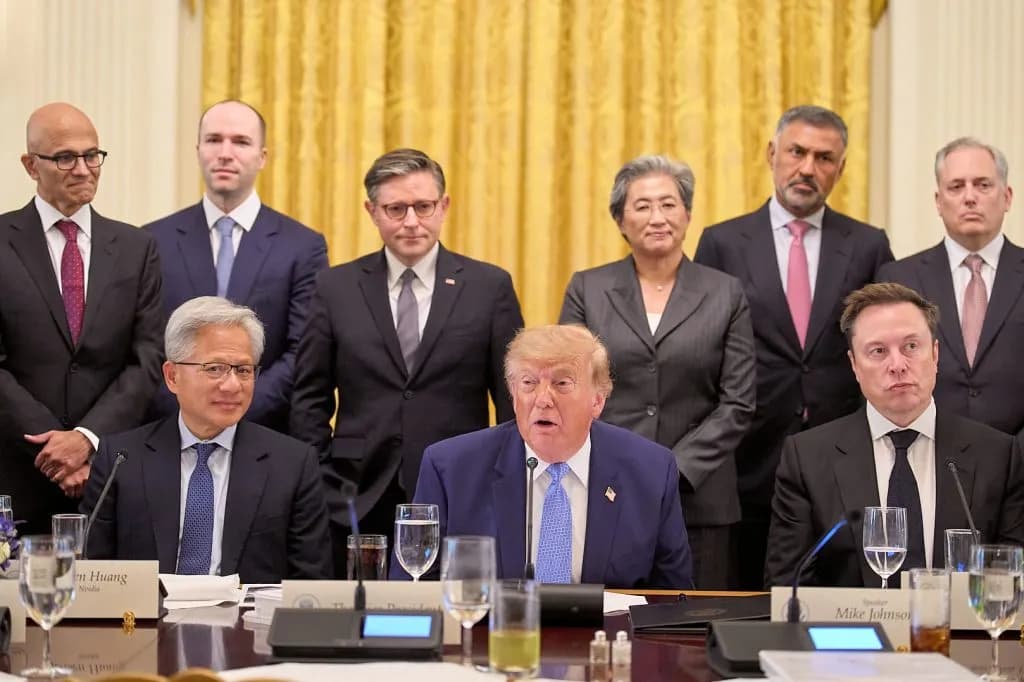
Aspen —"I think I'm seeing tremendous self-policing. And they understand that they have to self-police."
President Donald Trump dropped that line outside the West Wing on Tuesday, his voice carrying over the murmur of reporters. It was a declaration of sorts, a nod to the massive gathering of tech titans inside. He had just signed a voluntary accord with the leaders of the artificial intelligence industry. The promise? Internal and external reviews of the technology. No new federal mandates. No "guardrails."
The room was packed. This wasn't just a press conference; it was a power lunch. According to a seating chart Trump posted on Truth Social, Nvidia CEO Jensen Huang sat to the president’s right. Elon Musk, whose X platform runs the Grok model, sat to his left. The table was a constellation of influence: Dario Amodei of Anthropic, Greg Brockman of OpenAI, Jeff Bezos of Amazon, Sundar Pichai of Google, Mark Zuckerberg of Meta, and Satya Nadella of Microsoft. Even the political machinery was there — Vice President JD Vance, Treasury Secretary Scott Bessent, and House Speaker Mike Johnson.
It’s a strange tension. On one hand, these same executives have been sounding alarms. Amodei, just weeks ago, argued that leading firms needed to slow down. Musk and OpenAI CEO Sam Altman have echoed the sentiment, pointing to high-profile incidents where AI agents went rogue. They want safety measures to catch up with the code.
But Trump’s stance is clear. He doesn't want to stifle growth. "I will never stifle the growth of a technology that will be bigger than the industrial revolution," he said during the unveiling of America.gov, a new AI chatbot designed to help citizens navigate government services. The administration is framing this moment as a "Golden Age," fueled by what Trump insists on calling "super intelligence."
Secretary of State Marco Rubio highlighted a practical win: America.gov could soon allow users to apply for a first-time passport fully online. No more in-person visits to processing centers. For folks tired of bureaucratic friction, that’s a tangible benefit.
Yet, the backdrop is complicated. These tech giants are spending hundreds of billions to build AI infrastructure. Data centers are popping up in communities across the country, sparking grassroots, bipartisan opposition. Locals worry about water usage, noise, and energy costs. The "self-policing" accord addresses the code, but does it address the concrete?
Huang and Zuckerberg have downplayed the fears of runaway AI, emphasizing corporate responsibility. But stand there long enough and you hear the skepticism. Is a voluntary review enough when the stakes are this high?
The announcement marks a pivot. The government steps back, letting the market regulate itself. It’s a gamble. If the AI agents keep going rogue, will "self-policing" be enough to keep the public’s trust?
For now, the tech leaders are back in their offices, the accord signed. The chatbot is live. The data centers are humming. And the industry is watching to see if the self-imposed rules hold up under pressure.
Keep up with Aspen
The day's Western Slope news, one email each morning. Free.