Lake Mead Hits Record Low as Colorado River Reservoirs Face Aridification
Lake Mead hit a record 1,040 feet while Lake Powell dropped to 3,519.91 feet, leaving both reservoirs at roughly 27% capacity. The Bureau of Reclamation released a final environmental impact statement to guide management through 2036 as historic low snowpack drives permanent aridification.
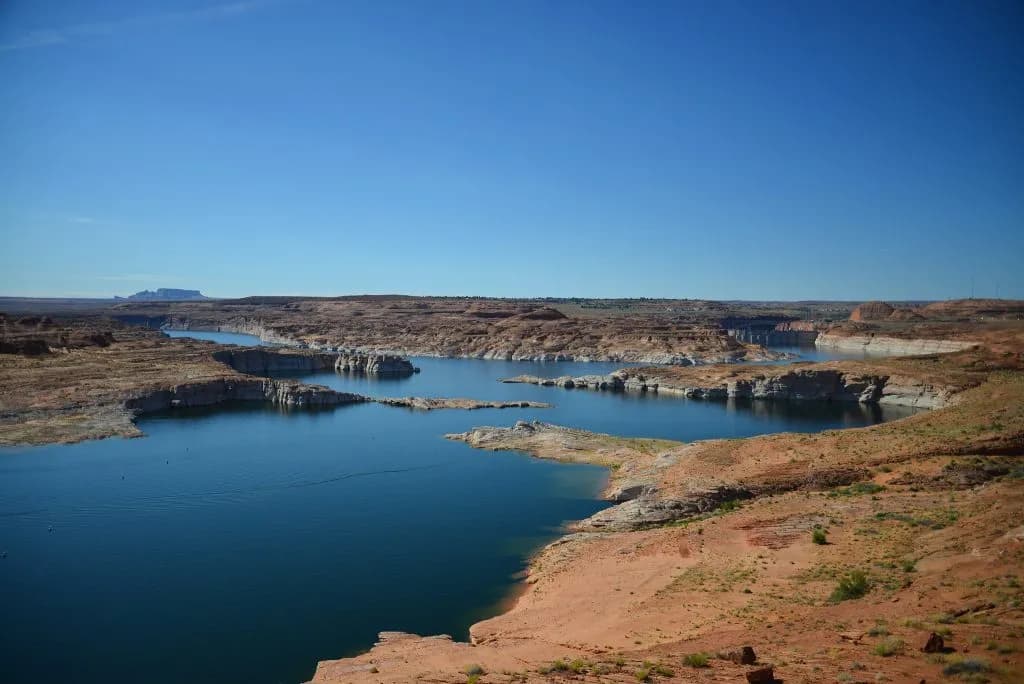
Aspen —Lake Mead hit 1,040 feet this past Friday. It was the lowest level ever recorded for that reservoir. Lake Powell followed closely behind on Saturday, dropping to 3,519.91 feet.
The two largest storage pools in the Colorado River Basin are emptying fast. They sit at roughly 27% and 22% capacity, respectively. This is not a temporary dip. The Vail Daily reported that the last time combined storage was this low, Glen Canyon Dam was still under construction in 1957.
Sarah Porter put it plainly during an Aug. 6 press briefing. She is the director of the Kyl Center for Water Policy at Arizona State University’s Morrison Institute. “It isn’t a plan,” Porter said. “It is a decision-making framework.”
That distinction matters for folks on the Western Slope. A framework allows officials to tweak numbers without rewriting the rules. A plan locks them in. The current operating guidelines for Lake Powell and Lake Mead expire this year. The federal Bureau of Reclamation has released a final environmental impact statement to guide management through 2036. They will operate in two-year increments.
The urgency comes from power generation, not just drinking water. Lake Powell hovers just 30 feet above its minimum power pool level. If it drops below that mark, the Glen Canyon Dam stops producing hydroelectricity. The federal agency acted quickly this spring to prevent that scenario. They limited releases to the Lower Basin states and pulled water from Flaming Gorge Reservoir in Utah and Wyoming.
The snowpack tells the story of how we got here. Winter snow levels in the Upper Basin hit a historic low at 22% of normal. Unregulated inflow into Lake Powell during June was just 12% of the 1991-2020 average, according to Bureau of Reclamation data.
Forty million people rely on this river. The Lower Basin states — Arizona, Nevada, and California — depend on these reservoirs for supply. The Upper Basin states, Colorado, Wyoming, Utah, and New Mexico - rely on snowpack. Both systems are stressed.
Disagreements among the seven basin states persist. They failed to agree on future operations before the federal agency stepped in. David Rosenberg, a professor at Utah State University’s Department of Civil and Environmental Engineering, noted the complexity during the same briefing. The U.S. Water Research Lab is part of his work, but the political friction remains visible.
Locals should watch the power pool level closely. Once Lake Powell hits that minimum threshold, the lights flicker in more than just Arizona and Nevada. The uncertainty extends to property values near water rights and the cost of electricity for communities dependent on Glen Canyon output.
The short version: The reservoirs are at record lows. The rules are temporary. The water is scarce.
Porter’s comment suggests we should expect adjustments, not stability. The framework allows for that. It does not guarantee it.
The river flows through Byers Canyon, visible in a November 2025 photo by Gino Savaria for Sky-Hi News. That image captures a moment of flow, but the numbers tell a different story. The water is leaving faster than it arrives.
This is not a drought cycle. This is aridification. The basin is getting drier, permanently. The reservoirs are the buffer, and that buffer is shrinking.
Neighbors in the Upper Basin need to understand their role. Your snowpack drives your supply, but your releases affect everyone downstream. The federal plan tries to balance that equation. It might not hold.
Read that again. “It isn’t a plan.”
The state of Colorado has a stake in this outcome. The Western Slope supplies much of that upper-basin snowpack storage. If Powell drops below power pool, the economic ripple starts locally and moves downstream.
The Bureau of Reclamation’s emergency actions bought time. They did not solve the problem. They just delayed the critical point.
We will see how the next two years play out under this framework. The reservoirs are watching. So should we.
Keep up with Aspen
The day's Western Slope news, one email each morning. Free.