Route 66 Centennial Celebrated at Santa Monica Pier
Explore how Route 66's shifting western terminus at Santa Monica Pier mirrors local community spirit, celebrating the highway's 100th anniversary with insights on adaptation and travel.
Aspen —There is a specific, dusty heat that clings to the memory of a road trip, the kind that settles into the upholstery of a car and refuses to leave until you’ve driven long enough to wash it off with wind. It’s a sensory anchor, a reminder that movement itself has weight and texture. But when we talk about Route 66’s centennial this year, we often get lost in the nostalgia of the "Mother Road" as a singular, linear myth, a straight shot from Chicago to Santa Monica that ignores the messy, shifting reality of how a highway actually becomes a cultural artery. The common assumption is that the end of the line is fixed, a final destination marked by a sign and a sunset. That assumption is wrong, and it’s precisely why the story of Route 66’s terminus in California is so much more compelling — and so much more relevant to us here on the Western Slope — than a simple travel guide suggests.
The geography of the road’s end has been in flux, a reflection of how communities claim and reclaim their place in history. While Chicago has always held its ground at the eastern start, the western terminus has bounced around like a loose ball bearing. It began at 7th Street and Broadway in Los Angeles, then stretched 13 miles west to Santa Monica in 1936 to hook up with Route 101 and the Pacific Coast Highway. Then, in a twist that feels like bureaucratic whiplash, it was shortened to Pasadena in 1964, only to be truncated again in Needles before Santa Monica Pier reasserted its dominance as the official endpoint. This isn't just trivia; it’s a reflection of how infrastructure evolves, how it serves the people who drive it, and how those people decide what matters enough to preserve.
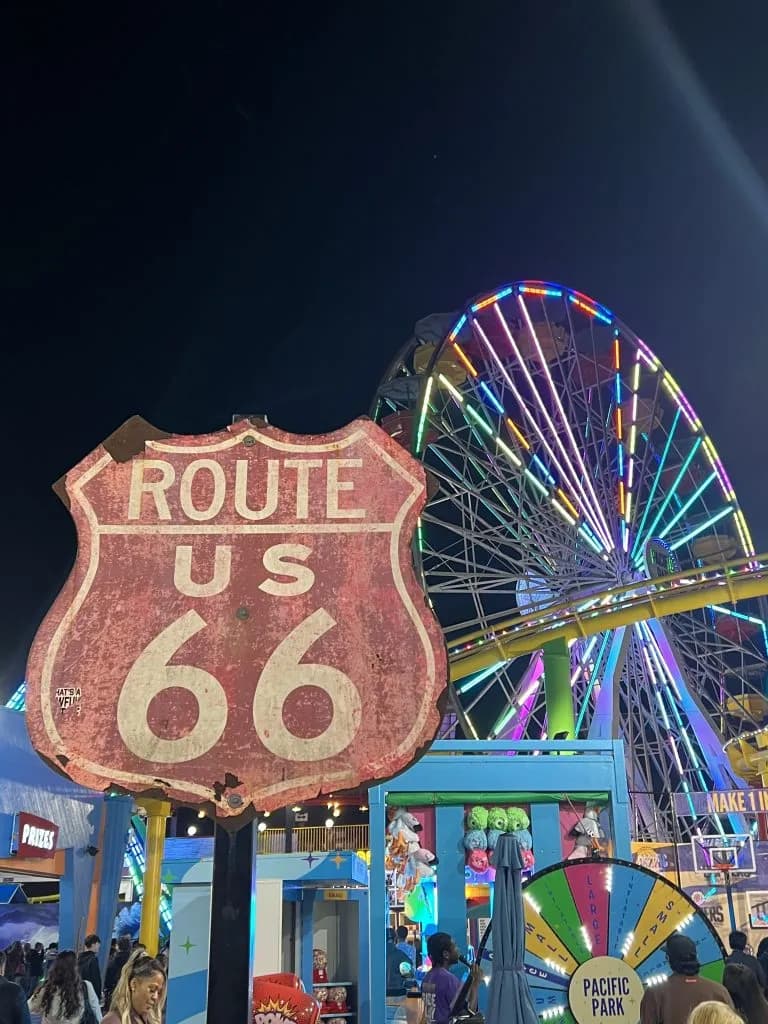
If you look closely at the modern experience of that Santa Monica endpoint, you’ll find a mirror of the carnival energy that draws locals to Rio Grande Park this Fourth of July. The article describes a permanent amusement park that rivals Aspen’s temporary rides, complete with a 130-foot solar-powered Ferris wheel that glows with 174,000 LED lights. It’s a stark contrast to the quiet, mountain-bound evenings we’re used to, yet the desire for that kind of communal spectacle is universal. The $45 wristband for unlimited rides, including the Pacific Plunge and the Shark Frenzy, offers a different kind of value proposition than a day pass at a local park, but the impulse is the same: to let go, if only for a few hours, in the name of fun.
And then there’s the food, the universal language of travel. The text notes the "last place to grab a burger on land" at Pier Burger, a fresh ono burger for under $12. It’s a small detail, but it grounds the grandeur of the highway in the everyday. We think of Route 66 as a historical artifact, but it’s also a lineage of fast food and roadside diners. The original McDonald’s, opened by Dick and Mac McDonald in 1937 in Monrovia before moving to San Bernardino, is part of this tour. It’s a reminder that the icons we cherish are often just small businesses that got lucky, or maybe just got big, in a specific place at a specific time.
Why does this matter to us, neighbors who might be planning a drive up I-70 or just dreaming of a weekend escape? Because the story of the Mother Road is a story about adaptation. It’s about how a road changes, how its endpoints shift, and how we, as travelers, decide what to celebrate. The 100th anniversary of the highway isn't just about looking back at a faded map; it’s about recognizing that the road is still being written, that the "end" is always just a new beginning for someone else. As the sun sets over the Santa Monica Pier, casting long shadows across the sand, the light hits the solar-powered wheel, turning it into a beacon. It’s a quiet, glowing reminder that history isn’t static. It moves. It shifts. And it’s always, always just beyond your backyard, waiting for you to drive out and see it for yourself.
Keep up with Aspen
The day's Western Slope news, one email each morning. Free.
Aspen's ACES Returns Annual Harvest Party to Rock Bottom Ranch
Glenwood Ghostwalk Brings Frontier History to Life in Linwood Cemetery