1986 Minturn Earthflows Report Warns of $1.7B Dowd Canyon Mudslide Risk
A look back at the 1986 Minturn Earthflows Task Force report which warned that Dowd Canyon mudslides could kill 3,100 people and cause $1.7 billion in damages, highlighting ongoing geological risks in Eagle County.
Aspen —The wind off the Eagle River still carries that specific, damp chill in late May, the kind that seeps into your boots and reminds you that the snowpack isn’t gone so much as it’s melting into the ground. It’s the same time of year it was forty years ago, when the valley floor was saturated and the hillsides were groaning under the weight of water.
On May 23, 1986, the Minturn Earthflows Task Force stood before the Eagle County commissioners and delivered a number that sounded like fiction until you looked at the map. They said mudslides could kill 3,100 people and cause $1.7 billion in damages. That’s not a typo. That’s $1.7 billion in 1986 dollars, which is roughly $5.5 billion today.
“Conceivably, if Murphy’s Law prevailed,” the task force reported, “mudslides could end up causing the deaths of 3,100 people and damages of $1.7 billion.”
It wasn’t just a theoretical exercise in fear. The threat to the Dowd Canyon area was real enough to warrant further study. The ground beneath Whiskey Creek, two miles up Meadow Mountain, was unstable. Geologists found areas of unstable mass going down 150 feet to bedrock. This wasn’t new ground; it was a landslide area that dated back to a much wetter climatic episode about 8,000 years ago, waiting for the right conditions to wake up again.
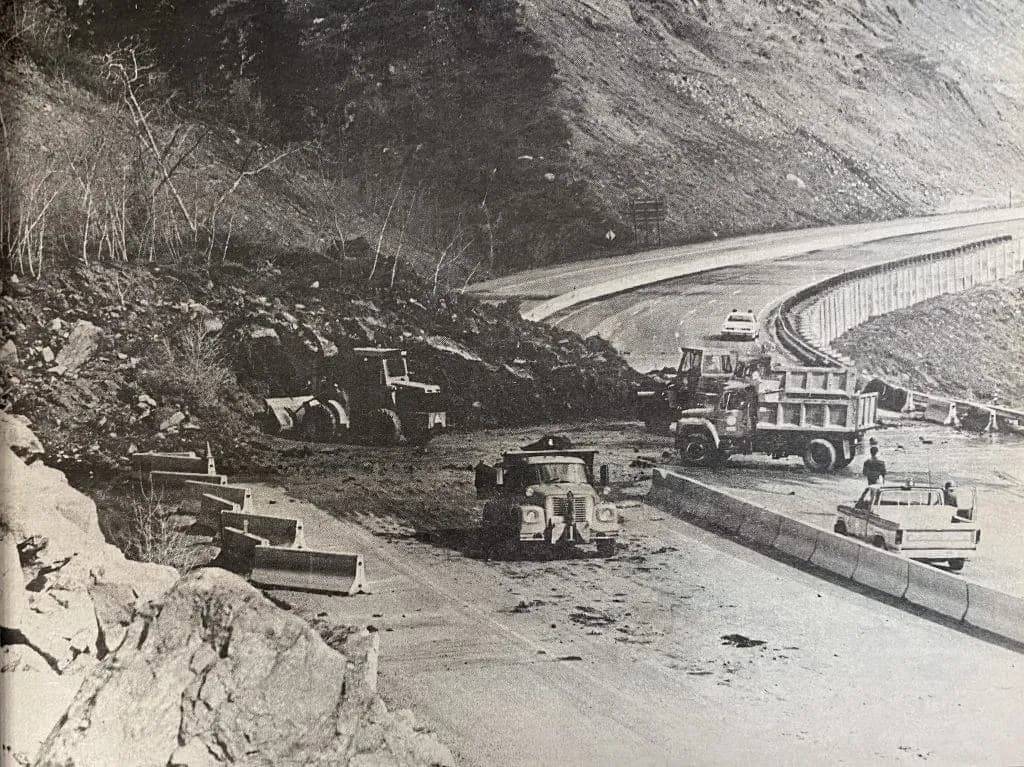
John Rold, director of the Colorado Geological Survey, told the Vail Trail that Western Colorado was still in a wet cycle. The risk was elevated. The evidence was visible to anyone driving I-70. Just three years prior, a massive landslide had dragged a grove of aspen trees right across the highway at Dowd Junction. You could see the scar on the hillside. You could feel the instability.
The question is whether we’ve learned anything from that wet cycle. We’ve built more houses in the canyons since 1986. We’ve paved more roads. But the geology hasn’t changed. The water is still there, just deeper in the ground.
The Vail Trail noted that while that sort of carnage was unlikely, the threat was real. It’s a distinction that matters when you’re deciding where to park your RV or where your kid’s school bus will drive on a rainy Tuesday. The task force didn’t say it would happen tomorrow. They said the conditions were there. The water was the trigger.
Today, as we watch the snowpack melt and the rivers rise, it’s worth remembering that the ground beneath our feet is not static. It’s moving. Slowly, but it’s moving. The 1986 report was a warning shot across the bow. It said the danger was here, and it was expensive.
The financial stakes are clear. $1.7 billion in damages. 3,100 deaths. Those are the stakes. And they’re still the stakes.
As Rold put it, the wet cycle was the key. And cycles repeat. The question is whether we’re paying attention this time.
Keep up with Aspen
The day's Western Slope news, one email each morning. Free.
Aspen's ACES Returns Annual Harvest Party to Rock Bottom Ranch
Glenwood Ghostwalk Brings Frontier History to Life in Linwood Cemetery