Colorado Cuts Mandate from Heat Safety Bill Amid Budget Shortfall
Colorado legislators remove the mandatory enforcement from House Bill 1272, leaving extreme heat protections for workers as an optional guideline due to a $1.5 billion budget shortfall.
Steamboat Springs —The parking lot at the Glenwood Springs Chamber of Commerce is usually a place of quiet commerce, but last week it echoed with the heavy, humid breath of a state trying to decide if its workers are worth saving. The air was thick, not just with the impending heat of a Western Slope summer, but with the weight of a $1.5 billion budget shortfall. That’s the number that matters. That’s the number that turned a mandate into a suggestion.
Here’s the thing though: the state didn’t kill the bill. It just cut the teeth out of it.
House Bill 1272 was supposed to be the shield for the landscapers, the construction crews, and the truckers who keep this economy moving. It was supposed to force employers to create site-specific plans for extreme heat and cold. Paid breaks. Access to water. Rest areas. Civil penalties for ignoring the thermometer. It was set to kick in by 2028, applying to private businesses and state agencies alike. Fiscal analysts said that last piece alone would cost the state over $5 million a year.
Now? It’s optional.
When the House Health and Human Services Committee met on March 18, they didn’t scrap the bill entirely. They axed the mandate. They left behind a requirement for the Colorado Department of Labor and Employment to collect data and develop an optional model plan by 2027. It’s a study group, not a safety net.
“It’s extremely frustrating,” Rep. Elizabeth Velasco, the D-Glenwood Springs sponsor of the bill, said on Tuesday. She didn’t mince words. The state’s budget hole is ballooning, and because of it, “there’s a lot of important things that we’re not able to fund.”
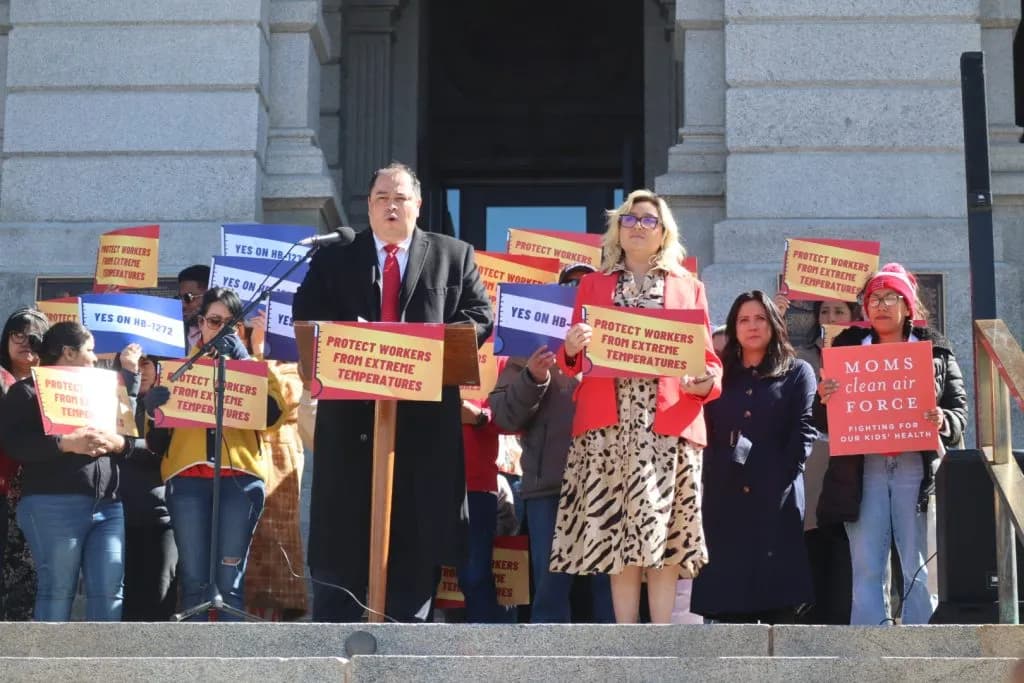
Picture this: a landscaper in Carbondale sweating through his shirt, his body temperature climbing past 104 degrees. Or a snow-removal worker on I-70, his finger lost to frostbite because the cold was biting harder than the paycheck. Alex Sanchez, president and CEO of Voces Unidas, a Glenwood Springs-based immigrant advocacy group, stood at the Capitol earlier this month and told those stories. “People are getting sick. People are getting hurt. And too often, they’re being expected to just keep working.”
Voces Unidas has been a vocal champion for the bill, arguing that climate change is turning Colorado’s already harsh weather into a workplace hazard. But business groups weren’t buying the urgency. Michael Cox, an attorney for the Colorado Chamber of Commerce, argued during the hearing that state employers are already subject to federal worker safety standards under Occupational Safety and Health Administration rules. To them, HB 1272 was redundant. It was just more red tape in an already heavily regulated environment.
So, we’re left with a compromise that satisfies no one completely. The mandate is gone. The penalty is gone. What remains is data collection and a model plan that employers can use if they feel like it. It’s a step forward for advocates who’ve been calling for action at the state level, but it’s a small step. Velasco hopes that removing the costly provisions eliminates the fiscal impact, making the bill easier to pass. But for the worker on the ground, an optional plan is just paper.
The budget shortfall is real. The $1.5 billion gap is a tangible thing that forces tough choices. But when you strip away the mandate, you’re betting that the market will self-correct. You’re betting that employers will provide breaks and water because it’s good for business, not because the state forces them to. In a state where a single bad summer can turn a minor heatstroke into a major emergency, that might be enough. Or it might be nothing at all.
Outside the Capitol, the sun was still beating down on the granite steps. The workers were still out there, under the same sky, waiting to see if the state’s new "optional" guidance would actually keep them alive when the mercury hits 100.
Keep up with Steamboat Springs
The day's Western Slope news, one email each morning. Free.