Colorado Gray Wolf Population Shifts Northwest and Southwest
Colorado Parks and Wildlife reports a shift in the state's gray wolf population to northwest and southwest regions, with implications for local ecosystems and communities.
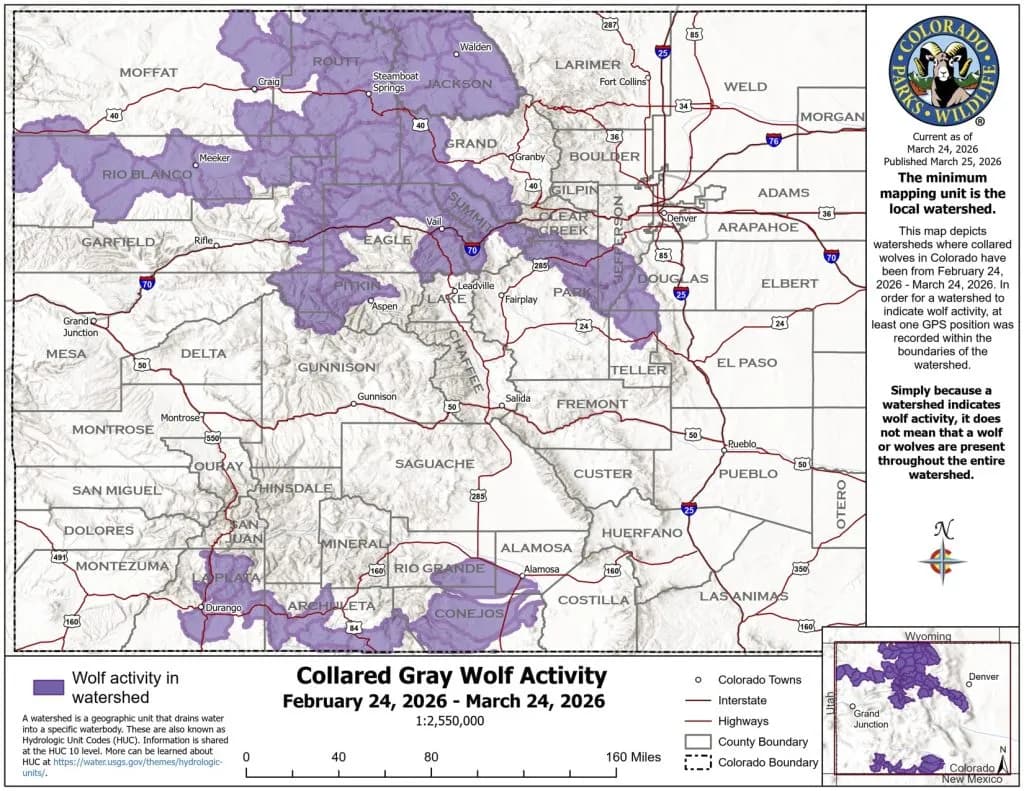
Glenwood Springs —What's behind the shift of Colorado's gray wolf population to the northwest and southwest regions? Make no mistake — this isn't a uniform distribution. Colorado Parks and Wildlife's latest wolf activity map shows the state's collared gray wolves have condensed into pockets of the northwest and southwest counties.
The map, which tracks wolf activity between February 24 and March 24, reveals a notable change in movement patterns. Compared to the previous month, wolf activity appears isolated to the northernmost and southernmost regions of the Western Slope, with no movement highlighted through the middle of the state.
In the northwest, activity continued in watersheds touching parts of Rio Blanco, Routt, Jackson, Grand, Summit, Eagle, Pitkin, and Garfield counties. This activity stretched further west than the prior month, including a watershed touching the Colorado-Utah border. The northernmost stretches of Routt, Jackson, and Moffat counties saw more watersheds bordering Wyoming than in February.
One wolf was moving through watersheds near Colorado's tribal lands in the southwest. The map shows activity in a pocket of southwest Colorado, brushing up against watersheds bordering the state of New Mexico. This included watersheds around Durango in La Plata County, as well as those stretching between Archuleta, Conejos, and Rio Grande counties.
The short version: Colorado Parks and Wildlife has agreements with neighboring states to capture and return wolves that leave Colorado. Only one wolf has been returned this way after traveling into New Mexico in December.
The agency has an agreement with the Southern Ute Indian Tribe to guide management of wolves on tribal lands. However, they don't have an agreement with the Ute Mountain Ute Tribe — yet. They've been finalizing the agreement for several months. These agreements will also apply to the Brunot Treaty Area, spanning 3.7 million acres in the San Juan Mountains. The agency's management of wolves in these areas will be significant, and their agreements with neighboring states and tribes will play a crucial role in this process. Locals in the affected areas should be aware of the changing dynamics.
Worth watching: the March activity map shows some wolf activity in watersheds brushing up against the Front Range, including in Park, Jefferson, Douglas, and Teller counties. What's not being said is how this shift will impact local ecosystems and communities.
The map only shows activity within the state of Colorado. If Colorado's wolves leave the state, different rules apply depending on where they go. Parks and Wildlife has an agreement with Utah, New Mexico, and Arizona to capture and return wolves that enter these states.
Folks around here need to know: the agreements between Parks and Wildlife and the tribes will significantly impact the region. As the situation develops, staying informed about the latest updates and changes in wolf activity is vital for understanding the implications for the region's wildlife and human communities.
In the San Juan Mountains, the Brunot Treaty Area spans 3.7 million acres, a significant portion of the region. Management of the wolf population in this area will be shaped by the agreements between Parks and Wildlife and the tribes.
People in the valley should be aware that the shift may have unforeseen consequences. The growing number of wolves in the state will likely have significant implications for the region; and locals need to be prepared. What's the plan for managing the growing number of wolves in these areas?
Keep up with Glenwood Springs
The day's Western Slope news, one email each morning. Free.
Glenwood Springs Closes I-70 Interchange for $14 Million Road Overhaul

Colorado's New Digital Warrant Law Forces Social Media Platforms to Act Fast