Colorado's 32 Wolves Press Wyoming and Utah Borders
GPS data shows Colorado's 32 wolves pressing against Wyoming and Utah borders in August, risking loss of protections upon crossing state lines.
Steamboat Springs —Thirty-two wolves. That is the estimated population of gray wolves in Colorado as of March 31, according to Colorado Parks and Wildlife. About half of them are wearing GPS collars, which allows state biologists to track exactly where these animals are roaming.
In August, the data showed that wolf activity remained heavily concentrated in the state’s northwest. For context, this region contains the territories for all four of Colorado’s reproducing packs, plus a fifth non-reproducing group. But the movement didn’t stop in the valley’s core. Activity pressed right up against the state borders with both Wyoming and Utah.
Let’s do the math on what that border proximity actually means for the animals themselves. If a collared wolf steps across the line into Wyoming, it loses both state and federal protections. In practice, it becomes legal game. In 2025 alone, three of Colorado’s collared wolves died in Wyoming. Two were legally hunted. The third was killed by the U.S. Fish and Wildlife Service after being tied to the deaths of five sheep.
The situation is different, but no less complex, on the Utah side. Under an inter-state agreement, any Colorado wolf entering Utah can be captured and sent back. So far, only one wolf has been returned this way, after wandering into New Mexico in December.
Closer to home, the pressure on livestock has been real. Since late March, three uncollared wolves have been removed from the population. One adult was killed after being linked to the depredation of at least 22 sheep across Rio Blanco and Routt counties. A yearling from the One Ear Pack was also culled following repeated summer attacks. A third uncollared wolf died in the northwest, and its cause of death is still under investigation.
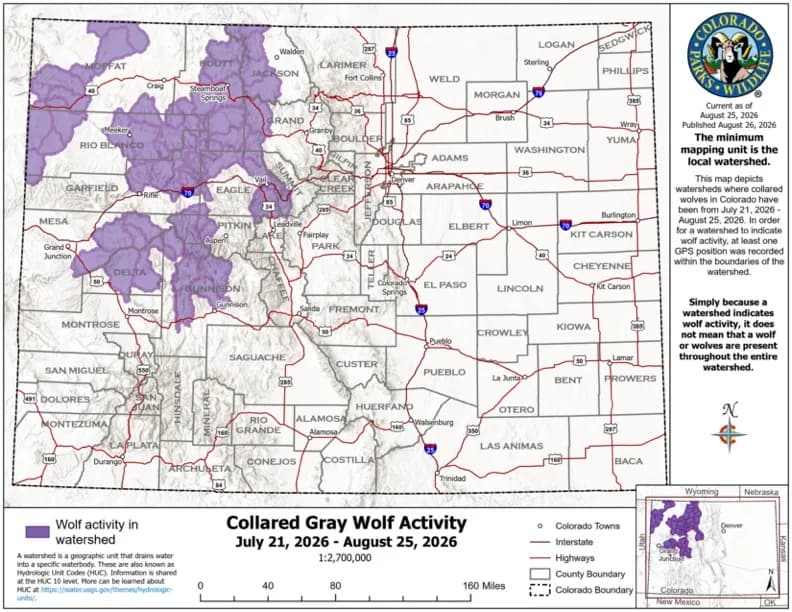
The monthly activity map from Parks and Wildlife highlights the specific watersheds where GPS points were recorded between July 21 and August 25. Those points span segments of Jackson, Grand, Routt, Rio Blanco, Eagle, Mesa, Delta, Gunnison, Summit, Pitkin, Garfield, and Chaffee counties. A highlighted watershed simply means at least one wolf was there. Because GPS pings happen roughly every four hours, you can see gaps in the map. Wolves can cover large distances in the time between pings, so a blank space doesn’t necessarily mean no wolves were present.
There is also a distinct pocket of activity near the state’s northwest corner. Watersheds in western and northern Moffat County, western Rio Blanco County, and along the Colorado-Wyoming border in Routt and Jackson counties all showed movement.
These maps only track activity inside Colorado. Once a wolf leaves the state, a different set of rules applies. Whether it faces a hunter in Wyoming or a capture crew in Utah depends entirely on which side of the border it crosses.
With the spring pupping season now behind us, the total population count will likely rise once the pups from the four reproducing packs are accounted for. Until then, the 32-wolf estimate stands, with the northwest remaining the epicenter of their range.
Keep up with Steamboat Springs
The day's Western Slope news, one email each morning. Free.

Steamboat’s 15th Yampa Valley Crane Festival Adds Bird Calling Contest

Steamboat Springs Mandates Drought-Proof Landscapes to Slash Water Use