Drought Exposes 1968 Ford F-100 in Green Mountain Reservoir
Prolonged drought has dropped Green Mountain Reservoir levels, exposing a rusted 1968 Ford F-100 that crashed into the lake during a winter commute.
Aspen —The rusted Ford F-100 sitting in the mud at the bottom of Green Mountain Reservoir is not a historical artifact. It is a $15,000 lesson in how quickly a two-wheel-drive pickup with summer tires fails on Heeney Road during the first snow.
Dennis Carpenter didn’t plan to become a local legend in 1968. He just needed to get from his neighborhood below Green Mountain Dam to his flying business in Kremmling. According to the Vail Daily, Carpenter drove his brother’s white Ford because his own ’65 Chevy Impala was unavailable — likely being repaired by his brother Jerry. He packed the truck with essentials: cowboy boots, shirts, receivables for mailing, and a briefcase holding his flight computer. It was a standard commute for the “Dam kids” who used that route to get into town.
The math of that day was simple: steep hill, icy road, inadequate tires. Carpenter approached mile marker 9 on Heeney Road when the receivables started slipping off the bench seat. He reached across the cab to catch them. The truck slipped.
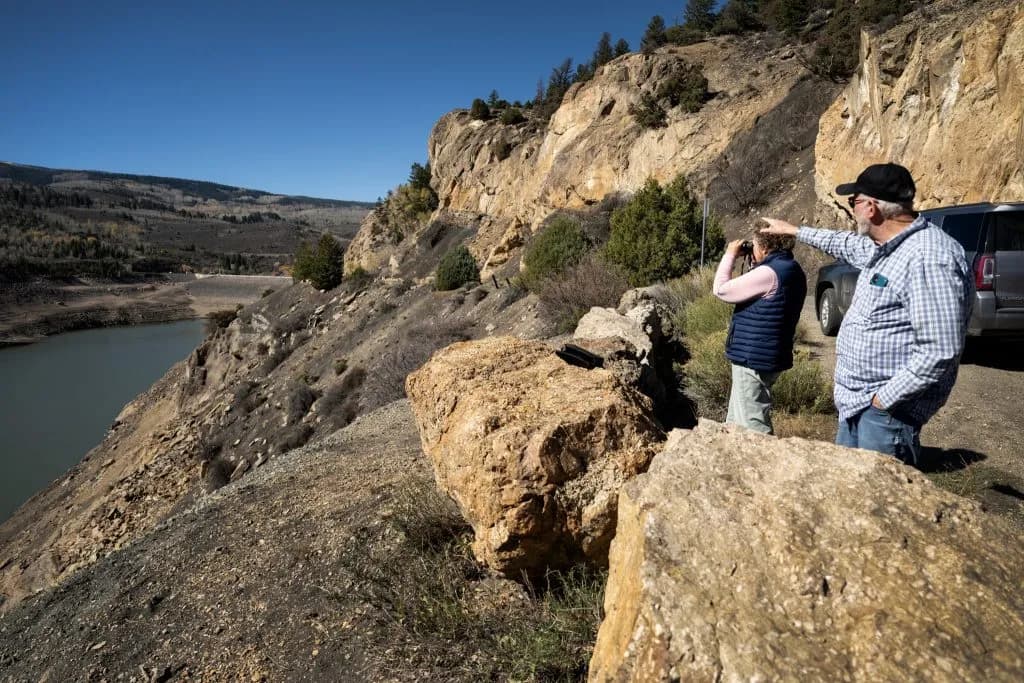
He jerked the wheel to avoid the cable guardrail, but it was too late. The guardrail punched through the bumper and flipped the truck. Carpenter counted five rolls as it tumbled parallel to the road — a habit from his aviation training, where you count “rolls and loops” to stay oriented. When the Ford finally stopped, it hung precariously over a 100-foot rocky cliff into Green Mountain Reservoir.
Carpenter unbuckled, slid to the passenger side, and opened the door. He got one foot out before the truck plummeted. He flung back to the driver’s side, wrapped his arms around the steering column, and listened to the truck hit the bank twice before crashing into the water tail-first. “Kerpow, Kerpow, then Kerpuuuuuuuuush,” he recalled the sounds in an interview with Ski-Hi News. He climbed out through the window and swam to shore.
The truck sank. Carpenter rebuilt his aviation career, creating four different businesses from the late 1960s through the late 1980s. He received his private license in Rangely and his commercial license at Reno Stead Airport. Today, he is retired and living in Kremmling with his wife, Francine.
The truck did not survive the 1968 winter. It sat in the reservoir for decades, a silent witness to every snowmow and every low-water recreation season. Now, with the reservoir levels dropping due to prolonged drought conditions across the Western Slope, the Ford is visible again. It’s a rusted hulk of metal and glass, half-buried in mud at the edge of the water.
For context, Green Mountain Reservoir is a critical infrastructure asset for the region. It supplies water to agricultural districts and municipalities downstream, including parts of Routt County. The reservoir’s water levels are currently at historic lows, exposing the lakebed and any debris that has accumulated since the 1960s. The Ford is not a tourist attraction, though it has become one by accident. It’s a reminder that the infrastructure we rely on, dams, reservoirs, roads - is only as good as the maintenance and the weather allow.
Carpenter’s story is a personal one, but the location is public. Heeney Road remains a steep, icy route in winter. The 100-foot drop is still there. The guardrail is likely new, but the physics haven’t changed. A two-wheel-drive truck on summer tires will still slide at mile marker 9 when the first snow hits.
The practical bottom line for locals is that the reservoir’s low levels are exposing more than just old cars. They’re exposing the fragility of our water supply and the infrastructure that manages it. The Ford is a curiosity, but the drought is a crisis. Every inch of water lost from Green Mountain Reservoir is an inch less available for the farms and homes in Routt County. The rusted Ford will eventually be covered again when the snowmelt comes, but the water won’t come back at the same rate. The truck is a relic of 1968; the low water level is a reality of today. One is a story. The other is a budget line item that’s about to get much bigger for everyone in the valley.
Keep up with Aspen
The day's Western Slope news, one email each morning. Free.