Eagle County Paramedics Master Prolonged Backcountry Emergency Care
Eagle County paramedics undergo specialized training to provide prolonged, complex medical care in remote backcountry settings when hospitals are inaccessible due to weather or terrain.
Aspen —Eagle County paramedics are no longer just waiting for a helicopter to airlift you out. They are learning to stay.
The goal isn’t just to stabilize and transport. It’s to treat you for six to eight hours in the backcountry when the road is closed, the power is out, and the hospital is a world away.
This is austere emergency care. It’s not the 911 response you’re used to. It’s medicine without the safety net of a waiting room.
Brandon Daruna, CEO of Eagle County Paramedic Services (ECPS), put it plainly. The team needs to traverse the backcountry safely. Then they need to provide a level of medicine that is "very different than 911 response."
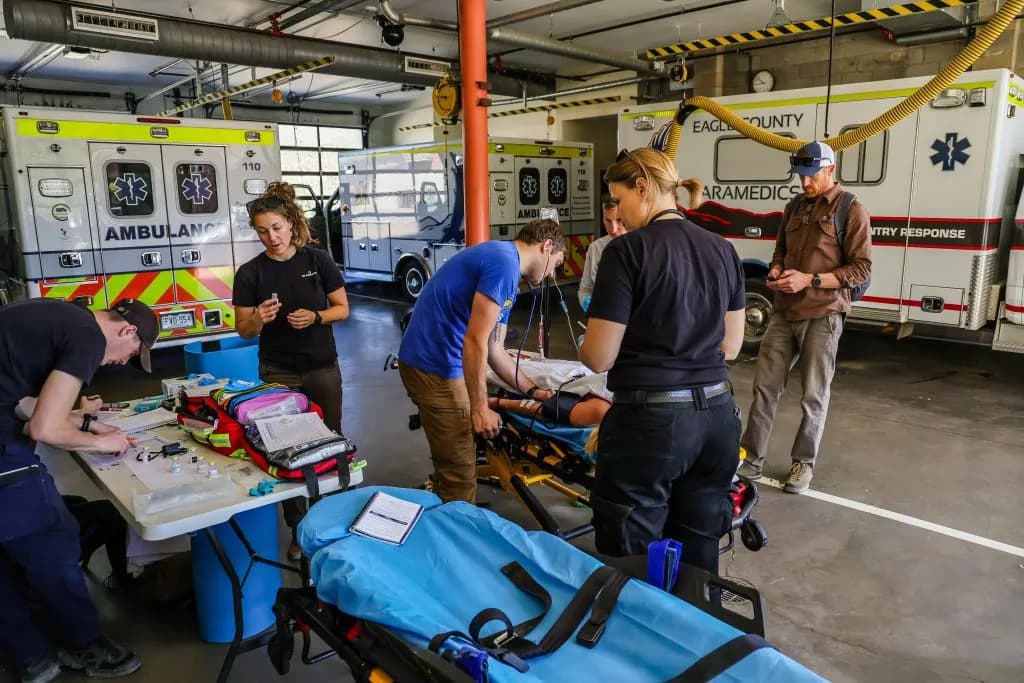
The training hit 11 paramedics over four days. They faced fictional scenarios that mirrored the worst of the Western Slope. Avalanches. Whitewater. Patients pinned under trees.
The constraint was simple: no hospital. Limited resources.
You can’t just call for a chainsaw crew and hope for the best. You need paramedics who understand complex injuries in chaotic environments. Daruna recalled a specific incident where a patient was pinned under a tree. Search and rescue was needed. Firefighters with chainsaws were needed. But the paramedics had to handle the medical crisis while everyone else cleared the way.
Now, more than 33% of Eagle County paramedics hold this certification. Alex Oberg is one of them.
Oberg didn’t start in an ambulance. She started as a ski patroller. She’s been an EMT for three years. Her drive for this training came from joining ECPS’s wildland fire team. She needed to know how to treat burns. She needed to know how to aid firefighters who were putting themselves at risk.
"I think one of the critical things that people often forget is how big Eagle County is," Oberg said. "And how much people recreate outside of the ski areas, and in truly those backcountry austere environments."
It’s easy to assume emergency care is a straight line to a bed. It’s not. It’s a prolonged engagement.
Aaron Zinser brought the program back for a second run. It arrived in 2022 as a beta-version designed for military medics. Zinser saw the gap. Standard EMS paradigms focus on short bursts of care. You treat, you drop, you go.
That doesn’t work in the high country.
The class, held in Edwards on June 11, used live patients in remote locations. It wasn’t a classroom lecture. It was a simulation of failure. What happens when the resources you rely on aren’t there?
Specialized Medical Standards ran the training. They taught providers how to initiate prolonged patient care. The idea is to simulate the reality of the terrain. The terrain doesn’t care about your protocol.
This matters for locals. It matters for the folks who hike the Gore Range on a Tuesday. It matters for the ranchers checking cattle in the winter. It matters when a storm hits and the main arteries are blocked.
The short version: The system is changing. It’s getting wider. It’s getting deeper.
Daruna said the goal is a team that can make access safely. Then provide the care. Not just the basics. The complex stuff.
Oberg noted that initiating prolonged care is "absolutely critical." She’s right. We live in a county that swallows people whole. The emergency response needs to be able to swallow them back, keep them alive, and bring them home.
The training is ready. The certification is spreading. The question is whether the rest of the infrastructure can keep up.
Keep up with Aspen
The day's Western Slope news, one email each morning. Free.