Eagle Residents Debate County Pickleball Court Proposal
Eagle residents gathered Tuesday to debate a county proposal for six to eight pickleball courts on nearby land, with neighbors citing noise and loss of quiet.
Aspen —The fluorescent lights in the Eagle Town Hall meeting room hummed with a low, electric buzz, casting a sterile glow over rows of folding chairs. It was a Tuesday evening, and the air smelled faintly of floor wax and the stale coffee that had been brewing since noon. This was the scene on Aug. 25, when the Town of Eagle opened its doors for a night that promised to settle the argument that had been tearing the community apart since May.
The question on every resident’s mind that night was simple: Who actually gets to decide what happens on that county-owned land?
It wasn’t supposed to be this complicated. When Bryan Woods took the oath as mayor, he likely imagined dealing with potholes, budget shortfalls, or the usual municipal grind. He certainly didn’t think pickleball would be on his bingo card for his first year in office. But here we were, standing in the middle of a debate that had overtaken the town.
The roots of the conflict trace back to late March, when the county’s new geothermal system began operating. Since then, Eagle County government officials had been visiting the town to present ideas for developing the county-owned land situated above the geothermal infrastructure. The proposal was ambitious: install six to eight pickleball courts, complete with shaded structures, seating areas, and low-water landscaping. For many, it sounded like progress. For others, it sounded like noise.
Mayor Woods stood before the crowd, his voice steady but tinged with the weight of recent months. His objective for the evening was clear: share updated plans from the county and bridge the gap between official proposals and public understanding.
“I think there’s a lack of publicly accessible information,” he said, his gaze sweeping across the room.
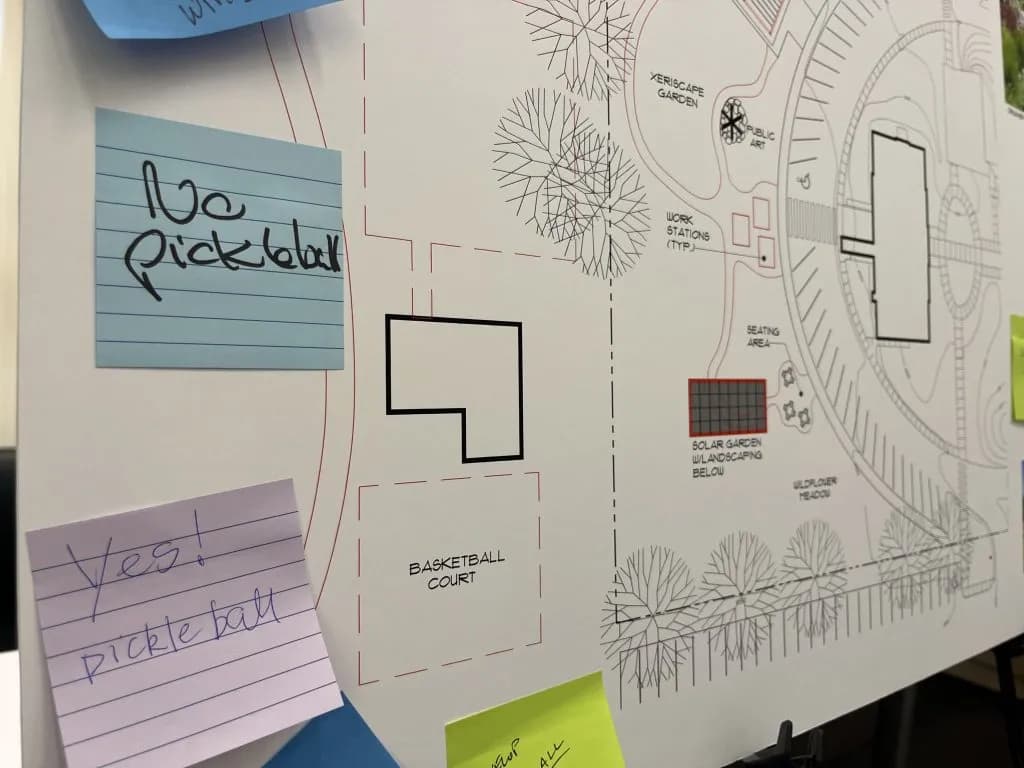
He noted that while the county had held two previous meetings to present their ideas, there hadn’t been a dedicated forum for the community to respond. This open house was meant to fill that void. No formal presentation took place; instead, the focus shifted to the materials displayed on the walls.
Deputy County Manager Regina O’Brien echoed this sentiment, emphasizing that the goal was to show the community the concepts and gather direct input. “This part is just critical to get the community feedback,” she said, pointing to the posters lining the walls.
Those posters displayed four distinct designs for attendees to review. The options ranged from a no-pickleball concept to variations featuring four, six, or eight courts. Beyond the courts themselves, the displays highlighted ancillary features such as outdoor work stations, specific landscaping choices, beam lengths intended to provide barriers around the playing areas, and an estimated construction cost that included sound mitigation measures. Attendees were encouraged to affix sticky notes directly to the boards, offering their thoughts on each design element.
The room was filled with people who had come to weigh in, representing a spectrum of opinions. Among them was Arthur Wessel, an Eagle resident who used the opportunity to share a counter-proposal. His plan suggested a different vision for the space, including a fire pit and gathering area, a fountain, and gardens designed in the style of an eagle in flight. Wessel argued that these amenities would serve a broader range of users rather than catering to a singular type of activity.
On the other side of the aisle stood Brenda Wyatt, who lives right next to the proposed area and has emerged as a vocal leader in the opposition. Her concerns centered on the impact of the paddle sport’s noise and the disruption it would bring to the traditional park experience.
“We’ve got traditional park users,” she said, her voice rising slightly as she addressed the room. “They come for relaxation, they come for quiet, they come to have their kids play in the park. Having courts right there, 68 feet from my property, is going to just destroy our downtown.”
Wyatt pointed to her personal research, which indicated that over 40 municipalities had closed public courts due to similar complaints. For her, the proximity of the courts to her home wasn’t just an inconvenience; it was a threat to the character of the neighborhood.
As the night wore on, the sticky notes accumulated on the posters, creating a mosaic of community sentiment. Some praised the landscaping, while others questioned the sound mitigation costs. The debate wasn’t resolved in a single evening, but the process had begun. The county had shown its cards, and the people of Eagle had started to play theirs.
Outside, the Eagle River continued its steady flow through the valley, indifferent to the arguments raging inside the building. But inside, the atmosphere had shifted. The rigid lines between "for" and "against" had softened, replaced by a more nuanced conversation about what kind of town they wanted to live in. Whether that conversation leads to a compromise or a stalemate remains uncertain, but the silence that had previously surrounded the decision-making process was broken. The community had spoken, even if only in fragments. And in the quiet aftermath of the open house, the real work of listening had just begun.
Keep up with Aspen
The day's Western Slope news, one email each morning. Free.