Englewood Pays Tribute to Lakewood Officer Nick Graham
Thousands gathered at BRAVE Church in Englewood to honor Lakewood Officer Nick Graham, whose funeral procession drew bagpipers and flags, marking a communal tribute to his sacrifice.
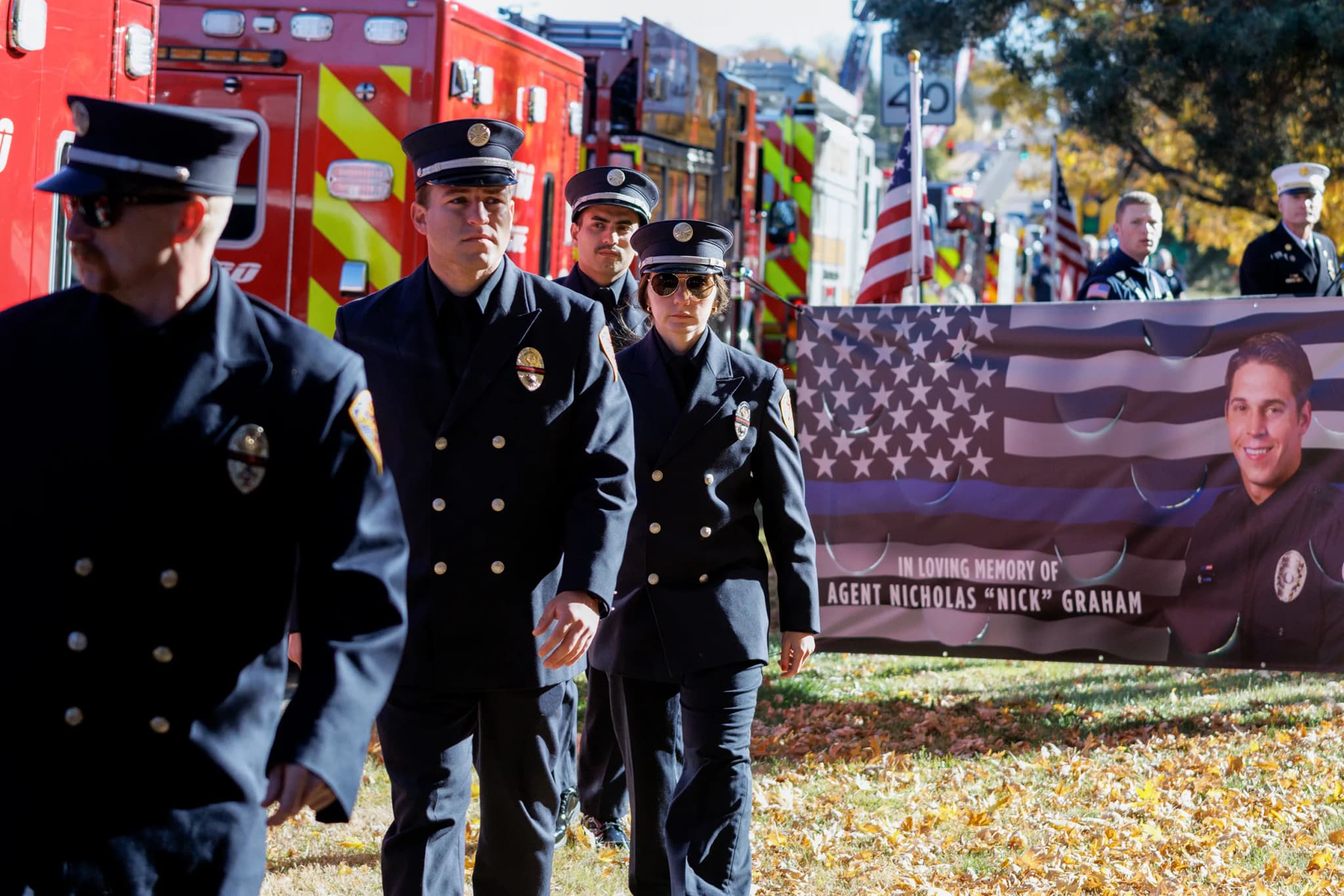
Montrose —The bagpipes didn’t just play; they cut through the humid November air, a sharp, reedy sound that seemed to vibrate in the chest of anyone standing near the front of BRAVE Church in Englewood. It was a sound meant for funerals, yes, but also for victories, for the return of soldiers, for moments when the ordinary world felt too small to contain the weight of what had happened. As the flag-draped casket of Nicholas “Nick” Graham was rolled down East Hampden Avenue by a procession of flashing police lights, the noise wasn’t just ceremonial. It was a warning shot against the silence that usually follows a shooting on a city bus.
We tend to think of fallen officers as statues, frozen in the moment of their sacrifice, their identities reduced to the badge they wore. But the obvious take — that Graham was simply a cop who died doing his job — is too clean, too easy. It ignores the messy, human reality of who he was before the uniform. The evidence suggests he was less a symbol of authority and more a neighbor who happened to carry a gun.
His life, as recounted by those who knew him, was not that of a career cop who chose the job for the pension or the power. He followed his parents, Tom and Heidi, both of whom worked for the Aurora Police Department and the crime lab, respectively. Growing up, he and his brother Jason took ride-alongs, visiting the crime lab regularly. It was a childhood steeped in the procedural side of law enforcement, yet Graham still had to fight for his place. His mother, aware of the risks, actually tried to sway him toward firefighting. He couldn’t be talked out of it. He joined the academy in January 2019, worked as a detention deputy at the Larimer County Sheriff’s Department, and finally accepted the first offer from the Lakewood Police Department. This trajectory matters because it frames his death not as an accident of profession, but as a culmination of personal choice.
His widow, Kassidy Graham, captured this nuance during the memorial service. She didn’t just praise his bravery; she highlighted his capacity for selflessness. “He was the epitome of the kind of person you hope is out there protecting your community, someone who takes responsibility seriously, someone who is willing to put others before himself and someone who runs towards danger when everyone else is running away,” she said. “Nick made the ultimate sacrifice doing exactly what he believed in.” This quote is crucial because it shifts the focus from the institution (the police department) to the individual (Nick). It suggests that his value lay in his character, not just his rank.
The scale of the turnout reinforced this point. Law enforcement officials attended from across Colorado, including Park and Montrose counties, and from across the country. Even Graham’s relatives in law enforcement from Germany were present. Thousands of people packed the church for nearly two and a half hours. This wasn’t just a departmental affair; it was a communal one. The presence of his young son, Peyton, who pointed up to a giant photo of his dad projected on a screen, added another layer of intimacy to the event. The 1-year-old, trailing the casket in his mother’s arms, represented the future that Graham had left behind.
So, how should we remember Nick Graham? We should remember him as a man, not just a martyr. We should acknowledge the complexity of his life, the choices he made, and the relationships he built. We should recognize that his bravery was rooted in his kindness, and that his sacrifice was driven by his belief in his community. By doing so, we honor his memory more fully, and we challenge ourselves to see the humanity in all those who serve us.
The image that lingers is not of the badge, nor the uniform, nor even the flag-draped casket. It is of a one-year-old boy, a spitting image of his father, pointing upward at a screen, his finger tracing the face of a man who ran towards danger when everyone else was running away. That is the legacy. That is the warmth. That is the truth.
Keep up with Montrose
The day's Western Slope news, one email each morning. Free.