Hegseth Cuts Generals 20% to Launch New Drone Command
Defense Secretary Pete Hegseth proposed cutting senior officers by 20% and establishing a new four-star drone command to address costly missile expenditures during the Iran stalemate.
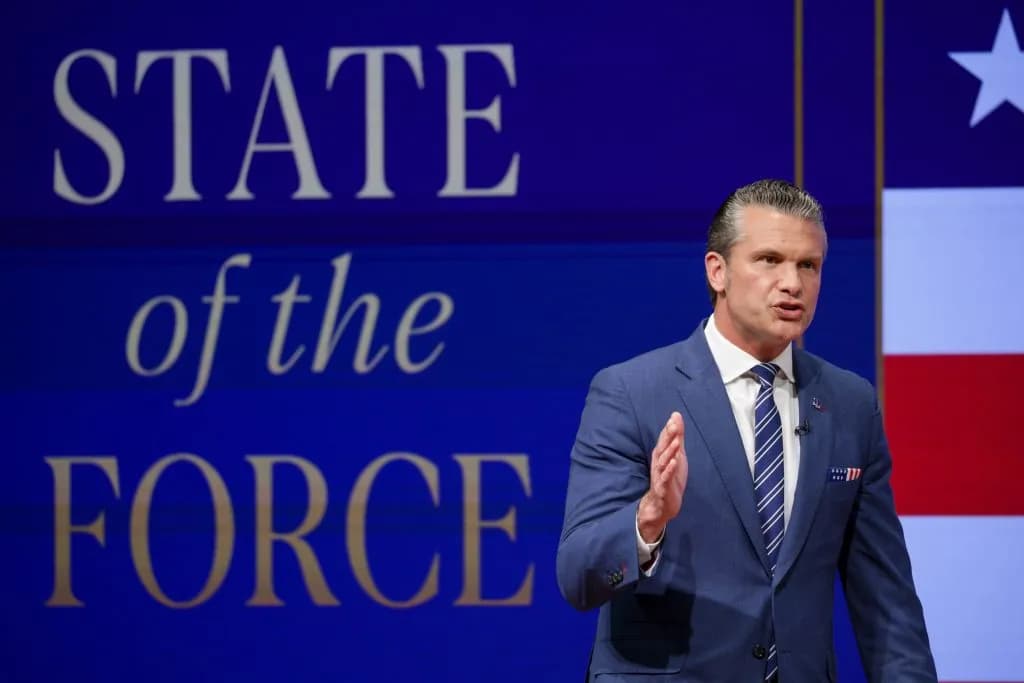
Aspen —A 20% cut. That is the headline number from Defense Secretary Pete Hegseth’s “State of the Force” address delivered at Marine Corps Base Quantico. He is proposing to slash the ranks of generals and admirals by one in five. On paper, that sounds like a massive streamlining of the brass. In practice, it is a bet that the current top-heavy structure is bloated.
But the drone command is where the real money talks. Hegseth is establishing a new four-star command specifically for autonomous and robotic capabilities. He called it “the fastest peacetime shift in modern military history.” Let’s do the math on why that matters. The U.S. is currently in a seven-month stalemate with Iran over the Strait of Hormuz. During that time, American forces have expended hundreds of expensive missiles to counter Iranian threats. Iran relies on cheap drones. We are shooting down $50,000 drones with $1 million interceptors. That is bad economics.
The new command aims to fix that imbalance. Hegseth noted that Ukraine’s experience taught us that no single drone type wins wars; instead, we need a purpose-built system that adapts. This is a direct response to the lessons learned from both the Ukrainian conflict and our own engagements in the Middle East.
There is a contradiction, though. While the Pentagon pushes for a new high-level drone command, a U.S. Army unit in Europe recently had its drone warfare mission cancelled. They were ordered to revert to a traditional infantry battalion. A bipartisan group of lawmakers has already asked the Army to explain why they are pulling back from a critical capability while simultaneously creating a new headquarters to oversee it.
For context, this restructuring happens alongside other sweeping changes. The Pentagon will launch a study on the future of warfare, led in part by SpaceX CEO Elon Musk and former Speaker Newt Gingrich. They are also creating an Office of Religious Affairs and planning to build a new military base for the first time in 40 years.
Hegseth also targeted what he calls “woke” culture. This includes rolling back diversity programs, reviewing ground combat units with female troops, and implementing a screening program for “testosterone deficiency” among male personnel. These moves are designed to retool the military’s internal culture as much as its external capabilities.
The bottom line for locals is complex. If the military shifts heavily toward drones and robotics, the nature of deployment changes. Fewer boots on the ground might mean fewer families separated by long tours, but it also means the technology is doing the fighting. For those in the defense industry or with military connections, the 20% cut in senior leadership could mean fewer decision-makers, potentially speeding up orders but also concentrating power in fewer hands.
The new base construction is another factor. Building a new installation after four decades is a significant infrastructure project. It will require local labor, materials, and land acquisition. Wherever this base is located, it will transform the local economy and landscape.
Hegseth’s speech was directed at junior officers and enlisted leaders. This is a strategic choice. By bypassing the general officer corps to speak directly to the rank and file, he is signaling that the middle and lower management are the ones who need to adapt to the new drone-centric warfare model. The generals are being cut; the soldiers are being told to look up.
The introduction of Elon Musk and Newt Gingrich into the defense planning process is also notable. Musk brings private sector efficiency and satellite communication expertise. Gingrich brings political strategy and a hawkish foreign policy perspective. Their involvement suggests the Pentagon is looking outside its traditional bureaucracy for solutions to the drone problem.
This is not just a military reorganization. It is a fundamental shift in how the U.S. fights wars. From expensive missiles to cheap drones, from large general staffs to lean robotic commands, the changes are profound. The next few years will determine if this new structure works or if it creates new problems. For now, the announcement is made. The work begins.
Keep up with Aspen
The day's Western Slope news, one email each morning. Free.