Judy Woodruff Corrects Reagan Shooting Record at Vail Valley Symposium
Judy Woodruff watched unseen footage of her coverage of President Reagan's shooting and corrected her own past reporting on the number of shots fired during a Vail Valley Symposium appearance hosted by Clay Jenkinson.
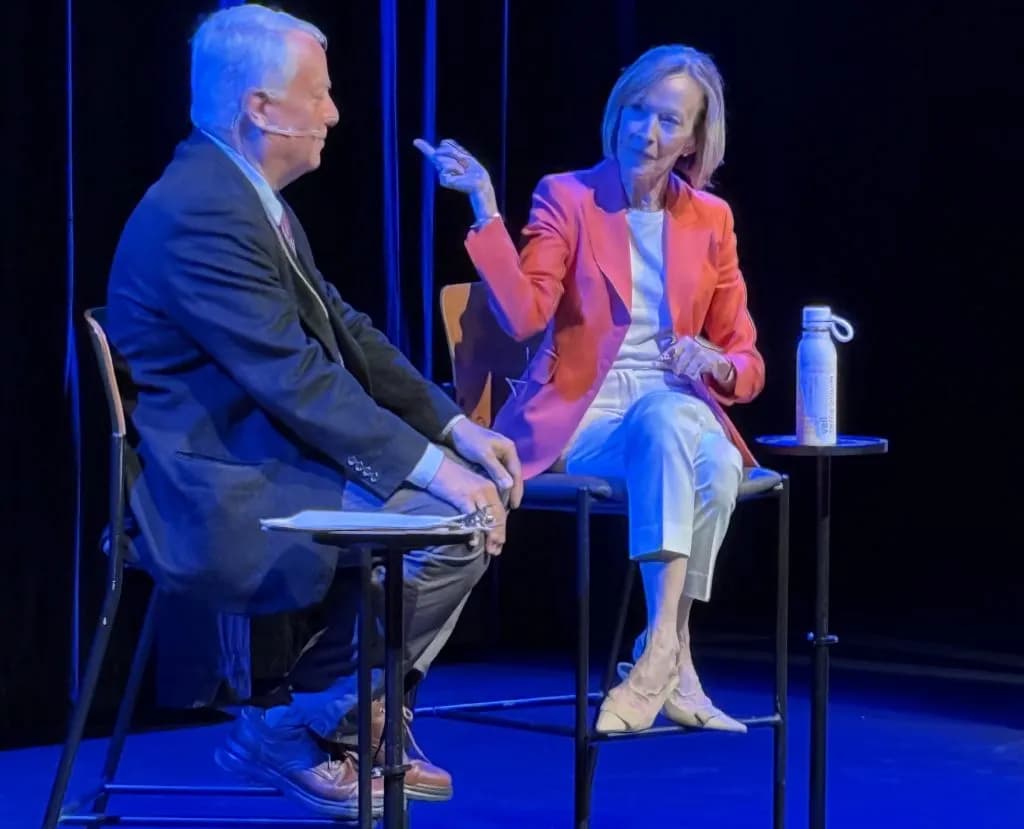
Aspen —The air in the Vail Valley Symposium hall held that specific, heavy silence reserved for moments when history is being recounted by someone who lived it. Judy Woodruff sat on stage, listening to host Clay Jenkinson play a clip from March 30, 1981, footage she had never actually seen herself. It was a raw, grainy recording of the immediate aftermath of President Ronald Reagan’s shooting, and for the first time, Woodruff watched herself on screen — a 34-year-old reporter in the thick of it, trying to make sense of chaos.
Here’s the counterintuitive part: we often remember Woodruff for her poise, for the steady voice that anchored PBS NewsHour for decades, but we forget that her authority was built on the willingness to admit when she was wrong. In that moment, watching the clip, she didn’t just nod along; she critiqued her own past self. She had reported that six to eight shots were fired, adding that “one of those shots, I believe, came from a Secret Service agent who was stationed overhead.” Jenkinson praised her calm, calling it one of the “most terrifying moments in modern American history,” noting that she could have easily panicked and rushed away. But Woodruff corrected the record. The six shots came only from John Hinckley, Jr. “It’s really important that you get it right … and that you don’t say more than you know,” she told the audience.
That humility is rare in an era where news cycles move faster than fact-checkers can breathe. It’s a lesson for locals who tune in to the evening news on their local affiliates or stream clips on their phones, wondering why the coverage sometimes feels so detached from the ground truth. Woodruff’s career didn’t just start in the polished studios of Washington, D.C.; it began in the humid, turbulent newsrooms of Atlanta in 1970, where she followed Jimmy Carter around the state. She told Jenkinson that covering Georgia at that time was, in retrospect, a national story, yet she had to fight the entrenched sexism of the profession to get there. Male editors feared women couldn’t remain calm under stress, a stereotype Woodruff helped shatter not just with her reporting on the Reagan shooting, but with her steady rise through the ranks.
She described herself as a beneficiary of shifting policies, citing Richard Nixon’s directive to the Equal Employment Opportunity Commission that stations must put more women on the air or lose their licenses. “So stations and networks paid attention,” she said. It’s a reminder that the diversity we take for granted in media wasn’t an accident; it was a mandate, enforced by politicians watching their bottom lines.
Woodruff’s journey from a local CBS affiliate reporter to a national icon mirrors the broader evolution of American journalism. She joined NBC in 1975, right as Carter announced his presidential run, telling the network to “take him seriously.” Her career spanned major institutional changes, including PBS’s recent loss of federal funding in 2025, a shift that threatens the stability of the public broadcasting model she helped define. Yet, even as the industry fractures, the core ethic she demonstrated in that 1981 clip remains vital. It’s not about being perfect; it’s about being precise.
As the Q&A session wound down, the light in the hall shifted, catching the dust motes dancing above the audience. Woodruff remained seated, the clip still playing softly in the background, a reminder that truth is often found not in the first report, but in the correction that follows.
Keep up with Aspen
The day's Western Slope news, one email each morning. Free.

Aspen's ACES Returns Annual Harvest Party to Rock Bottom Ranch
Glenwood Ghostwalk Brings Frontier History to Life in Linwood Cemetery