How Silver and Scenery Shaped Aspen's Maroon Bells
Explore the dual discovery that built Aspen: how the silver rush funded the town while the Maroon Bells' aesthetic beauty eventually drove its tourism economy.
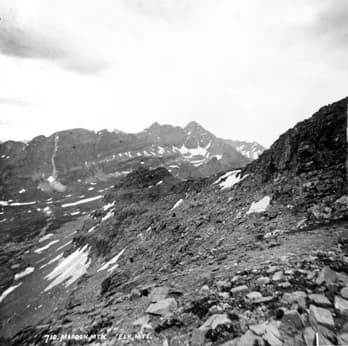
Aspen —“Every person should buy one to send to his friends in the East — The Pictures of Maroon gulch is worth double the money.”
That was the pitch in 1882. McIville Reed, an artist, was trying to sell us on the idea that beauty had a price tag. It did. But it wasn’t the only treasure hiding in the rocks around Aspen.
The geology that built the Maroon Bells also built the town’s economy. It was a dual discovery. One kind of treasure was visual. The other was financial. And the definition of which mattered more shifted faster than the seasons.
The first photo of the Bells wasn’t taken by a tourist chasing Instagram likes. It was taken by the United States Geological Survey in the 1870s. Specifically, the Hayden survey. Their job was to inventory the West. They mapped surface geology because minerals had already been found in Colorado. They needed to know where the next veins were.
The survey party climbed the peaks for triangulation. They wanted to know which peak in Colorado was the highest. But they also documented the scenery for folks back East who couldn’t believe the mountains were real. The Yellowstone report got the glory. The Maroon Bells didn’t make the cut in the initial reports.
That omission didn’t stop the silver rush. The survey maps drew prospectors to Aspen in 1879. They weren’t looking for pretty views. They were looking for silver.
The earliest mention of Maroon itself came in 1881. W.A. Moore offered horse care for $2.50 a month. That same year, Maroon Gulch — or East Maroon Gulch, was flagged for mining. The ore had high copper. It had lead. It had enough silver to make the claims viable.
Prospectors examined every acre surrounding Aspen and Ashcroft. The claims were scattered. Some were in East Maroon Valley. Others were near the top of the ridge on the opposite side, near Conundrum Valley. Some were even on the Gothic side. There was talk of building a road from Aspen to Gothic that would have gone up Maroon Creek, then up East Maroon Creek, then over the mountain.
The Maroon Valley itself, except for those specific discoveries, had no significant mineral deposits. The treasure was on the edges, not in the center.
The shift to aesthetic value took longer. Maroon Lake didn’t appear in the papers until later. It was usually mentioned when groups went there to camp and fish. In 1887, the paper suggested a “good scheme” to improve the grounds around the lake. It was full of fish. It could be a summer resort for picnics. The scenery was grand.
But don’t mistake the timing. The silver drove the initial boom. The beauty drove the later tourism. The Bells were the backdrop; the silver was the engine.
Today, we treat the Bells as sacred. We protect them. We charge entrance fees. We limit permits. We’ve turned the geological accident into a curated experience. In 1882, you bought a picture to prove you’d been there. Now, you buy the view itself.
The short version? The rocks gave us two things. One paid for the town. The other paid for the postcards. We spent a century deciding which one was more valuable. We picked the pretty one. The silver is still there, buried under the dirt and the tourists.
The lo stopping fishing in 1893? That was the start of the ecological shifts. The real shift was cultural. We stopped looking at the land as a ledger and started looking at it as a landscape.
It’s a clean break. One moment you’re counting ore. The next, you’re counting steps. The geology didn’t change. Our eyes did.
Keep up with Aspen
The day's Western Slope news, one email each morning. Free.
Aspen's ACES Returns Annual Harvest Party to Rock Bottom Ranch
Glenwood Ghostwalk Brings Frontier History to Life in Linwood Cemetery